Does Your AI Act Between Your Messages, or Only When You Type?

Most people who use AI at work would describe their tool as "smart." Fewer can say what it actually does when they step away from the keyboard. That gap matters, because two very different kinds of software wear the same label, and treating them as interchangeable leads to disappointment in one direction and unnecessary worry in the other.
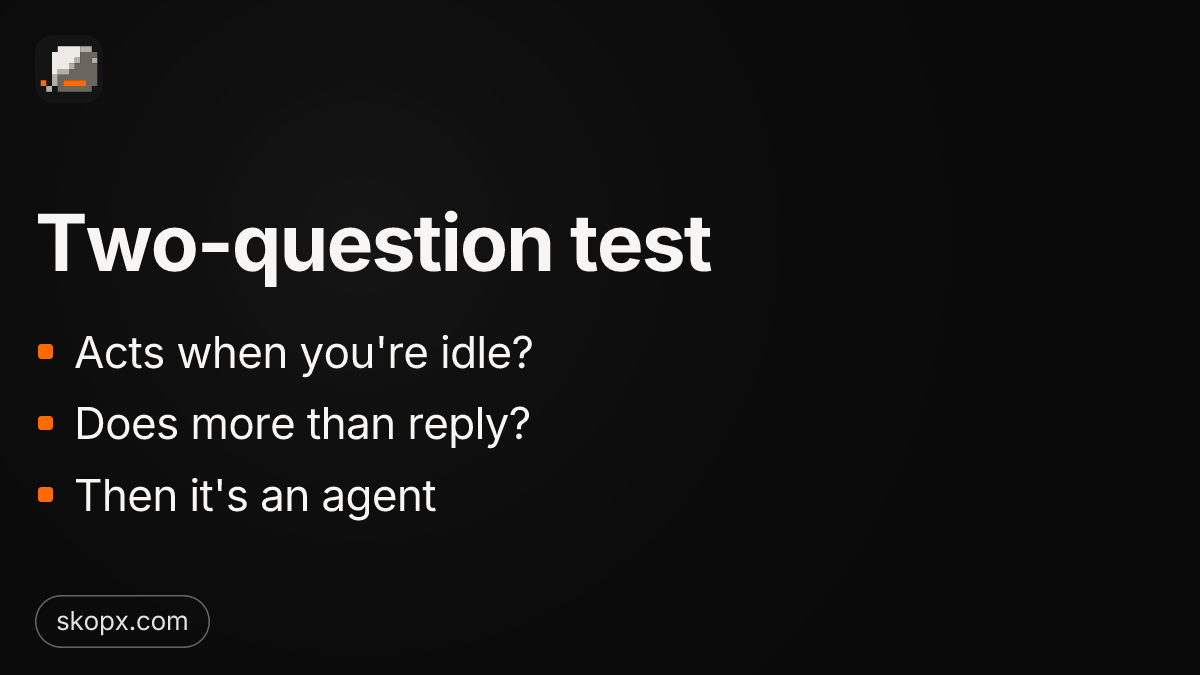
Here are two questions that sort them quickly.
Question one: does it act when you are not typing?
A chat assistant waits. You write a prompt, it returns text, and then it goes quiet until you return. Everything useful happens inside the window you have open, and when you close the tab, the work stops. This is a fine tool for drafting, summarizing a document you paste in, or thinking through a problem out loud. But it does not notice that a customer has been waiting five days for a reply, and it has no reason to.
A different kind of system runs on a schedule or in response to an event. It checks the inbox at seven in the morning, notices that a deal has stalled, or sees that a figure in a shared sheet changed overnight. The point is not that it is more impressive. The point is that it has a job that continues while you do something else. If your AI tool cannot do anything without a prompt, you are doing the monitoring yourself, and the tool is only as good as your attention that day.
Question two: can it do more than reply?
The second question is about reach. A reply is text. An agent can read a record, compare it with another, write a draft, open a ticket, or update a field, depending on what it has been permitted to touch. Those are different capabilities with different risks.
When you ask whether your tool can do more than reply, look at the specifics rather than the marketing. Which systems can it read? Which can it write to? Can it send an email on its own, or does it leave a draft for you? Who decides what it is allowed to change? A tool that can only read is safe in a narrow way. A tool that can write needs guardrails: an approval step before anything leaves the building, a log of what it changed, and a clear way to undo it.
Why the two questions together matter
Put the questions side by side and you get four rough categories. A chat assistant neither acts unprompted nor touches your systems. A read-only dashboard acts on a schedule but only shows you things. A drafting tool does real work but waits for your approval before anything goes out. An autonomous agent acts on its own and can change things, which is the category that most deserves scrutiny.
None of these is automatically the right one. A small team may be well served by a chat assistant and a weekly summary. A team with many inboxes and a sprawling customer database may need something that watches continuously. What goes wrong is choosing by the label. Buying "an AI agent" when you needed a reliable reader, or deploying a tool that can send messages to customers without anyone reviewing them, produces problems that a clear-eyed question would have caught.
A practical way to check your current tool
Take the tool you use most and write down its answers. Does it do anything between your sessions? If so, what triggers it, and who reviews the output? Can it reach systems beyond the text box? If so, which ones, with what permissions, and is there a record of its actions? If you cannot answer these from memory, that is useful information too. Ask the vendor, or check the settings, before you rely on it for anything that matters.
Knowing which kind of AI you are using is the first step toward using it well. The label on the box tells you less than the answers to these two simple questions.