Which Model Should Answer This? Fast, Balanced, or Best, Chosen Per Message

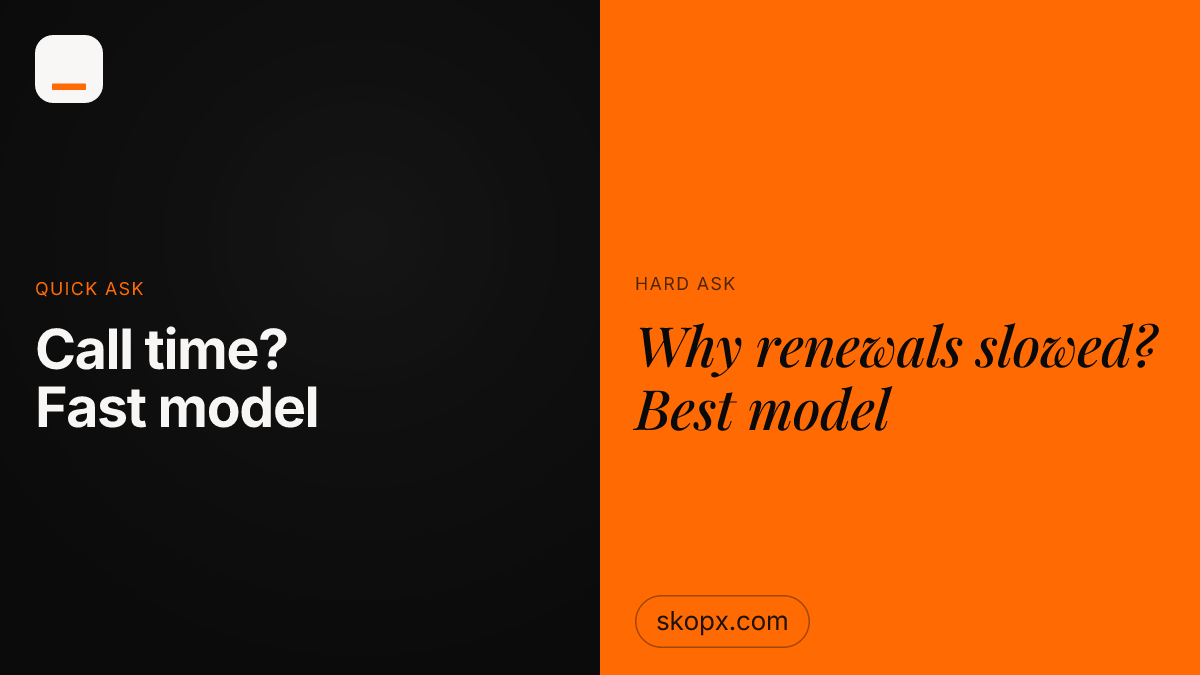
Not every question deserves the same amount of thinking. "What time is the client call?" is answered in a second by a quick lookup against your calendar. "Why did renewals slow down this quarter?" asks the assistant to compare accounts, read the notes behind them, and reason about cause and effect. Sending both to the same model is wasteful in one direction or the other: either the simple question costs more and takes longer than it should, or the hard question gets a shallow answer that sounds confident and misses the point.
Skopx's Helper handles this by choosing a model tier for each message. You can let it pick fast, balanced, or best automatically, or you can set a preference when you know what you want. Each reply tells you which tier answered, so the choice is never hidden.
Three tiers, three kinds of work
The fast tier is for lookups and short confirmations: a date, a status, a name, a figure that already lives in a record. It returns quickly and costs little, which matters when a team asks dozens of small questions across a day.
The balanced tier covers most everyday work. Drafting a follow-up, summarizing a thread, pulling together three related records into a short paragraph. It reasons enough to be useful without spending effort it does not need.
The best tier is for questions where the answer depends on weighing several things at once: an analysis across customers, a diagnosis of why a metric moved, a recommendation that has to hold up when someone asks how it was reached. It is slower and more expensive, and that cost is justified only when the question earns it.
What automatic selection looks like in practice
When the Helper picks automatically, it reads the shape of the request. A message with a single clear target and a direct answer tends to route to fast. A message that asks for a comparison, an explanation, or a judgment tends to route to balanced or best. Length alone is not the signal; a long message that just pastes a block of text and asks for a reformat can still be a fast job.
Automatic selection is a default, not a guess you have to trust blindly. Because every reply names the tier that produced it, you can see at a glance whether a quick answer came from the quick tier and whether a considered answer had the reasoning behind it. If a fast answer felt thin, ask again and let it route up, or set the tier yourself for that conversation.
Setting a preference on purpose
Some teams want a fixed tier. A finance lead reviewing invoices may want best every time, because a wrong figure costs more than a slow reply. A support team answering a high volume of routine status questions may want fast by default and escalate only when needed. You can set this per conversation or as a standing preference, and the Helper will respect it over its own automatic choice.
The useful habit is to decide where the stakes sit. Route the cheap questions cheaply and spend the thinking where a mistake would hurt. A question about a renewal forecast deserves the careful tier. A question about tomorrow's meeting room does not.
Why labeling the tier matters
It would be easy to hide which model answered and simply present the reply. Skopx does not do that, for a practical reason: knowing how an answer was produced is part of judging it. A reply from the best tier that cites the records it used carries a different weight than a quick reply from the fast tier that did a single lookup. Seeing the tier lets you calibrate how much to rely on the answer before you act on it, and it lets you spot when a question was routed too low for its difficulty.
Matching effort to the question is what makes an assistant feel fast when it should and careful when it must. The Helper's job is to make that match, and the label on each reply is how you check that it did.