AI tools are breaking your business in the gaps between them

AI tools are breaking your business in the gaps between them
The modern enterprise runs on specialized AI. A chatbot answers questions about your CRM. A coding agent navigates your repository. A support bot manages your ticket queue. Each tool is genuinely smart within its domain. Each one does one thing well. And together, they create a fundamental problem: no one is watching what happens between them.
This is the soloist problem. Excellence in isolation creates blindness at scale.
Where AI tools fall apart
Consider a real scenario. A customer support agent using an AI chatbot receives a question about a feature. The chatbot answers from your documentation. The customer follows the guidance and hits a bug. That bug report lands in your ticket queue. An AI support bot triages it and assigns it to engineering. The engineering team has its own AI coding agent that reviews the repository to understand the problem. Three separate AI tools, three separate data streams, three separate processes. None of them know what the others are doing.
What slips through? The connection. The customer's original question might have indicated a documentation problem. The bug report might reveal that your support documentation is misleading. The coding agent might spot the pattern but has no way to flag it back to the documentation team. Information moves between silos but nothing orchestrates the response. Your business doesn't learn. The customer doesn't get better service. Your team fights the same fire repeatedly.
This isn't a gap in any single tool. It's a gap in the system.
The orchestration layer
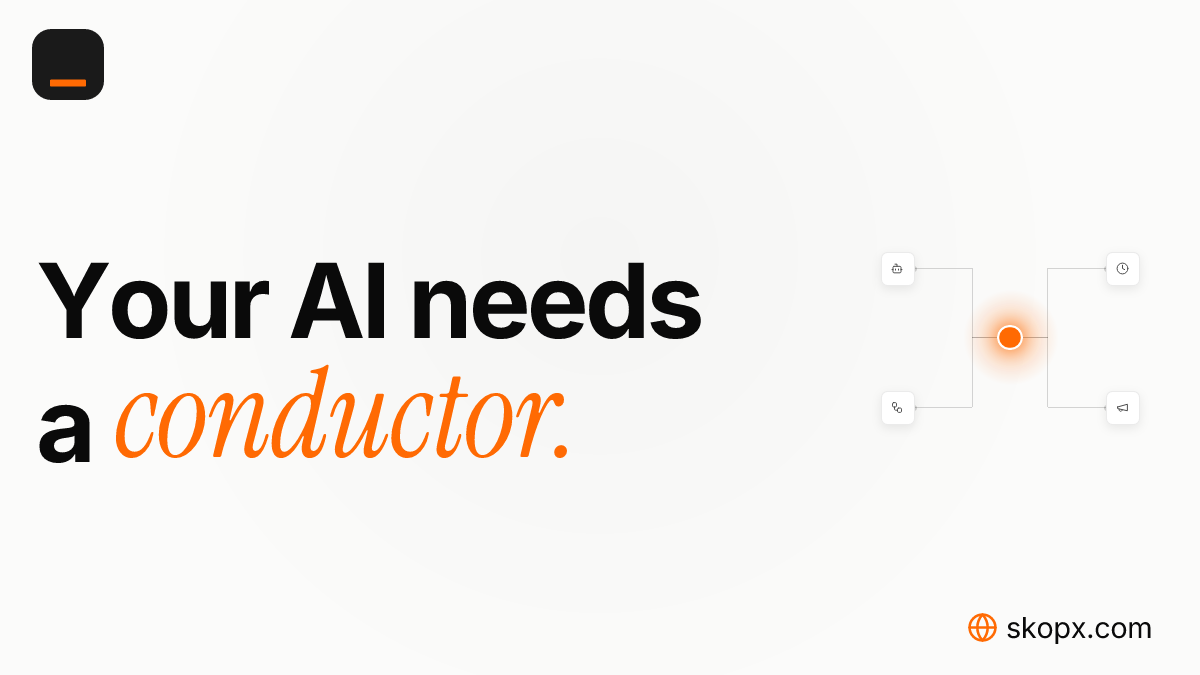
Skopx operates at the level above your tools. While your specialized AI agents do their work in their respective domains, Skopx watches everything that moves between them. It sees what data flows from CRM to support to development. It detects patterns that individual tools can't see because they lack the full picture. It notices when something is slipping: when a customer issue bounces through multiple systems without resolution, when a documentation problem generates repeated support tickets, when a code pattern keeps creating bugs.
The platform then orchestrates the follow-up across everything you run. When Skopx spots that pattern, it doesn't just alert you. It coordinates actions across your connected tools. It can route relevant information to the right system. It can trigger workflows that connect previously disconnected processes. It turns the gaps into opportunities for coordination rather than places where work gets lost.
Visibility across the entire flow
Most AI platforms show you what happened inside their system. Your chatbot platform shows you conversations. Your ticket system shows you tickets. Your code repository shows you commits and pull requests. Skopx shows you what happens across all of them simultaneously. Every run is visible. Every handoff is tracked. Every piece of information that moves from one tool to another is part of the picture you can see and act on.
This visibility changes what's possible. When you can see the complete flow of information and work across your tools, you can spot inefficiencies that were invisible before. You can see where processes are redundant. You can identify where human judgment needs to intervene. You can understand which gaps are actually costing you money or frustrating customers.
One platform, nearly 1,000 tools
The reason Skopx can do this is that it's built to connect with your actual tool stack. Not a replacement for your CRM, your code repository, your support system, or your specialized AI agents. An orchestration layer that sits above them and speaks their language. Support for nearly 1,000 tools means you're not choosing between Skopx and your existing systems. You're adding coordination to the systems you already run.
The business case for orchestration
Every business runs on AI now. The question is whether that AI works in concert or in isolation. The soloist approach is simpler to implement and easier to explain to stakeholders. Each tool has a clear owner and a clear ROI. But it leaves work undone. Customer issues that should be one solved problem instead become three separate tickets. Documentation problems that should trigger updates instead get fielded repeatedly by support. Code patterns that should be caught get deployed again and again.
Skopx addresses this by making orchestration operational. Not a research project or a future capability. A platform that actually watches your tools, actually detects the gaps, and actually coordinates across them. Where your business breaks is where your AI tools meet. Skopx conducts at that intersection.