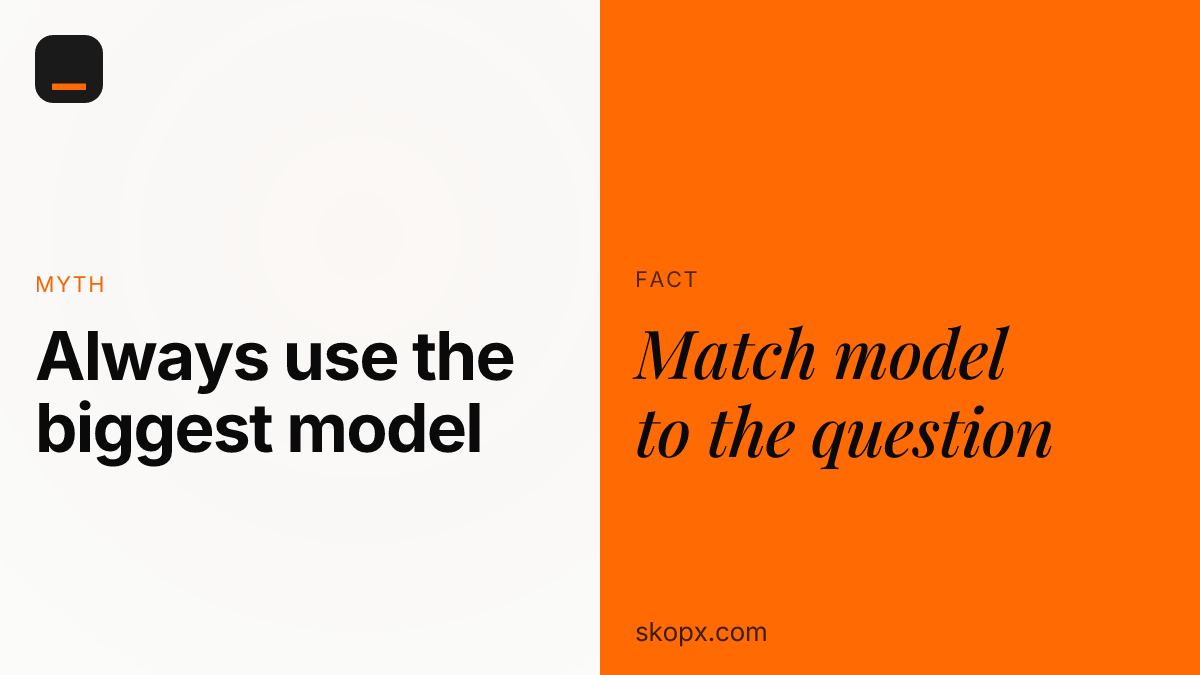
Every AI Question Deserves a Model, But Not the Same One

The instinct most people have with AI is to reach for the strongest model available and use it for everything. It feels safe. If the best model is the best, why would you ever settle for less? The problem is that the best model is frequently the wrong answer for the question in front of you.
Consider two requests that might arrive in the same afternoon. In the first, you want to know the current status of an order, or the name of the person who owns a renewal, or whether a particular field in your data is blank. The answer is sitting in a system somewhere, and what you need is speed. You are going to glance at the result and move on. In the second, you want to understand why a customer's usage has dropped across three quarters, what the likely causes are, and which of several responses would hold up under scrutiny. That question rewards depth. A quick, shallow answer would be worse than useless because it would look authoritative while missing the point.
Asking one model to serve both of these well means accepting a bad trade in one direction or the other. A large, careful model is slower and more expensive per question, which is a real cost when you are asking dozens of small questions a day. A small, fast model is cheap and responsive, but it will stumble on problems that need sustained reasoning. Neither choice is wrong in the abstract. The waste comes from making the choice once, for everything.
Matching the question to the model
Helper, the routing layer inside Skopx, makes that choice per message rather than per account. When you send a question, it looks at what the question is asking for and sends it to the model best suited to that kind of work. A lookup or a short reformatting task goes to a quick model where latency matters more than nuance. A request to analyze a tangled set of figures, weigh tradeoffs, or draft something that has to read well under pressure goes to a more capable model that takes longer and costs more because the result is worth it.
The routing is not hidden. Helper tells you which model produced each answer. That matters for two reasons. First, it lets you calibrate your trust. If a fast model answered a question about a complex pricing decision, you know to check it harder than you would an answer from the stronger model. Second, it keeps the system honest. You can see the pattern over time and notice whether the routing is serving you or whether you are consistently getting slow answers to questions that deserved speed, or quick answers to questions that deserved care.
What this looks like in practice
Imagine you run customer success for a mid-sized software company. Over a morning you might check which accounts renew this month, ask for the plain-language summary of a support thread, have a draft reply prepared for a frustrated customer, and then ask why churn rose in one region. The first three are well suited to a fast model. The last one benefits from the slower, more thorough analysis. Under a single-model setup, you would either wait on every small task or accept a shallow treatment of the hard one. With per-message routing, each request gets the response that fits it, and you do not have to think about the switch.
There is also a practical benefit to the cost side of this. Capable models are priced according to how much work they do. Sending every trivial lookup to the most powerful option is paying for capacity you do not use. Routing the simple questions to a lighter model and reserving the heavy one for the questions that need it keeps spending tied to the value of each answer.
The point is fit, not ranking
It is tempting to rank models on a single scale and assume the top of the list should handle everything. Real work does not arrange itself that way. The useful question is not which model is best but which one is best for this particular request, given how quickly you need the answer and how much depends on it being right. Once you start asking that question, you stop treating model choice as a one-time decision and start treating it as part of answering well.