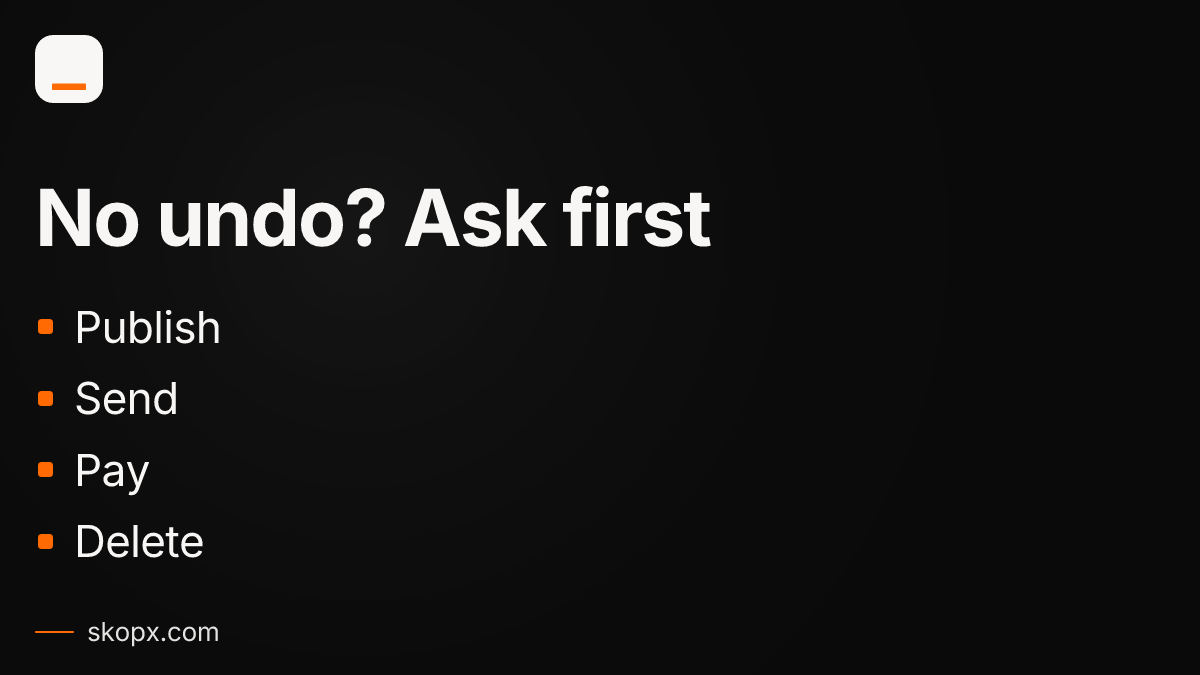
The Five-Word Test for Any AI Action

Publish, send, pay, delete, submit. Five verbs, and between them they cover most of what an AI tool can do to a business that cannot be taken back. The rule the original post suggests is simple: check any AI tool against these five, and if the action can't be undone once it leaves the building, it should stop and wait for a yes.
This sounds obvious until you watch how most AI tools are actually built. They are designed to be helpful in the moment, and helpfulness tends to mean finishing the task. If you ask for a reminder to go to a customer, the tool sends the reminder. If you ask it to clean up a list, it deletes the rows. Nothing about that is malicious. It is simply what happens when speed is the only metric anyone tracks.
Why Reversibility Is the Real Question
Before you ask whether an AI is accurate, ask whether its mistakes can be recovered. A wrong sentence in a draft costs you thirty seconds. A wrong sentence sent to a client costs a relationship. A wrong figure in a report you have not circulated is a correction. The same figure in a payment run is money that has already moved.
The useful distinction is between actions that leave a draft and actions that leave a record. Drafting, summarizing, and analyzing are safe to automate because a human still stands between the output and the world. Publishing, sending, paying, deleting, and submitting remove that buffer. Once the action happens, the only remedy is an apology, a refund request, or a restore from backup, and those are slow, partial, and sometimes impossible.
Applying the Test to a Normal Week
Take a typical Monday in a small operations team. The AI pulls last week's open invoices, drafts payment reminders, flags three overdue accounts, and proposes a cleanup of duplicate contacts in the CRM. Run each output through the five verbs.
The summary is safe. The reminder drafts are safe to prepare but not safe to send without a look, because the tone might suit one customer and offend another. Sending the reminders is a send, so it waits for a yes. The duplicate cleanup is a delete, and deletion is where careful tools differ most from careless ones. A good assistant shows you which rows it would remove, why it thinks they are duplicates, and what it would keep, then asks.
Most of the value comes from the first two steps, and the friction sits only where it protects you. That is the design goal: an assistant that does the tedious work of gathering and preparing, and pauses precisely at the points where a mistake would be permanent.
What a Good Stop Looks Like
A stop is only useful if it is specific. "Are you sure?" is noise that people learn to click through. A useful checkpoint tells you what will happen, to whom, and what the tool is relying on. "Send reminder to three customers with invoices more than thirty days overdue. Totals and recipients below. Confirm?" gives you something to verify in ten seconds.
This is also why the test works as a habit rather than a policy document. Anyone on the team can ask of any tool: which of the five verbs does this touch, and where is the yes? If the answer is nowhere, that is worth knowing before you deploy it, not after.
The Discipline Is the Product
Speed matters, and nobody should want an assistant that asks permission to read a file. The point is to be deliberate about the narrow set of actions that cannot be reversed. Keep the drafting, the gathering, and the checking fast and automatic. Keep the five verbs behind a human decision.
Done well, this does not slow your team down. It removes the quiet dread of wondering what the tool did while you were not looking, and it lets you hand over more of the routine work because you trust where the brakes are.