The Problem With Single-Tool AI

The Problem With Single-Tool AI
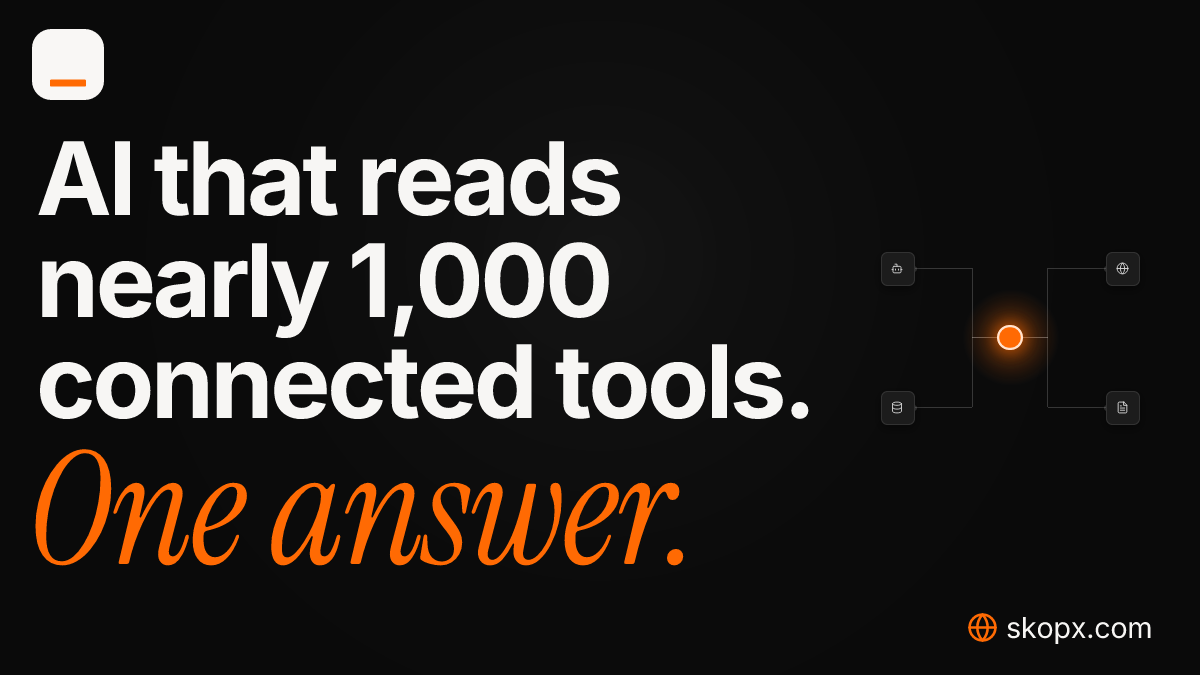
Most AI tools live in one place. Skopx sits above nearly 1,000 connected tools and reads them all at once. Ask one question. Get one answer that cites every source it touched.
Why Location Matters for AI
The AI tools you use every day operate in isolation. ChatGPT lives in its own environment. Gemini exists in another. Specialized tools for writing, coding, research, or analysis each sit in their own corner of the internet. When you need an answer, you jump between platforms, copy and paste information, and manually stitch together insights from different sources.
This fragmentation creates real problems. You lose time switching contexts. Information gets lost in translation between tools. You cannot be certain whether an answer draws from the most recent data or overlooks a critical source. Most AI tools cannot even tell you which sources they consulted, let alone let you verify them.
A Different Architecture
Skopx takes a fundamentally different approach. Instead of being another isolated AI tool, Skopx sits above nearly 1,000 connected tools and platforms. This architecture means that when you ask Skopx a question, it does not just search its own training data or a single knowledge base. It reaches across an ecosystem of connected services.
This matters because different tools excel at different tasks. A weather API provides real-time conditions. A financial database contains market data. A research repository holds academic papers. A news aggregator tracks current events. Spreadsheets store your own data. Project management tools track your team's work. Skopx can query all of them in parallel.
From Many Sources to One Answer
When Skopx receives your question, it determines which connected tools contain relevant information. It queries multiple sources at once. Then it synthesizes the results into a single, coherent answer.
More importantly, Skopx cites every source it touched. You see not just the answer but the evidence behind it. You can verify which tools provided which information. If you disagree with a conclusion, you can trace it back to its origin and examine the underlying data yourself.
This changes how you work with AI. Instead of asking one tool a question and accepting whatever it returns, you get a complete picture. You understand which sources were consulted. You can see if a critical data source was missed. You can make decisions with confidence because you know where the information came from.
Practical Examples
Consider a business analyst researching market trends. A traditional approach means opening multiple browser tabs. You check financial databases for revenue data. You search news sites for recent announcements. You review analyst reports. You pull data from your own company's systems. You manually compare and synthesize all these sources into a presentation.
With Skopx, you ask one question. Skopx reaches into financial databases, news feeds, industry reports, and your internal systems simultaneously. It returns a synthesized answer that cites each source. The analyst gets to analysis faster.
Or imagine a product manager planning a feature. They need to know: What problems are customers experiencing? What solutions exist in the market? What capabilities does our platform already have? What does our development team have capacity for? These answers live in different tools: support tickets, competitor websites, product databases, and project management systems. Skopx connects them.
The Challenge of Integration
Connecting 1,000 tools is not simple. Each tool has different authentication methods, data formats, and API structures. Each requires different permissions and access levels. Skopx handles this complexity behind the scenes so you do not have to.
This integration enables something that single-tool AI cannot: certainty about what your AI actually knows. When an isolated AI tool gives you an answer, you cannot always tell if it is drawing from its training data, which may be months or years old, or from current information. With Skopx, you know which live sources were consulted.
Beyond the Tool
The shift from single-tool AI to connected AI represents a broader change in how work gets done. Instead of AI being another specialized application you learn and master, it becomes infrastructure. It sits between you and the tools you already use. It makes your existing systems work together more effectively.
This is why architecture matters. The most powerful AI is not necessarily the one with the best training or the most sophisticated algorithms. It is the one that connects to the sources that matter to your work. Skopx is built on this principle: better answers come from broader access to better information.