Stop Paying for the Whole Conversation: How to Ask AI Cheaper Questions

Think about how a taxi fare works. You pay for distance, so the longer the ride, the more it costs, whether or not every mile was useful. AI tools mostly charge differently. They bill by the chunk of text, called a token, that goes into the model and comes back out. Every word you send, every document you paste, and every earlier message the tool carries along adds to the meter. That makes the way you phrase a request a real cost decision, not just a matter of style.
Consider a simple request: "Where is my invoice?" That is about five tokens. It names the thing you want, and it is enough for a capable system to know what to look up. Now compare it with a message that opens with three paragraphs of background, pastes an entire email thread, and ends with the question buried at the bottom. The answer might be identical, but you have paid for dozens of tokens the model never needed.
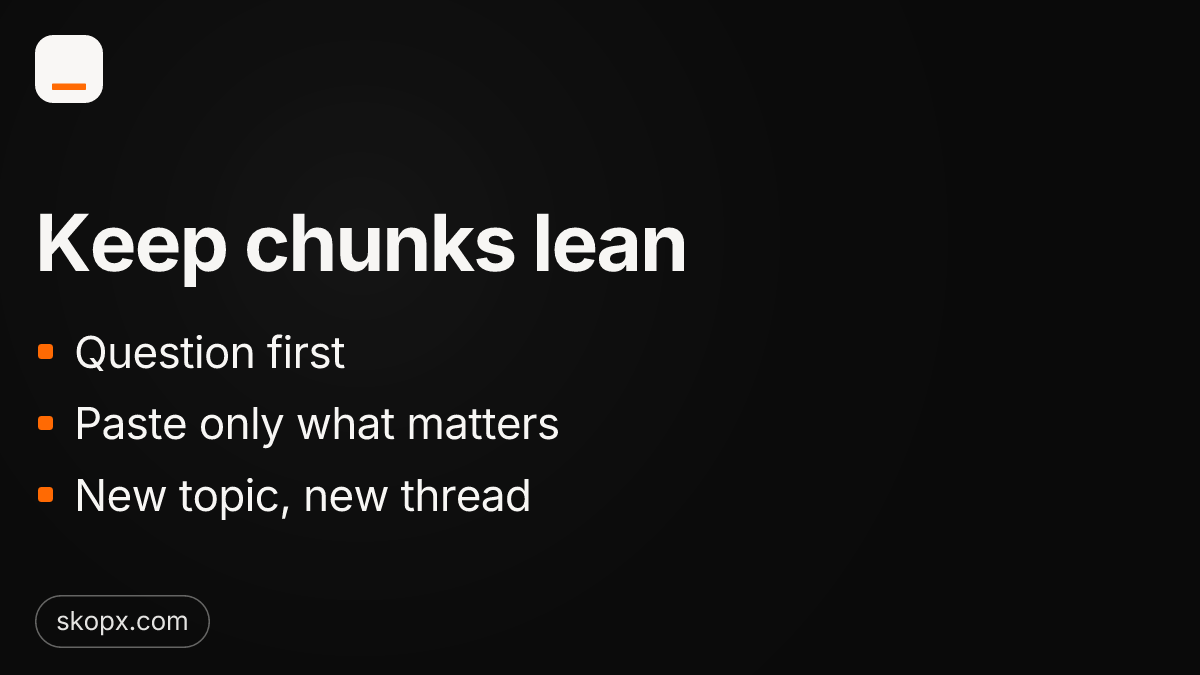
Three habits cover most of the savings.
Put the question first
When the question comes first, the model knows what it is looking for before it reads anything else. It also makes the request easy to scan later, both for you and for anyone who reviews the conversation. A good opener sounds like "Which renewals close this month without a signed order?" followed by whatever context is actually needed.
Paste only what matters
Pasting is the most common source of waste. People drop in a whole spreadsheet export when the model needs three rows, or copy an entire email chain when only the last reply carries the decision. Select the specific lines that bear on the question. If a number needs checking, paste the number and the line it came from, not the full report. You will usually get a sharper answer too, because the model is not sorting through noise.
Start fresh when the topic changes
Long conversations accumulate cost. Every new message in a thread can carry the earlier ones along with it, so a chat that began with a billing question and drifted into a hiring plan is now paying to re-read the billing discussion every time you ask about hiring. When the subject shifts, open a new conversation. You keep the old thread for reference, and the new one starts light.
Why this matters beyond the bill
Cost is only part of it. A focused request tends to produce a focused answer, and a focused answer is easier to verify. If the question is short and the pasted material is exact, you can check the result against the source in seconds. A sprawling prompt with mixed topics produces a sprawling reply that is harder to trust, and you end up re-doing the work to confirm it.
This is also a useful discipline for teams. When everyone asks in the same tight shape, the outputs become comparable, the costs become predictable, and it becomes obvious when a request has drifted into territory that needs a different tool or a person.
A quick test before you send
Before you submit a prompt, ask yourself three things. Does the first sentence state what I want? Have I removed everything the answer does not depend on? Is this still the same topic as the conversation I am in? If you can answer yes to all three, you are paying for the distance you actually need and nothing more.
The taxi analogy holds in one more way: you learn the route. Once you notice how much each habit saves, short and precise requests stop feeling like a constraint and start feeling like the normal way to ask. The meter runs either way. What you control is how much of the ride you are actually using.