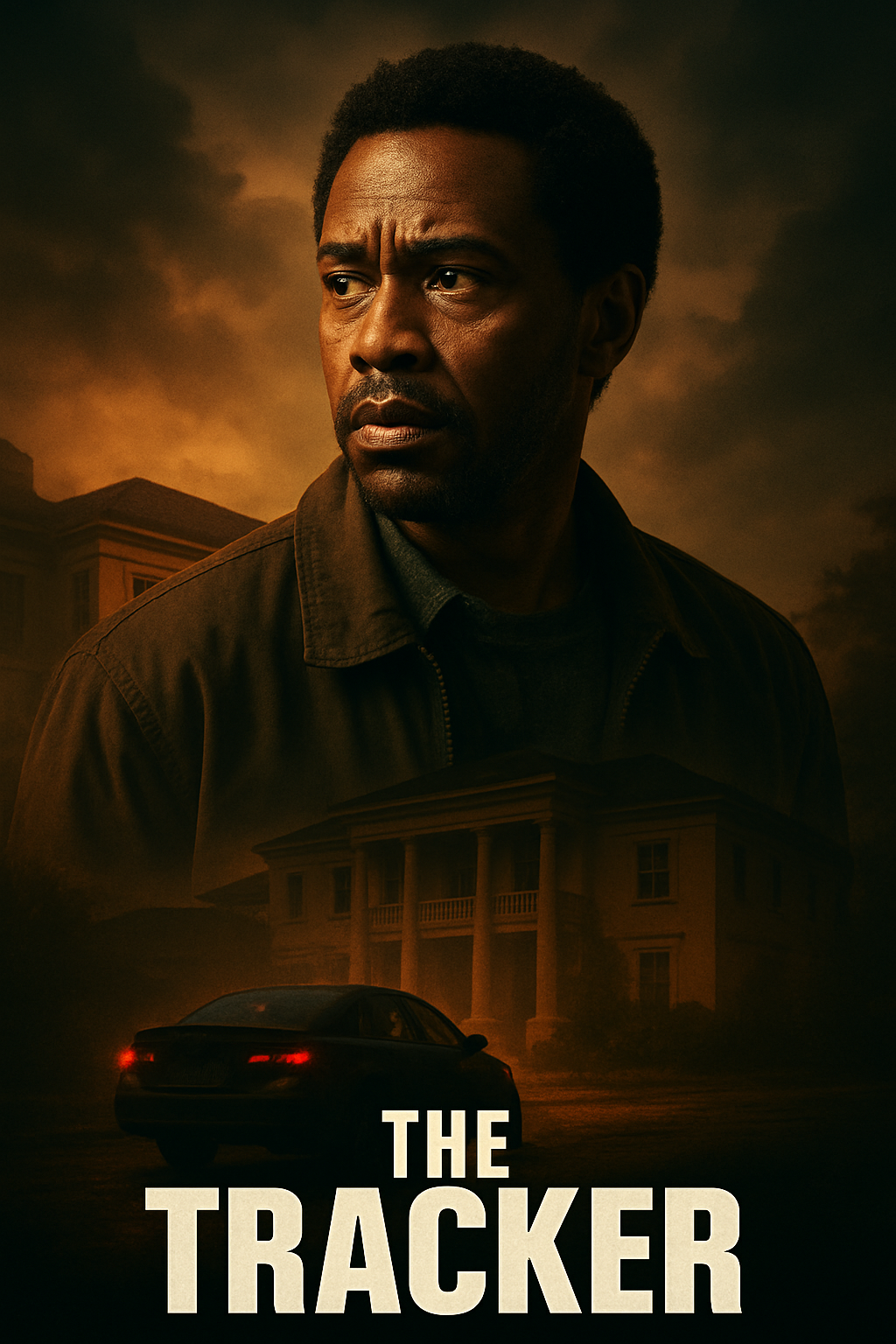
THE TRACKER
Logline
When a man tracks down his stolen rental car and discovers the renter dead inside a stranger's mansion, Marcus Cole must follow a dead man's fragmented trail of evidence before the professionals who killed once finish cleaning up what he has already started to find.
Synopsis
MARCUS COLE, 38, runs a peer-to-peer car rental operation out of his Portland apartment. Three vehicles, one laptop, and a system of AirTags zip-tied under each driver's seat. It is not a career. It is a survival strategy that requires him to be meticulous, patient, and good at reading people quickly. When a renter named DANIEL PARK goes three days past his return window and stops answering calls, Marcus pings the tracker and drives forty minutes outside the city to retrieve what he assumes will be a dispute over a deposit. He finds his Honda Civic in the driveway of a large residential property with the front door open. Daniel Park is inside. Dead two days, maybe three. On the dining room table, in rubber-banded stacks, sits somewhere between four hundred and six hundred thousand dollars in cash. Untouched. A painting has been cut from its frame and left hanging. Six prepaid phones sit wiped in a kitchen drawer. Whatever killed Daniel Park was not the money. Marcus calls the police. But in the forty minutes before that call, he walks through the house and pockets a small notebook full of coordinates, and he does not know why he does it except that something in the room tells him the notebook is the only thing that still matters.
The police investigation moves forward with Marcus on its periphery. DETECTIVE YOLANDA SHAW is assigned to the case. She is thorough and skeptical and quietly alert to the fact that information about the case seems to travel upward through her department faster than it should. Marcus, back in his apartment with the notebook, begins following the coordinates. He is not a detective. He has no training and no particular courage and every rational reason to stop. What he has is stubbornness and the specific observational skill of a man who has spent years reading strangers quickly to decide whether to hand them his car keys. The coordinates lead him across the city through a sequence of locations, each recently disturbed, each component of something larger. A storage unit. A library archive. A decommissioned office building. A church closed for four years. At each location, someone got there before him. He is always a step behind. But he is still moving. The shape of what he is assembling becomes clear slowly and then with the particular nausea of something that should have been obvious earlier. Daniel Park was not a graphic designer. He was a former compliance analyst who had spent two years building a hidden documentary record connecting a network of shell companies to fraudulently awarded infrastructure contracts covering water treatment facilities, emergency response systems, and public housing. The cash on the table was his exit fund, untraceable, assembled for a disappearance that arrived one day too late. He fragmented the documentation deliberately, nothing useful in isolation, so that no single seizure could end it. Marcus, following the notebook, is inadvertently reconstructing what Daniel built.
The people responsible are not criminals in any cinematic sense. They are lawyers and administrators and a deputy city official who have been operating inside legitimacy for long enough that cleanup feels routine. Their instrument is a private security contractor, EVERETT CROSS, who is competent and methodical and entirely without rancor. When they realize the trail is being followed, the decision to address Marcus is procedural. The film's final act is not a confrontation. It is Marcus in a public library, uploading Daniel's assembled documentation to a journalist he has never met, while Cross sits in a car outside and a plainclothes officer whose loyalties are not certain waits in the lobby. The tension is entirely about whether the upload finishes. It does, with almost nothing to spare. The film ends three months later in Marcus's apartment, his operation still running, a news segment on his laptop describing a city council investigation that is slow and uncertain and may or may not produce consequences. His phone buzzes with a new rental request. He looks at the screen for a long moment. Then he accepts it.
Characters
Marcus Cole (Lead)
- 38 years old. Medium build, unremarkable appearance, the kind of face that does not register in a crowd. Wears practical clothes out of habit. Lives alone in a two-bedroom apartment, one room for himself and one room for the operational logistics of his rental business.
- Core desire: to recover his car, protect his business, and return to the ordinary difficulty of his life. Core need: to finish something for someone who cannot finish it themselves, which he would never articulate that way and may never fully articulate at all.
- Arc: Marcus begins the film as a man whose entire energy is directed toward maintaining a small independent life against constant low-grade precarity. He ends it as a man who has done something that cost him considerably and produced an uncertain outcome, and who chooses to keep going anyway. He does not transform. He reveals.
- Voice: "I'm not trying to be involved in this. I'm already involved. That's different."
Everett Cross (Antagonist)
- 44 years old. Trim, quiet, looks like middle management at a company that manages other companies. Gray coat. Sensible shoes. Could be anyone.
- Core desire: to complete the assignment cleanly and return to the routine of his professional life. Core need: the film does not grant him a redemptive need, because the film is not interested in rehabilitating him. His motivation is entirely comprehensible: he is a professional and Marcus is a problem, and problems get solved.
- Arc: Cross begins the film having already solved the primary problem. He ends it having failed to solve a secondary one, not through any failure of capability but because Marcus is not the kind of variable his methods are built to anticipate. He expected someone impressive. He got someone stubborn.
- Voice: "I'm not going to explain anything to you. I'm just going to ask you once to think carefully about the next ten minutes."
Detective Yolanda Shaw (Supporting)
- 41 years old. Portland PD, eleven years. Sharp dresser by department standards, which is not saying much. Drinks bad coffee with the focused commitment of someone who has given up on the good kind.
- Assigned to Daniel Park's death, she is good at her job and careful about what she shows. She begins the film treating Marcus as a peripheral witness and ends it as his most important ally, which neither of them planned. The parallel track of her realizing her own department has a leak runs against Marcus's investigation, and the question of whether they find each other in time is one of the film's central engines.
- Voice: "You held onto that notebook for six days before you called me. I need you to tell me why, and I need you to tell me everything, and I need you to do it in the next four minutes before my supervisor calls me back."
Renata Voss (Supporting)
- 55 years old. Investigative journalist, currently freelance after a staff buyout three years ago. Runs a newsletter that has maybe four thousand subscribers and has broken two stories in the last eighteen months that larger outlets then credited without attribution. She is tired and accurate and unimpressed by most things.
- Marcus finds her through Daniel's notebook. She was the journalist Daniel intended to contact. She never heard from him. When Marcus reaches her, she is the first person in the story who immediately understands what he has and what it means, and that comprehension frightens her and does not stop her.
- Voice: "I need you to understand that publishing this does not mean anyone goes to prison. It means it becomes harder to pretend it didn't happen. That's different from justice but it's not nothing."
Kevin Lim (Supporting)
- 29 years old. Marcus's neighbor and occasional logistics help for the rental operation. Not officially employed by Marcus, just the kind of person who is nearby and useful. He is the one person in Marcus's life who knows what Marcus is doing and cannot convince him to stop.
- He functions as Marcus's grounding wire, the person whose genuine fear for Marcus gives the audience permission to feel what Marcus will not show.
- Voice: "You're describing a situation where the only reason you're still walking around is that nobody important has decided to pay attention to you yet. I want you to hear what you just said."
Three-Act Structure
Act 1: Setup (Pages 1-30)
Opening image: A laptop screen at 2 a.m. in a modest apartment. Spreadsheets, rental calendars, a map with three pulsing dots. Marcus's face in the blue light. He is not troubled. He is working. This is what his life looks like and he is accustomed to it.
Establishment: We see Marcus's operation in two or three beats, each economical. He hands off the Civic to Daniel Park in a brief, professionally pleasant exchange. Daniel is polite, organized, pays on time. Marcus reads people for a living and nothing registers. That will matter later.
Inciting incident: Three days past the return window, Marcus pings the tracker. The signal is stationary in a residential area he does not recognize. He drives out expecting a negotiation. He walks into something he has no language for. Daniel Park is dead. The money is on the table. The notebook is in Daniel's jacket pocket, which Marcus searches not for evidence but for a phone to call someone who knew this man.
First act turning point: Marcus gives his statement to Shaw. He is cooperative and frightened and almost complete. He does not mention the notebook. He drives home. He opens it. The coordinates are handwritten in a cramped, systematic script. The last entry is dated three days ago. Marcus does not go to sleep.
Act 2: Confrontation (Pages 30-90)
Rising complications: Marcus begins visiting the coordinates. The first location, a storage unit rented under a name that does not match any person on record, has been cleared. The second, a library archive, shows a request record for materials that were checked out and never returned. At each location, Marcus is learning to read the negative space of what is missing. He is also, without knowing it, becoming visible. Cross receives a report. A man has been asking about storage unit 14. A man matching a description signed into the archive. Cross notes it and does not yet move.
Shaw, working the Park case from the inside, pulls financial records and hits a wall. Certain documents have been flagged and rerouted to a supervisor she trusts by default. She does not trust by default for long.
Marcus finds Renata Voss through a name in the notebook, a source citation from a story she published eighteen months ago about irregularities in a municipal vendor contract. He meets her in a diner. She listens. She tells him what she thinks Daniel was building. For the first time, Marcus understands the full shape of what he is holding.
Midpoint reversal: Marcus visits the decommissioned office building, the fourth coordinate, and finds it is not empty. Cross is there. Not waiting for Marcus specifically, clearing a final item. They see each other. Neither one acts. Cross gets a look at Marcus's face. Marcus gets a look at Cross's coat and his car and his plates. They separate. The film shifts. Marcus is no longer following a trail through empty rooms. He is being followed.
All-is-lost moment: Marcus returns to his apartment to find it has been searched. Professionally done, nearly invisible, but Marcus knows where things sit and something is four inches wrong on a shelf. The notebook is still in his jacket, which he had on him. They did not find it. But they found him. Kevin comes over and genuinely begs Marcus to stop, and the speech he gives is the most honest articulation of the danger the film has offered. Marcus listens to all of it. He does not stop.
Shaw calls Marcus and says she needs to talk to him about the notebook. Marcus realizes she knows he kept it, which means someone told her, which means someone from the department. He agrees to meet her. She tells him she knows about the rerouted documents. She does not know yet which supervisor is implicated. They are tentative with each other and careful and beginning to understand they need each other.
Second act turning point: Marcus, working with Renata to understand the final coordinates, locates the last cache of documentation. Daniel hid a drive in a physical location Marcus would not have found without the notebook and Renata's contextual knowledge of the case Daniel was building. Marcus has everything. Daniel's two years. The complete record. He now has to decide what to do with it, which is not a decision because he already decided the night he did not mention the notebook. The question is whether he can do it without dying before it transmits.
Act 3: Resolution (Pages 90-120)
Climax: Marcus and Renata agree: the upload happens in public, somewhere with exits and witnesses and internet infrastructure that is not Marcus's apartment. The central branch of the public library is chosen for reasons that are practical rather than symbolic, though the symbolism is not lost. Marcus drives there alone because involving others at this point is not protection, it is liability.
He is inside, at a terminal, with everything loaded and the connection established, when he sees Cross's car through the window. He does not run. Running means stopping the upload. He sits. The progress bar moves at the pace of public library bandwidth in 2009. Shaw arrives in the lobby in plainclothes. She is not sure yet whether the officer the department sent to cover the library entrance is clean. Marcus does not know she is there. She does not know he is upstairs. They converge by accident and by the logic of two people who have been following the same shape from opposite ends.
The upload completes. Marcus steps away from the terminal and sends Renata a single text. Shaw intercepts Cross in the lobby. Cross, who has seen enough situations reach this particular moment, understands that the window has closed. He does not escalate. He walks out. There is a patrol car outside that was not there three minutes ago.
Resolution: The arrests are not immediate and not clean. The deputy official retains counsel and issues a statement. One of the lawyers takes a plea. The contractor disappears for two weeks and is found in a different city and extradited slowly. The city council investigation opens with the kind of deliberate, photogenic incompetence that suggests it may produce real consequences and may not. Renata's newsletter piece is picked up by two regional outlets and then a national wire service. The original story credits her.
Final image: Marcus's apartment. His laptop. The news segment about the investigation plays and he watches it with the specific attention of someone who knows what the reporters do not know yet. His phone buzzes. A rental request from a name he does not recognize. A woman, a five-star renter rating, needs the Civic for four days. Marcus looks at the screen. The cursor hovers. He accepts the request. He closes the news segment. He opens his calendar.
Sample Scene
The Diner Scene: Marcus meets Renata for the first time. Pages 44-48.
INT. BOULEVARD DINER - BOOTH BY WINDOW - DAY

A working diner. Coffee that has been on the burner
since before it was interesting. MARCUS COLE sits in
a window booth with a cup he has not touched and the
notebook open on the table, turned so the pages face
away from the room.

He watches the door.

RENATA VOSS enters. She is fifty-five and moves like
someone who has been running late for twenty years and
made her peace with it. She spots Marcus, reads him
in one pass, and slides into the booth across from him
without asking if it is the right table.

                    RENATA
        You said you found my name in a notebook.

                    MARCUS
        It was a source citation. An article you
        published about municipal contracts, a
        vendor called Meridian Infrastructure
        Solutions. Eighteen months ago.

                    RENATA
        Nineteen. Nobody read it.

                    MARCUS
        Somebody did.

She looks at the notebook. Does not reach for it.

                    RENATA
        Who owned the notebook?

                    MARCUS
        His name was Daniel Park. He rented my car
        about twelve days ago. He was supposed to
        return it on a Thursday.

                    RENATA
        Was supposed to.

                    MARCUS
        He's dead. I found him in a house that
        wasn't his. There was a lot of cash in
        the room that nobody took.

A beat. Renata sets her bag on the seat beside her.

                    RENATA
        You told the police?

                    MARCUS
        I told them everything except the notebook.

                    RENATA
        Why?

Marcus looks at the window. A pause that is honest
rather than dramatic.

                    MARCUS
        I don't know. I've thought about it every
        day and I still don't have a clean answer.
        Something in that room felt like if I put
        it down, it would disappear into a process
        and the process would be managed. I don't
        have a better explanation than that.

                    RENATA
        That's not a bad instinct given what
        you're describing.

She finally picks up the notebook. Turns pages carefully,
the way someone handles a document rather than an object.

                    RENATA (CONT'D)
        These coordinates. You've gone to them?

                    MARCUS
        Most of them. Every location I've found
        has been recently cleared. I'm always behind
        whoever got there first.

                    RENATA
        But you have this.

                    MARCUS
        But I have this.

She turns another page. Stops. Reads something twice.

                    RENATA
        Daniel Park. You said he was a graphic designer?

                    MARCUS
        That's what he put on the rental agreement.

                    RENATA
        He wasn't a graphic designer. Or he wasn't
        only that. There was a compliance analyst
        who left Harwick Capital Partners about
        two years ago. Quietly. The kind of quiet
        that gets negotiated. I tried to source him
        for the Meridian piece and he wouldn't talk.
        The name I had was a different name, but
        this notation here.

She taps a page.

                    RENATA (CONT'D)
        This is a filing reference from a
        specific regulatory submission. I pulled
        that same filing when I was reporting the
        piece. I know this number.

Marcus watches her.

                    MARCUS
        What was the story you were trying to tell?

                    RENATA
        The same story someone killed him to prevent.
        Meridian Infrastructure Solutions wins
        contracts. Repeatedly. Implausibly. Water
        treatment, emergency dispatch, public housing
        retrofit. The margins on those contracts
        don't make sense unless someone is adjusting
        the bid evaluation criteria after the fact,
        and the someone in that sentence isn't a
        company. It's a person or a small group of
        people in positions where they can affect
        the outcome and have been doing so for at
        least six years.

                    MARCUS
        I'm following coordinates in a dead man's
        notebook to locations where everything is
        already gone. What am I actually holding?

She looks at him steadily.

                    RENATA
        If Daniel Park spent two years on this
        and he was methodical enough to fragment
        the documentation, which this notebook
        suggests he was, then what you're holding
        is a map to what's left. The pieces whoever
        came in after him didn't find, or couldn't
        find, because they needed this to find them.

Silence.

                    MARCUS
        There are four more coordinates I haven't
        visited.

                    RENATA
        I know. I can see them.

She slides the notebook back across the table. He picks
it up. Neither of them speaks for a moment.

                    MARCUS
        I'm not a journalist. I'm not a detective.
        I rented this man my car and I found him
        dead and I kept a notebook I should have
        given to the police. I need you to tell me
        what I'm supposed to do with the thing I'm
        apparently in the middle of.

                    RENATA
        You find what's left. You bring it to me.
        I publish it. That's the sequence.

                    MARCUS
        And if someone decides to clean me up the
        way they cleaned up Daniel.

It is not quite a question. Renata does not treat it
like one.

                    RENATA
        Then you move fast. And you don't tell me
        anything about the locations until you're
        already somewhere else.

She finally picks up her coffee cup. Looks at it.
Sets it back down.

                    RENATA (CONT'D)
        For what it's worth, the fact that you're
        sitting here means they haven't identified
        you yet. Once they do, the timeline changes.

                    MARCUS
        That's not worth much.

                    RENATA
        No. But it's what we have.

Through the window, traffic moves. Ordinary Tuesday
afternoon. Marcus closes the notebook.
Themes
The cost of bearing witness. The film's central question is not whether Marcus will survive but whether finishing the thing costs more than it is worth. Daniel Park assembled evidence for two years and was killed before he could use it. Marcus, by following the trail, becomes the inheritor of that cost. The film does not resolve this question cleanly. The investigation opens. People are held accountable slowly and partially and within a system that had already failed once. Marcus goes back to his life. The question of whether it was worth it is left to the audience because the film does not think there is a clean answer.
Ordinary systems and extraordinary damage. The corruption in the film is not spectacular. It is administrative. Bid evaluations adjusted. Vendor relationships cultivated. Paperwork managed. The infrastructure being corrupted, water treatment, emergency response, public housing, serves the people least positioned to notice the corruption or survive its consequences. The film makes no speeches about this. It renders it structurally, in the gap between what those systems should do and what the documentation reveals they have been doing.
What we finish for people who cannot. Marcus did not know Daniel Park. He rented him a car. The relationship is commercial and brief and entirely without intimacy. Yet by the final act, Marcus knows Daniel's work better than anyone alive. The notebook is a kind of trust extended without consent, and Marcus's decision to honor it, against every rational self-interest, is the film's moral core. Not heroism. Completion. The distinction matters.
Visual Style Notes
Cinematography: Handheld but disciplined. Not agitated handheld, not the grammar of action, but the slight unsteadiness of someone watching carefully from slightly too close. When Marcus is in a space he does not understand, the camera stays wide and observational. When he begins to understand, it moves in. The shift is earned rather than announced.
Color palette: Desaturated Pacific Northwest. Gray-green exteriors, institutional fluorescent interiors, the specific quality of natural light in a region where the sky is almost always a form of ceiling. The cash on the dining room table in Act One is the most vivid color in the first forty minutes of the film, which is intentional. It draws the eye and then becomes irrelevant, which is the point.
The 2009 specificity: No smartphones with clean interfaces. GPS devices with small screens and long load times. Library computers with wired connections. Public bandwidth that makes a file upload genuinely tense. The year is not a setting detail but a functional element. The story works in 2009 in ways it would not work in a world with faster connections, better surveillance, and less friction between a person and the information they need.
Visual references: Sidney Lumet's "Michael Clayton," particularly its treatment of institutional spaces as sites of genuine menace. Kelly Reichardt's Pacific Northwest geography, unhurried and accurate. The Dardenne brothers' approach to following a single body through a series of decisions, close enough to see the decisions being made but not so close as to editorialize about them.
Sound design: The film earns its quiet. Traffic. The hum of a diner. A keyboard. Rain, which is Portland's ambient track. The scenes with Cross are notable for what they do not contain, no score, no heightened design, just the ordinary sounds of a space in which something frightening is happening at a low register.
Movie Poster