AI That Notices What Slipped Your Mind
Most AI tools are reactive. You ask them a question, they answer it. They're fast, they're smart, but they sit quietly until you need them. Meanwhile, the work that matters sits in the gaps between your systems, invisible until it becomes urgent. Skopx reverses that equation. Instead of waiting for your next query, Skopx is built to ask the questions you didn't know to ask.
The Problem With Passive Systems
The challenge in running a business isn't usually that you lack information. It's that important information lives scattered across different tools. Your subscription management platform knows about renewals. Your accounting software tracks invoices. Your project management tool monitors task handoffs. But none of these systems talk to each other by default, which means no single view ever shows you what's actually slipping.
A renewal date quietly passes. An invoice sits unpaid for three weeks longer than it should. A handoff between departments stalls because someone missed a notification in Slack. These aren't exotic problems. They're the daily friction that compounds into lost revenue, damaged relationships, and wasted time chasing preventable problems.
Asking the Right Questions Automatically
Skopx works by connecting to your existing tools and learning what matters to your business. Once it understands your workflow, it stops being a dumb relay of information and starts asking the questions you should be asking yourself. Did that invoice go unpaid longer than normal? Is this renewal date approaching without next steps? Did a task get handed off but never picked up?
The system isn't looking for anomalies to create drama. It's specifically trained to notice when critical business processes slow down or stall. These are early warning signs that something needs attention, and Skopx is designed to surface them before small problems become expensive ones.
The Daily Briefing That Actually Matters
Every morning, before your day starts, Skopx delivers a summary of what moved and what didn't. It tells you which renewals are approaching, which invoices have aged beyond your terms, which handoffs are waiting for someone to actually pick them up. More importantly, it tells you which of these things changed since yesterday. If a renewal moved from "pending" to "confirmed," you see it. If an invoice suddenly went overdue, you know immediately.
This is the opposite of alert fatigue. Skopx doesn't yell about everything. It tells you about the things that actually indicate a problem is developing. The goal is to give you just enough information to act before friction turns into failure.
Why Humans Still Decide
It's worth being clear about what Skopx doesn't do. It doesn't make decisions for you. It doesn't automatically process refunds or reschedule tasks or send angry emails to clients. What it does is make the invisible visible. It gives you the information you need to make better decisions faster, which is the only lever that matters.
The humans in your organization still own the outcomes. Skopx just makes sure you see the problems in time to actually do something about them.
Designed for Integration, Not Replacement
Skopx works with the tools you already use. It connects to your accounting software, your CRM, your subscription management platform, whatever systems drive your business. It doesn't ask you to switch platforms or rebuild your workflows. It sits alongside your existing stack and watches across systems for patterns that any single tool would miss.
This approach matters because real business complexity doesn't live inside one software product. It lives in the connections between products. Skopx is built to monitor those connections.
The Compounding Effect of Early Attention
The real value isn't in any single alert. It's in the pattern over time. When you catch things early and consistently, you eliminate the cascading failures that eat time and money. A renewal that could have been saved with one conversation doesn't turn into a lost customer. An invoice that could have been followed up on in week two doesn't become a collections problem in month three. A handoff that could have been clarified with one message doesn't derail an entire project.
Skopx is built on a simple principle: the problems you notice early are the problems you actually solve. The ones you notice late are the ones that compound into disasters.
The Hidden Costs of Invisible Data Gaps
Your organization is leaking value every single day, and you probably can't see it happening.
Picture this scenario: Your sales team celebrates closing a major deal Friday afternoon. The customer is locked in, the paperwork is signed, and revenue recognition is ready to flow into next quarter's numbers. Meanwhile, in your support queue, that same customer has submitted three escalating tickets over the past week, each one more frustrated than the last. They're threatening to walk unless you fix your payment terms. Simultaneously, in your email system, you find a thread from last month where someone in your organization already agreed to net-60 payment terms to land the deal.
These three pieces of information exist in three separate systems. Your CRM knows about the closed deal. Your support platform knows about the churn risk. Your email knows about the commitment. But none of them talk to each other.
Why Your Tools Don't See What's Obvious
Most businesses operate with a collection of point solutions. A CRM handles sales. A support platform handles customers. An email system handles communication. An accounting system handles invoicing. They're all best-in-class for their specific function, but they exist in isolated silos. Data flows into each system and stays there, locked behind API walls and incompatible data structures.
The result is predictable: conflicts go unnoticed because they're distributed across systems. A customer success team doesn't see a payment terms promise made by sales. Sales doesn't know support is struggling with churn. Finance doesn't catch the discrepancy until reconciliation time, if at all. By then, relationships are damaged and revenue is at risk.
This isn't a technology problem you can fix with better training or stricter process discipline. It's a visibility problem. Your tools weren't designed to work together. They were designed to solve individual problems in isolation.
The Real Cost of Information Fragmentation
When data lives in separate systems, the most dangerous failures are the ones that never get flagged as problems at all. The deal that closes while a customer is quietly leaving. The payment commitment that gets made to Sales but never communicated to Accounts Receivable. The support ticket that reveals a systemic product issue that your analytics system never connects to usage patterns.
These gaps don't appear in your error logs. They don't trigger alerts. They just gradually erode customer relationships, damage retention, and create reconciliation nightmares for finance teams.
Consider what happens when a customer dispute reaches your legal team. The context is scattered across systems. Support tickets describe the issue. Emails show what was promised. The CRM shows what was sold. Finance shows what was invoiced. Your legal team has to spend hours stitching together a narrative from fragments. By contrast, if all of this information had been visible in a single place when the customer first expressed frustration, someone might have resolved it weeks earlier.
Building a Unified View
The challenge isn't that your existing tools are bad. Many of them are excellent at their primary function. The challenge is that they don't share context.
Skopx sits above this ecosystem of tools. It connects to nearly 1,000 different platforms, from major CRM and support systems to email, accounting, communication platforms, and specialized industry tools. Rather than replacing these systems, Skopx watches what moves between them. It creates a unified view of customer context that spans across every system where data relevant to that customer lives.
In the scenario above, Skopx would have seen the deal closing in your CRM, surfaced the support escalation threat, and flagged the payment terms mismatch from email. Before Friday's close, someone would have been alerted. The discrepancy could have been resolved with the customer, not discovered after the deal was supposedly locked.
The Operational Reality
This kind of cross-system visibility changes how your organization operates. Sales and support can actually coordinate on accounts instead of working blind to each other. Finance can catch payment terms commitments before they create reconciliation problems. Customer success can identify churn signals before they become cancellations.
The tool you use for each specific function doesn't change. Your sales team still uses their CRM. Support still works in their platform. But now these systems have a connective layer that lets your organization see what's actually happening across the customer journey, not just what's happening within each individual tool.
Most expensive operational failures aren't the ones that trigger alerts. They're the ones hiding in the gaps between your systems, invisible to everyone until they damage customer relationships or create compliance problems.
Unified data visibility doesn't eliminate these failures entirely, but it makes them visible. And visibility is the first step to prevention.
The Problem With Single-Tool AI
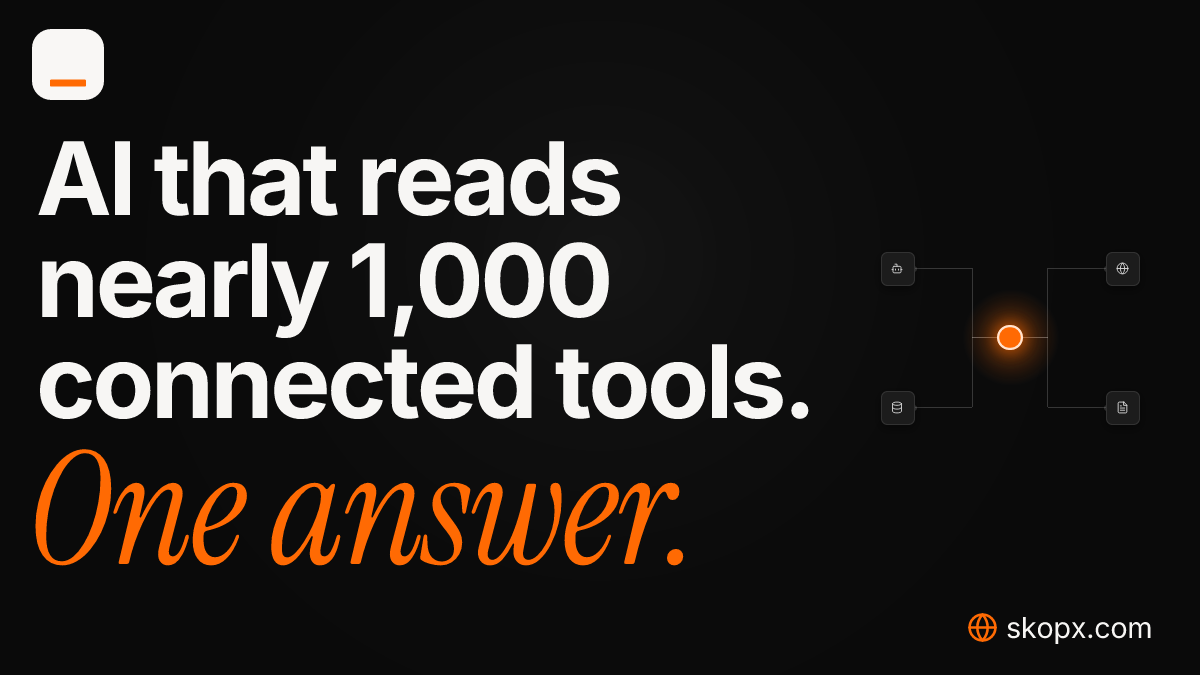
Most AI tools live in one place. Skopx sits above nearly 1,000 connected tools and reads them all at once. Ask one question. Get one answer that cites every source it touched.
Why Location Matters for AI
The AI tools you use every day operate in isolation. ChatGPT lives in its own environment. Gemini exists in another. Specialized tools for writing, coding, research, or analysis each sit in their own corner of the internet. When you need an answer, you jump between platforms, copy and paste information, and manually stitch together insights from different sources.
This fragmentation creates real problems. You lose time switching contexts. Information gets lost in translation between tools. You cannot be certain whether an answer draws from the most recent data or overlooks a critical source. Most AI tools cannot even tell you which sources they consulted, let alone let you verify them.
A Different Architecture
Skopx takes a fundamentally different approach. Instead of being another isolated AI tool, Skopx sits above nearly 1,000 connected tools and platforms. This architecture means that when you ask Skopx a question, it does not just search its own training data or a single knowledge base. It reaches across an ecosystem of connected services.
This matters because different tools excel at different tasks. A weather API provides real-time conditions. A financial database contains market data. A research repository holds academic papers. A news aggregator tracks current events. Spreadsheets store your own data. Project management tools track your team's work. Skopx can query all of them in parallel.
From Many Sources to One Answer
When Skopx receives your question, it determines which connected tools contain relevant information. It queries multiple sources at once. Then it synthesizes the results into a single, coherent answer.
More importantly, Skopx cites every source it touched. You see not just the answer but the evidence behind it. You can verify which tools provided which information. If you disagree with a conclusion, you can trace it back to its origin and examine the underlying data yourself.
This changes how you work with AI. Instead of asking one tool a question and accepting whatever it returns, you get a complete picture. You understand which sources were consulted. You can see if a critical data source was missed. You can make decisions with confidence because you know where the information came from.
Practical Examples
Consider a business analyst researching market trends. A traditional approach means opening multiple browser tabs. You check financial databases for revenue data. You search news sites for recent announcements. You review analyst reports. You pull data from your own company's systems. You manually compare and synthesize all these sources into a presentation.
With Skopx, you ask one question. Skopx reaches into financial databases, news feeds, industry reports, and your internal systems simultaneously. It returns a synthesized answer that cites each source. The analyst gets to analysis faster.
Or imagine a product manager planning a feature. They need to know: What problems are customers experiencing? What solutions exist in the market? What capabilities does our platform already have? What does our development team have capacity for? These answers live in different tools: support tickets, competitor websites, product databases, and project management systems. Skopx connects them.
The Challenge of Integration
Connecting 1,000 tools is not simple. Each tool has different authentication methods, data formats, and API structures. Each requires different permissions and access levels. Skopx handles this complexity behind the scenes so you do not have to.
This integration enables something that single-tool AI cannot: certainty about what your AI actually knows. When an isolated AI tool gives you an answer, you cannot always tell if it is drawing from its training data, which may be months or years old, or from current information. With Skopx, you know which live sources were consulted.
Beyond the Tool
The shift from single-tool AI to connected AI represents a broader change in how work gets done. Instead of AI being another specialized application you learn and master, it becomes infrastructure. It sits between you and the tools you already use. It makes your existing systems work together more effectively.
This is why architecture matters. The most powerful AI is not necessarily the one with the best training or the most sophisticated algorithms. It is the one that connects to the sources that matter to your work. Skopx is built on this principle: better answers come from broader access to better information.
Why Your Database Query Deserves a Screen Built From Real Data
Every database query tells two stories. There's the story of what you asked for, and then there's the story of what you actually got back. Most internal tools software stops after asking the question. Skopx looks at the answer first.
The Gap Between Schema and Reality
When you design an internal application interface, you face an immediate choice. You can build your screen based on the database schema, or you can build it based on the actual data that lives in your database right now.
Traditional internal tools platforms do the former. They take your query, look at the column definitions, and generate an interface from those definitions. A column named "account_name" becomes a text field. A nullable field becomes optional. A timestamp column becomes a date picker. The logic is clean and automated, which is why it's become standard practice.
But databases are living systems. Data doesn't always conform to its original schema. Values drift. Fields that were never supposed to be empty accumulate null values. Text fields that were meant for short codes end up holding sentences. Boolean fields that should only contain two values somehow contain six. This happens quietly, and it happens everywhere.
By the time you're building an internal tool to actually work with the data, you're not working with the schema anymore. You're working with the reality of what's in those tables. Building your interface based on the schema is like decorating a house based on the blueprints while ignoring the foundation's actual condition.
What Measurement Changes
Skopx takes a different approach. When you point it at a query, it runs that query. Then it actually measures the data that comes back.
This measurement phase is where AI becomes useful. Instead of assumptions, you get facts. It examines actual field lengths. It identifies which fields are genuinely empty and how often. It looks at distinct values. It finds patterns that no one documented in the schema.
In one example, an account name field had a schema definition of varchar(50). The actual data told a different story. Account names averaged 53 characters, with some running much longer. A screen built on the schema would have truncated data or forced users into workarounds. A screen built on the measurement fit the real data.
In another case, an owner field was marked as required in the database design. The actual data showed it empty 61% of the time. This wasn't a data quality problem to fix. It was reality. The application had been handling this gracefully in practice for years. The schema was just outdated. A properly designed interface would acknowledge this instead of pretending the field was always populated.
A status field with an enum of three values in the schema contained six distinct values in the actual query results. Again, this wasn't an error. It was the living system adapting to real-world needs. The interface should reflect what's actually there, not argue with users about what should theoretically be there.
Same Query, Same Rows, Better Layout
Here's the critical part: the query doesn't change. The rows you're working with don't change. You're getting the exact same data. Skopx isn't transforming anything or adding any layer between you and your actual database.
What changes is the screen. Because the screen is built from observation rather than assumption, it's built for your data as it exists, not as it was defined years ago. Field widths accommodate actual content. Optional fields stop pretending to be required. Rare values surface clearly instead of being crammed into dropdowns with dozens of other options.
This matters for speed. It matters for accuracy. It matters for how your team actually works.
The Advantage of Looking First
The philosophical difference is simple: measure before you build. This is how good design works in most fields. An architect measures the site before designing the building. An engineer tests materials before specifying them. But in internal tools, we've been building from schema definitions and hoping reality cooperates.
AI makes measurement practical at scale. Running an entire database query and analyzing its actual characteristics takes real computational work. It's not something you'd do manually for every internal tool. Automated measurement and AI-driven layout decisions make it feasible to do this for dozens of applications, consistently, every time.
The screen that results isn't fancier or more complex. It's just built on evidence instead of guesses. Same query, same rows, one just looked first.
AI That Works While You Sleep
Most AI products wait. They sit idle until you log in, ask the right question, or remember they exist. Skopx works differently. Instead of being a tool you activate on demand, it's a system that watches your business continuously, flags problems before they become crises, and delivers insights every single morning without requiring you to lift a finger.
The gap between reactive and proactive AI is where most businesses lose time and money. A renewal slips through the cracks in your CRM because nobody checked it today. Support tickets pile up silently while a customer grows frustrated. A contract term you care about changed hands three times and you only learn about it Thursday. These aren't failures of your team. They're failures of systems that only work when someone remembers to check them.
How Continuous Monitoring Actually Works
Skopx connects to the tools you already use: your CRM, ticketing system, email, calendars, and documentation. Once connected, it runs in the background continuously. Think of it like having someone on your team whose only job is to watch these systems for meaningful changes and patterns.
When something needs your attention, Skopx flags it. Not with noise. With substance. A renewal date drifting past its prep window. A high-value customer's support tickets going unanswered for longer than your standards allow. A contract term that contradicts your documented policy. These flags arrive as part of your morning brief, not as constant notifications that train you to ignore everything.
The Intelligence Comes from Your Context
The real power of continuous monitoring is understanding what matters in your specific business. Different companies have different thresholds, priorities, and workflows. A SaaS company cares desperately about renewal velocity. A services firm might prioritize support response times. A retailer might focus on inventory or supplier changes.
Skopx learns your context by integrating with your actual systems. It doesn't make guesses about what's important. It sees what you track, how you organize it, and where problems typically hide. This contextual awareness means the insights you receive are specific to your business, not generic AI observations.
The Daily Brief as Your Decision Engine
Instead of asking you to check multiple systems, Skopx delivers one morning brief. It covers what shifted overnight and over the past day. What needs a decision. What might become a problem. What you should know before your first meeting. This format respects your time and your attention. You get the full picture without hunting for it.
The brief is structured so you can scan it quickly or dive deeper depending on urgency. You see things clearly enough to decide whether action is needed right now or whether something can wait. You're making decisions based on complete information rather than fragments.
Approval Always Remains Yours
Skopx is designed around a simple principle: the system flags and informs, but you decide. You retain complete control over what happens next. When Skopx surfaces a renewal that's going cold, you choose whether to reach out, escalate, or adjust your timeline. When it flags a support ticket that needs attention, you decide how to respond. When it identifies a policy conflict, you determine the right next step.
This boundary between AI recommendation and human decision is critical. AI should amplify your judgment, not replace it. Skopx surfaces patterns and changes that matter. Your experience, relationships, and understanding of your business determine the action.
Why the Timing Matters
Most businesses operate in reactive mode by default. Something becomes urgent, then you address it. You're firefighting because the system only alerts you when something is already on fire. By then, you've lost time and lost options. A customer retention problem is much harder to solve after they've decided to leave. A renewal is much harder to close after the relationship has cooled.
Continuous monitoring shifts you toward proactive mode. You learn about the renewal when there's still time to prepare. You see the support ticket pattern before it becomes a customer issue. You notice the change early enough to have options.
The cost of continuous AI is low compared to the cost of missing these moments. But only if the system is actually watching, actually understanding your context, and actually delivering insights worth your attention.
Skopx exists because most AI doesn't do this. Most AI waits. Most AI asks. Skopx watches.
Toggling between inventory, orders, and storefront systems wastes hours weekly. Bloom Biz App consolidates everything into one platform-manage multiple branded storefronts, sync inventory across all stores, process orders without manual handoffs. Your catalog updates everywhere at once. No duplicate data entry, no version confusion, no delays. Scale to dozens of locations while reclaiming time your team spends managing systems. Visit BloomBizApp.com Now
Most AI answers when you ask. Skopx notices what moved before you think to look. Connect nearly 1,000 tools once. Tomorrow morning, your briefing shows what changed overnight without you writing a single prompt.
How AI Gets Internal Apps Wrong (And How Skopx Gets Them Right)
Most AI tools approach internal app generation the same way a tailor might design a suit by guessing your measurements from a photo. They read your column names, make assumptions about data types and relationships, and generate an interface. Sometimes it works. Often it doesn't. The mismatch between what the AI guessed and what your actual data looks like means spending an afternoon in fixes before anyone can use it.
Skopx works differently. Instead of guessing, it runs your actual query first.
Why Column Names Aren't Enough
When an AI tool sees a column labeled "status" or "amount" or "user_id", it makes educated guesses about what lives inside. A "status" field might contain single characters (A, P, D), or it might contain long text descriptions. An "amount" might be currency formatted to two decimals, or raw integers in cents, or null values scattered throughout. A "user_id" could be numeric IDs, UUIDs, or email addresses.
These differences matter enormously for interface design. A single-character status field can become a compact dropdown. A text-heavy status field needs a different component entirely. Currency amounts need right-aligned columns with specific formatting. Sparse data with many nulls requires different handling than dense data.
Generic tools make one assumption per column type and move forward. They optimize for the average case, which means suboptimal for most actual cases.
The Cost of Guessing Wrong
When an AI-generated app doesn't match your data reality, the friction compounds. A dropdown designed for five status values becomes unusable when your data actually contains fifty. A column width calculated for "Pending" breaks when a status reads "Awaiting Executive Approval and Budget Sign-Off". Number formatting looks wrong because the AI guessed USD when your column actually stores basis points.
These aren't catastrophic failures. They're just wrong enough that the app needs rework before deployment. That afternoon of fixes isn't spent on the logic or architecture. It's spent on UI tweaks, column widths, dropdown options, and data formatting. It's friction that shouldn't exist.
Running Your Actual Query First
Skopx takes a different approach. Before generating any interface, it executes your query against your actual database. It measures what comes back. It sees the real data types, the actual value ranges, the distribution of nulls, the length of text fields, the precision of numbers.
This is the information you need to design an interface that fits.
Once Skopx has measured your real data, it designs around those measurements. A status field with three values gets a compact dropdown. One with many values gets search functionality. Text fields get width calculated from the longest actual value in your result set. Number columns get formatting matched to what's actually there. Empty fields are handled differently than sparse fields versus dense fields.
The generated app isn't a guess. It's tailored to your specific query result.
What This Actually Changes
The difference feels small in description but compounds in practice. Your first draft app works immediately. The data displays correctly. The interactions make sense for your actual values. You can hand it to your team and they can use it without having to explain workarounds or request modifications.
This is particularly valuable for the internal tools that matter most: query results that need to be browsable, searchable, and actionable without requiring a developer to babysit them. Those tools exist in the gap between custom development (expensive, slow) and generic dashboards (rigid, limited). That's where AI generation should shine.
The Broader Point
There's a pattern here that extends beyond app generation. Generic AI tools optimize for broad applicability. They make reasonable default choices that work okay in many situations. But when your specific need doesn't match those defaults, you pay the cost of adaptation.
Tools that measure your actual inputs before making decisions can fit much more tightly. They use the real information available to them instead of working from assumptions. The difference isn't in the sophistication of the AI. It's in the quality of the input to the design process.
For internal apps, that means the difference between a tool that needs an afternoon of fixes and one that works on first use. For your team, that means less waiting and more time actually using the tool to do their work.
Artificial Intelligence That Works While You Sleep
The traditional relationship between humans and artificial intelligence has always been reactive. You identify a problem, you ask the AI tool to help solve it, you wait for an answer. This cycle repeats hundreds of times across your organization every day, creating a constant demand for attention and action from your team.
Skopx breaks this pattern entirely. Rather than waiting for you to notice something is wrong, Skopx actively monitors your connected business tools around the clock. It watches for anomalies, detects unusual patterns, and flags potential issues before they develop into actual crises. This proactive approach means critical problems get caught early, when they're still manageable.
Monitoring That Never Stops
The core difference lies in how Skopx operates. While you're sleeping, in meetings, or focused on other priorities, Skopx continues its work. It maintains continuous observation across your connected platforms and tools, analyzing data patterns and behaviors in real time. This 24/7 attention to detail means nothing slips through simply because no human was looking at that particular moment.
Most monitoring tools require configuration, threshold-setting, and ongoing manual oversight. You have to decide in advance what matters enough to watch. Skopx takes a different approach. It learns what normal looks like in your specific environment, then alerts you when things deviate from that baseline. This means it can catch problems that might not fit neatly into preset categories.
The Morning Briefing
Every morning, Skopx delivers a briefing that summarizes what changed overnight. Rather than forcing you to dig through logs or multiple dashboards, this briefing consolidates the important information into one clear report. You learn immediately about any issues that developed while you were away.
This structure transforms how teams approach their workday. Instead of starting by investigating what went wrong, you start with a complete understanding of your current situation. The morning briefing becomes essential context for planning your day and prioritizing your team's efforts.
Catching Problems Early
Problems grow exponentially when they're ignored. A small anomaly that could be resolved in minutes might become a critical issue after several hours of escalation. By flagging anomalies early, Skopx helps your team intervene at the point where solutions are simplest and impact is lowest.
This early detection works across your connected tools. Whether the issue originates in your data pipeline, application performance, workflow automation, or any other connected system, Skopx identifies it and brings it to your attention. The consistency and speed of detection means your team can maintain higher reliability across more systems with less manual effort.
AI That Understands Your Context
The anomaly detection in Skopx works because it develops genuine understanding of your specific environment. Generic monitoring tools apply the same rules to every customer. They might miss issues that matter in your unique situation or generate false alarms about variations that are actually normal for how you operate.
Skopx adapts to your baseline. It learns the patterns that characterize normal operation in your specific case. This contextual awareness means the alerts you receive are relevant and actionable rather than generic warnings that require human interpretation to determine whether they actually matter.
Reducing Firefighting
Organizations spend enormous resources fighting fires that could have been prevented. Critical systems fail because small problems weren't caught in time. Teams get pulled into emergency responses that could have been avoided with earlier detection. The reactive cycle becomes the dominant pattern of how technical teams spend their time.
Moving to proactive monitoring changes this dynamic. When problems are consistently caught early, the rate of critical incidents drops. Your team spends less time in emergency response mode and more time on planned improvements. The psychological difference is significant as well. Teams that spend their days fighting fires operate under constant stress.
A Different Approach to AI
Skopx represents a broader shift in how AI tools can operate. Rather than positioning AI as a specialized tool you consult, Skopx works as an integrated capability embedded in your operations. It participates in your workflow continuously rather than on demand. It takes responsibility for watching what matters rather than waiting for you to ask the right question.
This makes AI genuinely useful in a different way. Instead of focusing on how AI can be smarter or faster, Skopx focuses on doing something humans can't easily do at scale: maintaining consistent attention across complex systems 24/7.
The work that catches problems happens while you're away.
The Hidden Cost of Fragmented Business Tools
Every business runs on software. Most run on dozens of them. And somewhere in the gaps between those tools, problems grow in silence.
Consider a typical day at a mid-market company. A customer support agent logs a technical issue in one system. A sales rep tracks the same account's renewal progress in another. Finance monitors payment status in a third. These three people are looking at pieces of the same problem, but they're not looking at it together. By the time anyone realizes the customer is at risk, it's often too late.
This isn't a technology problem. It's a visibility problem.
Why Important Things Fall Through Cracks
The average company uses between 100 and 150 software tools. Some organizations use more. Each tool does something useful. But each tool also creates a silo. Your CRM doesn't see what your support tickets say. Your billing system doesn't talk to your project management software. Your customer success platform can't read the emails your sales team sends.
The consequence is predictable. Warning signs appear in one system while decision makers are watching another. A customer starts asking questions in support that signal renewal risk, but nobody connects those tickets to the deal record. An invoice goes unpaid because the contract details live in Salesforce while the billing system has its own copy of the terms. A project timeline slips in Asana while the client relationship manager is checking Slack.
These aren't dramatic failures. They're the steady accumulation of small breakdowns.
The cost is real. A renewal that goes cold because nobody connected the warning signs. A deal that closes but turns into a churn risk because implementation details never made it from one tool to another. Revenue that delays because billing and contracts can't sync. Customers who leave not because the product failed, but because the organization wasn't paying attention.
Most Tools Answer When Asked
Traditional AI has offered one solution to information overload: search and chat interfaces. Ask your AI assistant a question, and it will dig through your data and return an answer. This works if you know what question to ask. It works if you remember to ask. It works if the problem is obvious enough that someone notices it needs asking about.
But the most expensive problems in business are the ones nobody thought to ask about.
A renewal going cold isn't a crisis until it's a crisis. An invoice approaching 90 days past due wasn't flagged because nobody checked the intersection between your CRM and your accounting system that morning. A customer success risk living in support tickets stays invisible because the person managing that account doesn't read support tickets.
What you need isn't better answers to known questions. You need problems surfaced before you know to look for them.
Continuous Monitoring Across Your Entire Stack
Skopx approaches this differently. Instead of waiting for you to ask, it runs continuously. It connects to nearly 1,000 different tools and platforms. It monitors the relationships between them.
Every morning, you get a brief. Not a deluge of notifications. Not a list of everything that happened. A brief that surfaces what actually needs your attention today. The renewal showing early churn signals. The invoice that's moving past terms. The customer whose support tickets suggest a product misalignment that the account manager hasn't seen yet.
The AI doesn't need you to know what to look for. It looks across your entire toolstack for patterns that matter. It finds problems while they're still problems to be solved, not disasters to be managed.
What Changes
When your tools work independently, you're building decisions on incomplete information. You're reacting to crises instead of preventing them. You're asking your team to manually track relationships between systems, which is work they'll eventually stop doing because it's not their actual job.
Skopx turns your disconnected tools into a connected system. It turns reactive work into proactive work. It gives you the visibility to operate like your business is integrated, because it becomes integrated.
The expensive problems in business were always going to be the ones you didn't see coming. The point is to see them. The point is to know, every morning, what's actually falling through the cracks. And to fix it before it becomes a problem that costs you.
Skopx measures what your query returns, not the records themselves. It learns that account names average 53 characters (so they will break a bar chart), that owner fields are 61 percent empty, that status has six distinct values. Then it designs the interface to fit your actual data, not a guess about it. Connect your database and see the difference a single measurement makes.
Your Business Runs on Disconnected Islands of Data
Every AI tool you use reads one corner of your business. Your CRM sees deals. Your support queue sees tickets. Your database sees records. Your email system tracks communication. Your invoicing platform knows revenue. But none of them see the connections between them, which is where most problems hide.
This fragmentation creates a fundamental problem: decision-making happens in the dark. A customer success manager investigating why an account is churning has to manually cross-reference three systems. A founder trying to understand revenue trends pulls reports from two different places and reconciles them manually. A support agent resolving an urgent issue has no visibility into whether that customer just signed a major deal or is days away from cancellation.
The cost of this disconnection compounds. Teams waste time context-switching between tools. Critical insights get missed because the connection between them never gets made. Decisions get made on incomplete information.
The Single Source of Fragmentation
This isn't a failure of any individual tool. CRMs are built to track sales. Support platforms are built to manage tickets. Databases are built to store records. Each does its job well within its own domain. The problem emerges when you need to understand something that spans multiple domains.
A customer complaint in your support queue might be the leading indicator of a product issue affecting dozens of accounts. But if that insight is trapped in your support system and never connected to your usage data and your CRM, nobody sees the pattern. A sales opportunity might hinge on understanding a customer's full history with your company, not just the current deal stage. But if that history is split across email, CRM, and support tickets, the salesperson never gets the complete picture.
This creates a false scarcity of insight. The information exists. It's already being collected. It's just imprisoned in separate systems.
How Connected Data Changes Everything
Skopx connects nearly 1,000 tools at once, making data portability invisible to the user. Instead of asking five tools five different times and then manually stitching together the answer, you ask once. The system pulls from your database, email, CRM, support tickets, and every other connected platform simultaneously. You get one comprehensive answer instead of five fragmented ones.
This changes what questions become answerable. You can ask: "Show me every customer who contacted support about billing in the last month, their current contract value, and whether they've reduced usage." The system queries your support platform, CRM, and usage database in parallel and returns a unified result. You can ask: "Which deals are at risk, and what's the earliest warning sign we missed?" The system correlates your CRM data with support volume, email sentiment, and usage patterns.
These aren't hypothetical questions. These are the questions that drive actual business decisions. They're just currently trapped behind the effort required to manually gather the answer.
Seeing What Actually Matters
The real value of connection isn't speed, though speed matters. The real value is visibility into relationships that don't exist within any single system.
A customer might look healthy in your CRM (deal won, contract signed, payments coming in) while simultaneously showing warning signs in your support queue (tickets increasing) and usage data (feature adoption declining). No individual system reveals the pattern. Connected systems do.
A prospect might have interacted with your company five times across email, your website, a support ticket from a free trial, and a conversation with your sales team. Your CRM might only know about one of those interactions. Your connected system knows all of them, revealing a picture of genuine interest that might otherwise be invisible.
Your team has questions that require synthesis across multiple data sources. Right now, answering those questions requires manual work. Connected data makes synthesis automatic.
The Practical Impact
This translates to concrete outcomes. Shorter time to insight means faster decision-making. More complete information means better decisions. Less manual data work means more time for judgment and strategy.
A support team that can instantly see whether an escalating customer issue correlates to a broader product problem can escalate appropriately. A sales team that can see a prospect's full interaction history across all systems can close deals faster. A founder that can answer a strategic question without running a custom report can move faster.
The tools you already use contain the answers. They're just not talking to each other. Skopx makes them talk.
Most AI answers the questions you ask. Skopx watches what moves between your connected tools and raises the questions you forgot to ask. A renewal goes quiet in your CRM while support tickets sit unread elsewhere. An invoice ages unpaid because billing and deals live in separate systems. Skopx catches what falls through the gaps, briefs you every morning, and waits for your approval before it acts. Nearly 1,000 integrations. One conductor. Start free at skopx.com.
Your AI Should Work While You Sleep
Most AI tools operate on a reactive basis. You open them, ask a question, get an answer, and move on. They sit idle until you need them. Skopx works differently. It's designed to be proactive, running continuously in the background to monitor your connected tools and surface important changes before you even know they happened.
How Passive Monitoring Changes the Game
The fundamental difference comes down to timing and attention. Traditional AI requires you to decide what to ask and when to ask it. You need to remember to check your systems, formulate queries, and interpret results. This approach assumes you'll catch problems through active investigation.
Skopx inverts this model. The system continuously observes your connected tools around the clock. Rather than waiting for a prompt, it's constantly analyzing patterns, comparing current states against historical baselines, and identifying when something deviates from normal behavior.
Anomalies Surface Automatically
When Skopx detects something unusual, it flags it immediately. An anomaly might be a sudden drop in performance metrics, an unexpected change in data patterns, unusual user behavior, or any deviation from established norms that warrants attention. The system doesn't wait for you to stumble upon these issues during routine checks.
The value here is preventative. Most organizations discover problems when they've already caused damage. A performance degradation that cascades into downtime. A security issue that's been exploited for hours. A data pipeline that's been broken since yesterday morning. Skopx catches these before escalation.
The Morning Briefing Model
Every morning, Skopx delivers a briefing summarizing everything that shifted overnight. This isn't a generic report of all system activity. It's a curated summary of what actually changed and what matters. You see anomalies flagged by the system, changes across your connected tools, and priorities for the day ahead.
This approach recognizes that you have limited attention. Rather than overwhelming you with raw data, Skopx filters for signal. The briefing tells you what you need to know, not everything that happened.
Everything Else Still Requires Your Call
Skopx remains fundamentally a tool for human decision-makers. The system identifies problems and surfaces information, but it doesn't act unilaterally on your connected systems. It flags an anomaly, but you decide whether to investigate further or take action. It alerts you to a change, but you determine the appropriate response.
This balance matters. Automation that acts without oversight can create new problems. An AI system that makes autonomous decisions about your infrastructure might resolve one issue while creating others. Skopx provides the intelligence you need to make informed decisions while preserving human judgment in the loop.
Designed for Continuous Operation
Building a system that runs continuously introduces technical challenges that most AI tools avoid. It requires efficient monitoring that doesn't drain resources. It demands accuracy in anomaly detection, since false positives at scale create noise rather than insight. It needs to maintain context over time, remembering historical patterns to identify when something genuinely breaks from normal behavior.
Skopx is built specifically for this continuous operation model. Rather than processing individual queries as they arrive, it maintains ongoing awareness of your systems.
Real-World Impact
The practical result is different from what most AI users experience. You're not in a constant state of remembering to check your tools or wondering if something has changed that you haven't noticed. Instead, you wake to a briefing that tells you what happened while you weren't watching.
For teams managing multiple systems, this changes workflow. Instead of assigning someone to monitor dashboards, that person gets a curated briefing and focuses on decisions that require actual judgment. For executives overseeing operations, you get early warning of problems rather than discovering them through escalations.
The Broader Shift
This represents a larger shift in how AI tools can be designed. Rather than building systems that only engage when prompted, there's an opportunity to build systems that understand your context and provide value continuously.
That doesn't mean eliminating human agency or moving toward fully autonomous systems. It means designing tools that work alongside humans, providing information and flagging issues without requiring constant prompting. The intelligence operates in the background, and humans retain control over decisions.
Skopx embodies this approach. It's AI designed to reduce your workload while expanding your awareness.
ERP isn't just about syncing inventory across stores. It eliminates manual data entry, reduces errors, and lets your team focus on growth instead of spreadsheets. Unified operations mean smarter decisions, faster.
Visit BloomBizApp.com Now
The hidden cost of siloed business tools
When your sales team closes a deal, support doesn't automatically know. When a customer's invoice goes unpaid for sixty days, your account manager isn't notified. When a delivery stalls in your fulfillment system while the customer support queue fills with complaints, no one sees the connection. These gaps aren't accidents. They're the default state of how most businesses run their technology.
Every business runs on multiple tools. Your CRM holds deal data. Your support platform tracks tickets. Your billing system manages invoices. Your communication tools log conversations. Your project management software tracks deliverables. Each tool does its job reasonably well in isolation. The problem isn't what happens inside each silo. It's what happens in the space between them.
The silo problem costs real money
A customer's renewal date approaches. Sales targets it as a priority. Meanwhile, support has been managing five tickets from the same company about incomplete features. The support team knows the issue. The sales team doesn't. The renewal falls through because the customer's core problem never surfaced in a room where it could be fixed before it became a reason to leave.
An invoice ages past ninety days. The billing team flags it for collections. But the customer's project is incomplete because a deliverable got stuck between two handoff points. Your finance team doesn't know that context exists. Neither does account management. It becomes a collection problem when it should have been a delivery problem.
A customer opens a support ticket about a bug. The same bug was reported three other times in the past month, but each ticket lives in isolation. Support solves the same problem four times. Product never sees the pattern. A simple fix that would take a week sits undone while you pay salary for four support interactions that shouldn't have been necessary.
These situations aren't rare. They're standard. The companies that suffer them most aren't poorly run. They've simply built their technology stack the way it was designed to be built: best-of-breed point solutions that excel at their specific function and nothing beyond.
What changes when systems talk to each other
The alternative isn't one monolithic platform that does everything poorly. It's intelligent connection across the tools you already use.
Imagine if your CRM knew what support knew. When a renewal entered its final sixty days, the system could flag it not as a sales number, but as a risk. Sales could see that this customer opened support tickets about performance issues or feature limitations. Not as gossip or office knowledge, but as structured data. The conversation changes from "how do we upsell them" to "what do we need to fix to keep them."
Imagine if your billing system talked to your project management system. An aging invoice could trigger a check: is this project complete? Is it blocked? Do we need to escalate delivery before we escalate payment? You catch the problem before the relationship breaks.
Imagine if your support platform broadcast patterns. After the third ticket about the same issue, an alert reaches product. After the fifth, engineering is already working on it. The sixth customer gets a solution in days instead of months, not because your support team is faster, but because your business sees the full picture.
How connection scales beyond human attention
With five or ten tools, a skilled operations person might manually connect the dots. They build spreadsheets. They write scripts. They remember which tool has which information and who needs to know about it.
At scale, this breaks. No person can watch fifty tools. No spreadsheet scales to ten thousand customers and fifty thousand tickets a month. No manual process stays current as your business changes and new tools come online.
This is where AI becomes necessary, not optional. You can't write a rule for every situation. You can't anticipate every combination of data that matters. But an AI system connected to nearly a thousand tool integrations can watch across your entire technology stack simultaneously. It can notice when a pattern appears across three systems that would be invisible inside any single one. It can flag the renewal that's about to break because it sees the support history. It can catch the invoice that won't get paid because it knows the project is incomplete. It can surface the bug that's repeated five times because it sees each iteration.
The difference between answering and preventing
Most AI tools answer questions. You ask your sales AI which deals are at risk, and it tells you. You ask your support AI how many tickets are open, and it counts them.
Real value comes from watching for problems that haven't been asked about yet. From connecting data across systems before the situation reaches a crisis that requires a human decision.
That's the difference between a tool that responds and a system that prevents. Skopx watches your entire technology landscape at once. It doesn't just answer the questions you think to ask. It flags the problems hiding in the gaps between your systems.
Artificial Intelligence Works Best When It Can Actually See Everything
The promise of AI has always been tantalizing. A tool that can answer questions, solve problems, and surface insights faster than any human team. But in practice, most AI systems hit a wall. They're intelligent within a narrow domain, but the moment you need information that spans multiple systems, they fall silent. They can't see what you know because your knowledge lives scattered across disconnected tools.
This fragmentation costs time and accuracy. Your customer support team might have critical context in your CRM that your AI can't access. Your sales team might be asking questions that only your database can answer. You end up jumping between platforms, manually pulling data together, or settling for incomplete answers that miss crucial details.
Skopx approaches this differently. The platform connects to nearly 1,000 tools simultaneously, creating a unified information landscape where AI can actually see the full picture. When someone asks a question, Skopx pulls data from your database, CRM, email, support tickets, and other connected systems all at once. The AI isn't working in isolation anymore. It's working across your entire operational reality.
Why Data Silos Make AI Dumb
Consider a practical example. A customer support representative gets an email from a frustrated client. They want quick answers: What's this customer's history with us? What have they purchased? Are there known issues with their account? When did they last contact us? What's their payment status?
Traditionally, the support rep opens four or five different applications. They search the CRM for contact history. They check the billing system for account status. They dig through email for recent interactions. They search the knowledge base for known issues. This takes time. Details get missed. The customer waits.
An AI that only has access to email? It can see what the customer wrote today, but nothing else. It's like answering a question while wearing a blindfold. Useful, but limited. An AI that only has access to the CRM? It sees transaction history and contact notes, but misses the email thread or the support ticket that actually explains the underlying problem.
Data silos don't just make work slower. They make AI less intelligent. Intelligence requires context. It requires connections. The moment your AI can see relationships between what's in your database and what's in your email and what's in your support system, everything changes.
Connected Intelligence Changes What's Possible
Skopx's approach to integration means the AI doesn't have to choose which system to search. It searches everywhere. A single natural language question triggers queries across nearly 1,000 potential data sources at once. The system knows where to look because it's already connected.
This matters for several categories of work. For customer-facing teams, it means support reps and account managers get comprehensive context instantly. For operations teams, it means analyzing patterns across multiple systems without manual data compilation. For sales teams, it means understanding customer accounts more deeply without switching between tools. For leadership, it means asking questions about the business and getting answers that reflect reality, not just one system's view of reality.
The technical challenge is substantial. Different tools store data differently. They use different schemas, different naming conventions, different access patterns. Most AI systems avoid this complexity by narrowing their scope. They specialize. Skopx solves it through extensive integration work and unified data access, allowing the AI to work across the entire landscape without the user having to understand the underlying systems.
Practical Impact
The result is faster decision making. No more delays waiting for someone to manually pull data from three different sources. No more meetings that pause so someone can "check and get back to you." No more incomplete answers because key information lived in a system the AI couldn't access.
It also reduces human error. When you manually combine data from multiple sources, mistakes happen. Information gets mismatched. Context gets lost in translation. Automated data gathering from connected systems is more reliable.
The shift is subtle but fundamental. AI gets smarter the moment it has access to more information. But information access alone isn't enough. The AI also needs to understand connections between data in different systems, to cross-reference and synthesize. That's what near-universal integration enables.
Organizations spending significant resources on AI tools while keeping their data trapped in isolated systems are not getting the intelligence they're paying for. The AI can only be as smart as the data it can see. Skopx connects the data, giving AI what it actually needs to work.
AI That Watches So You Don't Have To
Most AI tools answer questions. You ask, they respond. That's useful for quick lookups and brainstorming, but it leaves you responsible for asking the right questions in the first place. If you don't think to check whether a vendor renewal is about to lapse, or whether an invoice has been sitting unpaid for two months, the AI won't flag it. You have to remember to look.
Skopx works differently. Instead of waiting for your question, it watches across your connected business tools and surfaces what's actually going wrong before it becomes a crisis.
The Problem With Reactive AI
Most business problems don't announce themselves loudly. A renewal notice gets buried in email. An invoice moves past its due date without anyone noticing. A handoff between teams stalls because no one realizes it stalled. These gaps compound quietly, then suddenly become expensive.
Traditional AI assistants are reactive by design. They excel at answering specific queries: "What's our contract status with Vendor X?" or "How many unpaid invoices do we have over 60 days?" But they can't alert you to something you don't know to ask about. The burden of vigilance stays on you.
That's the limitation Skopx solves. By continuously monitoring activity across your connected tools, it can detect when something has stopped moving or started drifting. It doesn't wait for you to think to check.
How Continuous Monitoring Actually Works
Skopx connects to nearly 1,000 different business applications. ERPs, accounting software, CRMs, project management platforms, HRIS systems, procurement tools. Once connected, it watches for signals that typically indicate problems.
When a renewal hasn't been touched in weeks and the contract expiration date is approaching, Skopx flags it. When invoices age beyond your normal payment cycle without resolution, Skopx flags it. When a project handoff was supposed to happen but the work hasn't moved to the next team, Skopx flags it. When a customer who normally orders monthly hasn't placed an order in two cycles, Skopx flags it.
These aren't predictions or guesses. They're observations about what's actually happening in your systems, compared to what should be happening based on your normal patterns and timelines.
The Morning Briefing Model
Rather than bombarding you with alerts throughout the day, Skopx compiles what it's noticed into a morning briefing. This means you start each day with a clear picture of what needs attention, prioritized by impact and urgency.
The briefing isn't just a list of problems. For each flagged item, Skopx proposes a next move. Renew the contract, reach out to the customer, escalate to finance, schedule the handoff, send a follow-up. These suggestions are grounded in what typically happens next in your workflow, based on patterns across your connected tools and best practices in your industry.
This approach respects your time. You're not reading through dozens of alerts. You're reviewing a curated set of issues with suggested actions, all in one place, once per day.
Human Approval Remains Central
This is critical: nothing happens without you. Skopx doesn't execute actions, change records, or send messages on its own. Every suggestion waits for your approval.
You might approve an action immediately. You might modify it before approving. You might skip it because you already handled it through a different channel, or because you've decided to take a different approach. That discretion is yours.
The system learns from your choices. When you consistently modify a particular type of suggestion, or when you repeatedly ignore certain flags, Skopx adjusts its briefings to better reflect what actually matters in your workflow.
Why This Matters
The cost of slipped renewals, aged payables, stalled projects, and missed customer signals adds up quickly. But the bigger issue is operational visibility. Many teams don't know what they don't know because there's no systematic way to know it.
Skopx fills that gap. It's the difference between hoping you remember to check and having a system that checks for you. It's monitoring that surfaces what's falling through the cracks before those cracks widen into problems.
You still make the decisions. You still approve the actions. Skopx just makes sure you're deciding based on a complete picture of what's actually happening in your business.
AI That Sees What Others Miss
Every business runs on data scattered across dozens of disconnected systems. Your customer success team works in one platform, engineering in another, billing in a third. Finance has its own view, support has theirs, and marketing has yet another. This fragmentation isn't just inconvenient. It's where critical information falls through the cracks.
Most AI platforms today treat this fragmentation as acceptable. They connect to one tool or a handful, then make decisions based on whatever narrow slice of data they can access. An AI connected only to your CRM might suggest a customer is at high risk of churning. But it doesn't know that customer just signed a major new contract in your billing system. It doesn't see that your engineering team just resolved a critical bug affecting them. It doesn't know half the context that would actually inform the decision.
The Integration Problem
The challenge isn't that good AI tools don't exist. It's that they operate in silos. A support AI sees tickets but not the customer's email history with your company. A sales AI sees pipeline but not implementation struggles in your project management tool. A financial AI sees invoices but not the quality of work reflected in your code repositories or support ticket history.
Each tool gives you a partial picture. And partial pictures lead to partial decisions. A customer flagged for churn might actually need a different solution. A deal marked as stalled might be moving faster than your CRM shows. A critical resource bottleneck might be invisible because the constraint crosses multiple systems.
Why Breadth Matters
Skopx connects to nearly 1,000 different platforms and tools. This isn't about complexity for its own sake. It's about completeness. When an AI system can read across your email, CRM, support tickets, billing data, code repositories, project management, documentation, and everything else, it actually understands your business.
This cross-system visibility changes what's possible. An AI that sees both your customer communication history and your internal notes catches the pattern where certain customer segments need more onboarding support. It notices when sales promises don't align with what engineering can deliver. It identifies bottlenecks by seeing where work stalls across handoff points between teams.
More importantly, it catches what falls between systems. That's where most business failures live. The customer who asked for a feature nobody documented in the requirements. The team dependency nobody flagged until it became a crisis. The billing issue that affected adoption but nobody connected to the customer success conversation. The security concern mentioned in an email that never made it to the backlog.
Real Business Impact
When your AI understands the complete context, its recommendations shift from tactical to genuinely strategic. Instead of suggesting you reach out to a churning customer based on reduced ticket volume, it can tell you they're churning because their implementation hit a technical blocker that's sitting unassigned in your backlog. Instead of flagging a deal as stalled, it knows the stakeholder is on vacation but the legal review is wrapping up next week.
This kind of intelligence compounds. Every decision made with fuller context leads to better outcomes. Better outcomes create better data. Better data flowing through your systems makes the AI smarter still.
The systems approach also reveals patterns invisible in isolated data. Customer success might see an uptick in support tickets as a negative signal. But combined with email data showing customers are actually asking more detailed questions, and billing data showing they're upgrading their plans, the full picture shows they're actually deepening their engagement.
Building for Integration
Supporting nearly 1,000 integrations requires a different architectural approach than most AI tools take. It means building flexible data connectors that handle vastly different schema and update patterns. It means designing AI reasoning that can work with incomplete or temporally inconsistent data across systems. It means making the system robust enough that gaps in one integration don't break understanding across the others.
This complexity is worth it because the alternative is accepting that your AI will be systematically blind to large parts of your business. And that blindness becomes expensive. It's expensive in missed opportunities. It's expensive in problems that could have been caught early. It's expensive in decisions made on partial information that turns out to be wrong when the full picture emerges.
The future of AI in business isn't more specialized tools. It's tools that finally see across the full landscape of how your business actually operates. That requires deep integration. That requires connecting broadly. And that's what actually makes the difference between AI that helps and AI that misleads you with incomplete data.
Stop designing from spreadsheet column names
We all know the disconnect. You're building a dashboard or report, staring at your database schema, and making assumptions about what the data actually contains. Column headers suggest one thing. Reality delivers another. Hours later, you're rebuilding layouts, adjusting calculations, and wondering why the first version didn't work.
Skopx solves this by running your actual query first.
How it actually works
When you connect a data source to Skopx, the system doesn't just catalog your tables and columns. It executes your query against your live data and measures what comes back. This means Skopx knows the real shape of your data before you start designing anything.
The AI then uses that measured reality to inform every design decision. It understands data types, distribution, cardinality, and density. It knows whether a field contains 3 unique values or 3 million. It sees which columns have nulls, what the actual string lengths are, and how much numeric variation exists. This is the information that matters when building something that actually works.
The traditional approach and why it fails
Most tools work backward. You select a table. They show you the column names and data types from your schema. You make design decisions based on that metadata. Then you test it with actual data.
This creates friction at every step. A field you thought would be perfect for filtering turns out to have 50,000 unique values. A summary you designed as a simple count needs aggregation logic you didn't anticipate. A number formatted as text won't sort the way you expected.
These aren't failures of the tool. They're failures of designing blind.
Why measuring first changes things
When Skopx runs your query before you design, it answers the real questions upfront. How much data are we actually working with? What's the actual range of values in this field? Does this column contain what I think it contains?
An AI system built on this foundation can make smarter choices about layout, visualization type, and interaction patterns. It can recommend whether a field works better as a filter or a grouping. It can suggest relevant calculations because it knows what data actually exists to calculate.
This is fundamentally different from pattern-matching against column names. It's the difference between reading a recipe and tasting the ingredients first.
Speed and confidence
The practical outcome is simple: you get a working screen faster, and you're more likely to keep it as-is.
If you've ever built a dashboard or report from schema alone, you know that first version usually needs work. You expected certain fields to be there. You guessed at cardinality. You made assumptions about data quality. Then you ran it against real data and adjusted.
Skopx eliminates that cycle. Because it measured the data before designing, the screen is built to handle what's actually there. You spend less time in revision and more time using the tool.
This matters for teams
For data teams, this changes how work flows. You don't need to iterate with business users as many times. For business users, you get something usable immediately instead of a "rough draft that we'll refine." For everyone, there's less back-and-forth about why something doesn't work the way they expected.
The reduction in iteration time compounds when you're building multiple views or when requirements change. You're always building from a foundation of actual data reality, not guesses.
Why AI is suited to this
AI excels at pattern recognition across high-dimensional data. When you measure a query result, you get dozens of data points about what came back: schema, cardinality, distribution, data types, null patterns, string length variance, numeric ranges. A trained system can recognize what patterns work together and which require different approaches.
More importantly, AI can do this automatically. You don't need to manually inspect and report on your data. The system does the measuring and learning for you.
The connected tool difference
This approach only works because Skopx runs your actual query. If the tool lived in isolation, disconnected from your data, it would have no way to measure anything. But because your tools are already connected, because Skopx has access to live data sources, it can execute real queries and base everything on what they return.
That's the core difference. You're not designing from theory. You're designing from evidence.
The next time you're about to build a dashboard or report, consider what assumptions you're making before you even open the tool. Column names rarely tell the whole story. Data reality does. Skopx is built around that reality instead of guessing from spreadsheets.