AI-Driven Data Analysis Examples for Business Teams
AI-driven data analysis is the use of artificial intelligence to automate insight generation, detect patterns, and connect raw data to operational decisions. The examples of AI-driven data analysis covered here span logistics, retail compliance, and software development, with real case studies from Ecolab, GitHub, and Netflix. These applications of AI in analytics move well beyond dashboards. They cut reporting time from weeks to minutes, save hundreds of thousands of dollars annually, and give analysts the ability to query complex datasets in plain English.
1. What are the best examples of AI-driven data analysis in reporting automation?
AI data agents replace manual reporting by integrating multiple data sources and generating dashboards in real time. One logistics company deployed an AI data agent that reduced reporting time by 90% and saved $420,000 annually. The agent replaced more than 20 hours of weekly manual work by pulling from five data sources and delivering natural language query interfaces to non-technical staff.

The business impact goes beyond cost savings. When analysts stop building weekly reports by hand, they redirect their time toward interpreting trends and advising on strategy. That shift from data assembly to data interpretation is where real decision-making value lives.
Key capabilities that make reporting automation work:
- Natural language queries: Analysts ask questions in plain English and receive structured answers without writing SQL.
- Multi-source integration: The agent connects to databases, spreadsheets, CRMs, and cloud storage simultaneously.
- Real-time dashboard updates: Data refreshes automatically rather than on a weekly export cycle.
- Scheduled summaries: The system pushes reports to stakeholders on a defined cadence without human intervention.
Pro Tip: Before deploying an AI reporting agent, map every data source your team currently queries manually. Agents perform best when the integration layer is complete from day one, not patched together after launch.
2. How does AI enhance compliance reporting with multi-agent systems?
Ecolab's retail intelligence rebuild is the most compelling AI data analysis case study in compliance to date. The company unified nine siloed data sources and deployed a multi-agent orchestration framework on Databricks using Anthropic Claude models, specifically Claude Sonnet and Claude Haiku, for reasoning and summarization tasks. The result: compliance report compilation dropped from 14 days to under two minutes.
That is not a marginal improvement. It is a structural change in how compliance teams operate. Analysts who previously spent two weeks assembling data now spend that time acting on findings.
The system uses five Judge LLMs running continuous quality evaluation alongside MLflow tracing for auditability. Batch inference across thousands of records in a single SQL call transforms what used to take hours of sequential row-by-row processing into sub-second operations. That speed is what makes real-time compliance scorecards viable at enterprise scale.
| Dimension | Single-agent approach | Multi-agent approach |
|---|---|---|
| Data source handling | One source at a time | Nine or more sources unified |
| Report compilation time | Hours to days | Under two minutes |
| Quality control | Manual review | Five Judge LLMs, continuous |
| Auditability | Limited | MLflow tracing, full audit trail |
| Model flexibility | Fixed model | Swappable models per task |
Pro Tip: Build your multi-agent system so individual models are swappable. Ecolab's architecture separates reasoning tasks from summarization tasks, which means upgrading one Claude model does not require rebuilding the entire pipeline.
3. Which AI techniques improve exploratory data analysis and interactive querying?
GitHub's Qubot AI agent answers natural language questions across complex, distributed datasets. It integrates with two query engines, Kusto and Trino, giving analysts both speed and depth depending on the query type. The agent's most important design decision was not the model choice. It was the context layer.
Curated context made Qubot three times faster and significantly more accurate. Product teams and business units contribute metadata, table descriptions, and usage notes in a federated model. Every team that owns data also documents it, which means the agent always has current, specific context rather than generic schema information.
This approach reframes what an AI data agent actually does. Qubot is not a dashboard replacement. It is a conversational explorer that centralizes distributed organizational knowledge and makes it queryable by anyone.
Key features that define effective exploratory AI agents:
- Federated context contribution: Multiple teams maintain their own metadata, keeping it accurate and current.
- Dual query engine support: Kusto handles fast lookups; Trino handles deep analytical queries.
- Ad-hoc question handling: The agent supports one-off questions that would never justify building a dedicated report.
- Contextual accuracy: Well-structured metadata directly determines answer quality.
Pro Tip: Treat your context layer as a first-class data product. Structured metadata is the single biggest lever for improving AI agent accuracy, and it requires ongoing curation, not a one-time setup.
4. What AI analytics use cases are transforming business operations?
AI-driven analytics shifts from describing what happened to recommending what to do next. That shift from descriptive to prescriptive is the defining change in how AI enhances data interpretation across business functions.
| Use case | Primary benefit | Common implementation challenge |
|---|---|---|
| Fraud and risk detection | Adapts to new suspicious patterns in real time | Requires labeled historical fraud data |
| Demand forecasting | Handles seasonality and external market signals | Data quality across supply chain sources |
| Customer segmentation | Identifies churn risk and behavioral clusters | Privacy compliance and data governance |
| Prescriptive analytics | Recommends specific operational actions | Connecting predictions to execution systems |
| Sentiment analysis | Surfaces product and service feedback at scale | Multilingual and domain-specific accuracy |
Fraud detection is where AI most clearly outperforms classical rule-based systems. Traditional fraud rules are static. AI models update their understanding of suspicious behavior as new patterns emerge, which means they catch novel fraud types that fixed rules miss entirely.
Prescriptive analytics represents the most advanced application. Rather than telling you what happened or what might happen, prescriptive systems recommend a specific action. That recommendation connects directly to operational execution, which is what makes it genuinely useful for decision-makers rather than just informative.
5. How can businesses implement AI-driven analytics while managing risk?
Generative AI works best as an augmentative layer for business analytics, not as a replacement for existing BI infrastructure. The most successful implementations layer AI on top of validated data pipelines, process mining tools, and established governance frameworks. Novelty alone does not justify deployment.
Human oversight is non-negotiable in agentic workflows. Netflix recommends rigorous human-augmenting templates that allow analysts to inspect AI reasoning at every step rather than accepting black-box outputs. This approach reduces subtle bias and keeps the analyst in control of the final interpretation.
Best practices for AI analytics implementation:
- Start with a defined use case. Automating one specific report or query type produces faster, measurable results than broad platform rollouts.
- Validate outputs against known benchmarks. Run AI-generated insights alongside existing reports for a defined period before replacing manual processes.
- Build governance before scaling. Define who owns each data source, who audits model outputs, and how errors get escalated.
- Use batch inference for high-volume tasks. Processing thousands of records in a single SQL call is far more efficient than row-by-row operations.
- Document your context layer. Agents with well-curated metadata consistently outperform those without it. Treat documentation as infrastructure, not overhead.
- Plan for model updates. Build systems that allow model swapping without pipeline rebuilds, as Ecolab's architecture demonstrates.
Governance and interoperability are the two most underestimated requirements in AI analytics adoption. Teams that skip governance frameworks early spend significantly more time fixing trust and auditability problems later. AI analytics consulting can help establish these frameworks before they become bottlenecks.
Key Takeaways
AI-driven data analysis delivers its greatest value when automation, curated context, and human oversight work together rather than independently.
| Point | Details |
|---|---|
| Reporting automation saves real money | AI data agents cut reporting time by 90% and saved one logistics company $420,000 annually. |
| Multi-agent systems handle compliance at scale | Ecolab reduced 14-day compliance reports to under two minutes using Databricks and Anthropic Claude. |
| Context layers determine agent accuracy | GitHub's Qubot became three times faster after teams built structured, federated metadata layers. |
| Prescriptive analytics connects insight to action | AI now recommends specific operational steps, not just descriptions of past performance. |
| Human oversight prevents black-box risk | Netflix-style human-augmenting templates keep analysts in control and outputs inspectable. |
What I've learned from watching AI analytics deployments succeed and fail
The pattern I see most often in failed AI analytics projects is not a technology problem. It is a context problem. Teams deploy capable models against poorly documented data and then blame the AI when outputs are inaccurate. The model is not the bottleneck. The metadata is.
The Ecolab and GitHub examples share one underappreciated trait: both teams invested heavily in the data layer before worrying about which model to use. Ecolab unified nine siloed sources. GitHub built a federated context contribution system across product and business teams. Neither of those is a glamorous AI task. Both of them are what made the AI actually work.
The second pattern I see is over-reliance on generative AI for tasks that require grounded, validated outputs. Generative models are excellent at reasoning and summarization. They are unreliable when asked to produce precise numerical outputs without strong grounding in verified data. The augmentative approach described in recent BI research is correct: use AI to enhance human judgment, not to replace the validation step entirely.
The future of this field is prescriptive and proactive. The teams building toward that future are not the ones with the most sophisticated models. They are the ones with the cleanest data, the most honest governance frameworks, and the clearest sense of which decisions they actually want AI to inform.
Skopx
Skopx brings AI analytics into a single, queryable interface
Managing five different analytics tools to answer one business question is a problem most data teams know well. Skopx connects nearly 1,000 integrations into a unified interface, so your team can query data and trigger actions in real time without switching platforms.
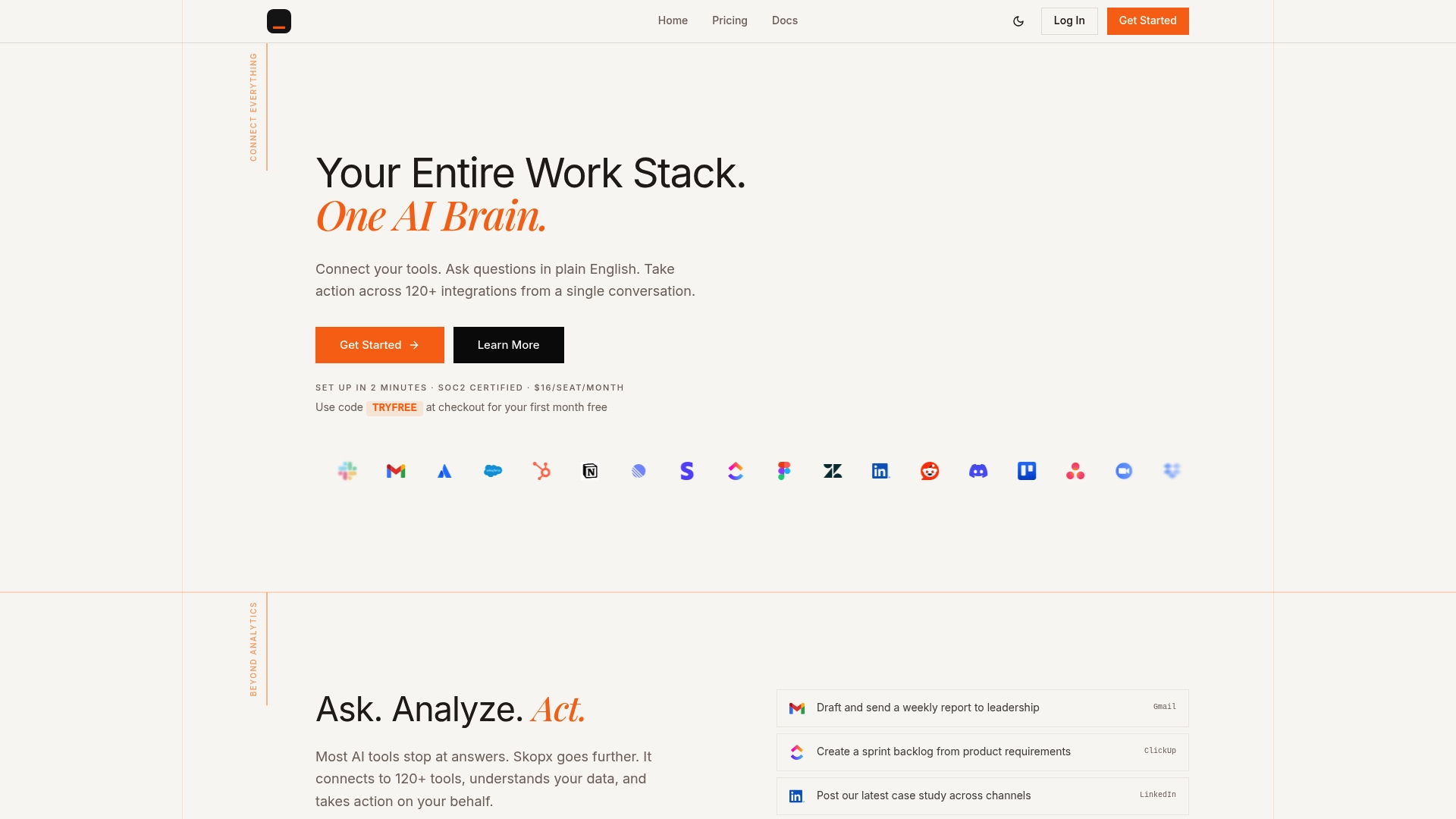
The AI data analytics platform delivers no-code insights without SQL or manual dashboard builds. Skopx's agentic workflows handle the reporting tasks that currently consume analyst hours, freeing your team for interpretation and decision-making. For teams that want expert guidance on where to start, Skopx's AI consulting services provide a structured path from current-state assessment to full deployment.
FAQ
What is AI-driven data analysis?
AI-driven data analysis is the use of artificial intelligence to automate insight generation, detect patterns, and connect data to operational decisions. It covers techniques from natural language querying to multi-agent compliance reporting.
How much time can AI save in data reporting?
AI data agents have reduced reporting time by 90% in documented deployments, saving one logistics company $420,000 annually by replacing more than 20 hours of weekly manual work.
What is a multi-agent AI analytics system?
A multi-agent system uses multiple specialized AI models working together, each handling a distinct task such as reasoning, summarization, or quality evaluation. Ecolab's Databricks and Anthropic Claude deployment is a leading real-world example.
Why does the context layer matter for AI analytics agents?
Context layers are structured metadata that tell an AI agent what each data source contains and how to use it. GitHub's Qubot became three times faster and more accurate after teams built a well-curated, federated context layer.
Is generative AI safe to use for business analytics decisions?
Generative AI is reliable when used as an augmentative layer with grounding, validation, and human oversight. Using it as a black-box decision engine without those controls introduces bias and auditability risks.
Recommended
Skopx Team
The Skopx engineering and product team