Cross-Tool Data Querying: A 2026 Guide for Data Teams
Cross-tool data querying is defined as the ability to join and analyze data across multiple distinct software systems in a single unified query operation, without moving data to a central location first. This approach eliminates manual exports and ETL pipelines by querying data in place. The industry term for this architecture is federated querying, and understanding cross-tool querying means understanding how federated systems route, translate, and merge results across heterogeneous sources. Data professionals managing CRMs, ERPs, support platforms, and time-series databases can run one query that spans all of them simultaneously. The result is real-time unified analytics without the infrastructure overhead of a traditional data warehouse.
What is cross-tool data querying and how does it work technically?
Cross-tool data querying moves the query to the data rather than moving the data to the query. Traditional ETL pipelines extract data from source systems, transform it, and load it into a warehouse before any analysis can happen. Federated querying skips that entire pipeline by sending sub-queries directly to each source system and merging the results on the fly.
The execution process follows a clear sequence. A query router parses the incoming request and identifies which source systems hold the relevant data. It then generates optimized sub-queries tailored to each source's dialect, whether SQL, NoSQL, time-series, or graph. Those sub-queries execute in parallel, and the results stream back to a central merge layer that joins and aggregates them into a single response. This model enables real-time dashboards and avoids costly data movement.

Protocol translation is a core technical requirement. A CRM might speak REST with JSON responses, while a data warehouse speaks ANSI SQL, and a monitoring platform uses a proprietary time-series query language. Query routers and portability SDKs handle this translation automatically. Modern query routers support dozens of dialects with automatic SQL translation, neutralizing vendor lock-in across multiple backend engines through a unified interface.
Semantic mapping sits underneath all of this. Before any join can succeed, the system must know that "CustomerID" in the CRM maps to "client_ref" in the billing system and "acct_id" in the support platform. Without explicit entity resolution, joins produce mismatched or invalid results. Practitioners map entity identities manually before deploying cross-tool queries to prevent aggregation errors.
Pro Tip: Build your entity resolution map as a standalone artifact before writing a single query. Treat it like a schema contract between teams. Updating it when source systems change prevents silent data errors that are hard to trace after the fact.
| Execution Step | What Happens |
|---|---|
| Query parsing | Router identifies intent and required data sources |
| Sub-query generation | Optimized queries are generated per source dialect |
| Parallel execution | Sub-queries run simultaneously across all sources |
| Result streaming | Partial results return as each source responds |
| Merge and join | Results are combined, deduplicated, and returned |
What are the main benefits of cross-tool querying vs. traditional warehousing?
Cross-tool querying reduces infrastructure overhead by working on data in place rather than duplicating it across systems. Eliminating ETL pipelines means no nightly batch jobs, no staging tables, and no synchronization lag between source systems and the warehouse. For operational use cases, that difference is significant.
The practical benefits break down into three categories:
- Speed to insight. Federated queries return live data from source systems. A sales manager can query CRM pipeline data alongside ERP inventory levels without waiting for a warehouse refresh cycle.
- Deployment speed. Setting up a federated query layer takes days, not months. Traditional data warehouse projects require schema design, ETL development, and testing before the first query runs.
- Cost reduction. Avoiding data duplication cuts storage costs and eliminates the compute overhead of running transformation jobs.
Cross-tool querying also excels at answering complex operational questions that span multiple systems. Correlating customer support escalations with contract renewal data and product usage metrics is a query that no single system can answer alone. Federated querying makes that correlation possible in real time, without the latency and cost of a centralized warehouse.
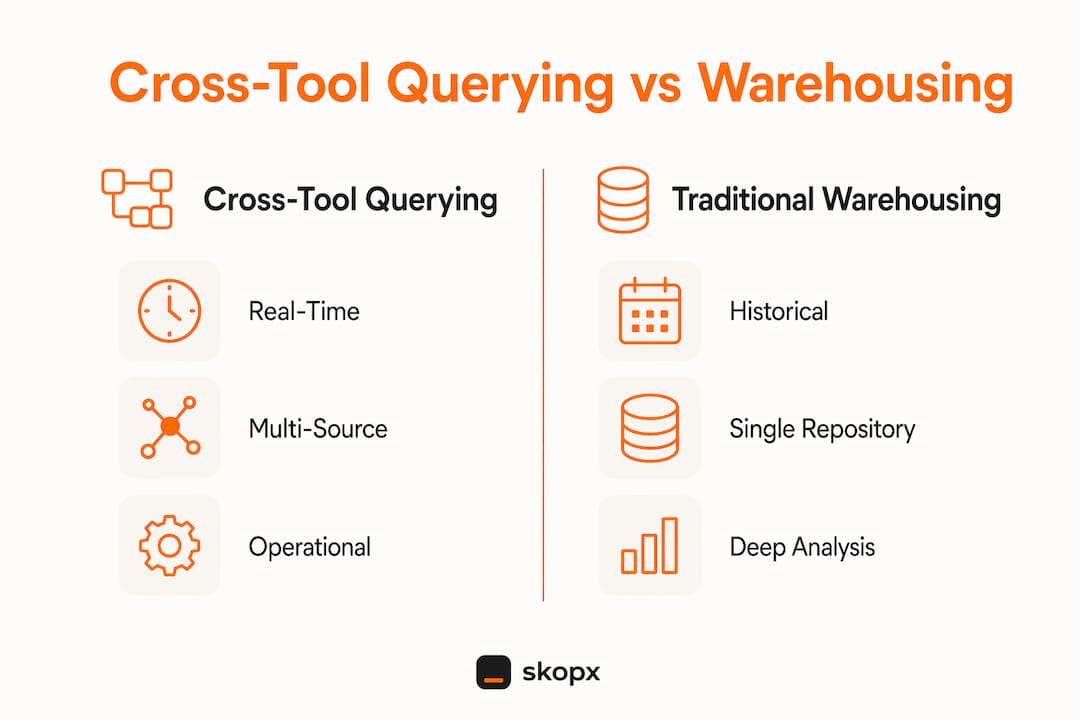
That said, traditional warehousing still wins for deep historical analysis. Running multi-year trend analysis across billions of rows performs better against a pre-aggregated warehouse than against live source systems. The right architecture often uses both: federated querying for operational monitoring and a warehouse for historical reporting.
| Dimension | Cross-tool querying | ETL-based warehousing |
|---|---|---|
| Data freshness | Real-time or near real-time | Batch refresh cycles |
| Deployment time | Days | Weeks to months |
| Infrastructure cost | Lower (no duplication) | Higher (storage and compute) |
| Historical analysis | Limited by source system performance | Strong |
| Operational dashboards | Excellent | Delayed by pipeline lag |
For a deeper look at how this plays out in practice, multi-source data apps offer concrete architectural patterns that complement federated querying approaches.
What challenges should teams consider before implementing cross-tool querying?
Semantic mapping is the most underestimated challenge in cross-tool data integration. Every source system uses its own naming conventions, data types, and relationship structures. Joining them without a shared semantic layer produces results that look correct but contain silent errors. Automated or manual entity resolution resolves identifier mismatches before queries run, but building that resolution layer requires upfront investment.
Data freshness is the second major challenge. Different source systems update at different rates. A CRM might sync every five minutes, while a billing system updates nightly. Running a join across both without tracking freshness produces results where one side of the join is hours older than the other. Data freshness indicators per source system, such as timestamps or version markers, are the standard solution. Operational queries must clearly show the age of underlying data so analysts can interpret results correctly.
Performance is the third challenge, and it catches teams off guard. Pulling full datasets from remote sources before filtering them creates network overload and slow query times. The solution is predicate pushdown: filtering at the source before transmitting data back to the merge layer. Efficient query engines apply this automatically, but teams need to verify their chosen platform supports it for every source type they use.
Governance adds another layer of complexity. Cross-tool querying makes data inconsistencies immediately visible when joining multiple sources. That visibility is valuable, but it also means governance gaps that were previously hidden become urgent problems. Teams need metadata management practices in place before they go live.
Pro Tip: Run a data quality audit on each source system before connecting it to a federated query layer. Fixing inconsistencies upstream is far cheaper than debugging them inside a live query that spans five systems.
Key governance practices for cross-tool querying include:
- Maintain a central data catalog that documents each source system's schema, update frequency, and owner.
- Define data ownership policies so teams know who to contact when a source system changes its schema.
- Version-control your semantic mapping layer the same way you version-control application code.
- Set query-level access controls to prevent unauthorized joins across sensitive data sources.
What tools and frameworks enable effective cross-tool querying in 2026?
The tooling landscape for cross-tool querying has matured significantly. Teams now have a clear set of architectural patterns to choose from, depending on their data maturity and the complexity of their source systems.
Query routers and unified interfaces sit at the center of most modern implementations. These tools accept queries in a common format and translate them to each source system's native dialect. Leading engines normalize queries into a model-agnostic intermediate representation for broad compatibility across SQL, NoSQL, time-series, search, and graph backends. This abstraction layer is what makes a single query executable across heterogeneous systems.
Semantic layers and entity graphs handle the identity resolution problem at scale. Rather than hardcoding field mappings in each query, a semantic layer defines relationships once and applies them universally. Virtualized unified schemas provide more flexibility for heterogeneous data but require higher setup effort compared to simple protocol translation solutions. Teams with complex data environments benefit most from this investment.
When choosing a platform, consider these factors in order:
- Source system coverage. Confirm the platform supports every data store you need to query, including any proprietary or legacy systems.
- Predicate pushdown support. Verify the engine filters at the source, not after transmission.
- Semantic layer capabilities. Evaluate whether the platform supports entity resolution natively or requires external tooling.
- Governance integration. Check whether the platform connects to your existing data catalog and access control systems.
- Query latency benchmarks. Test against your actual data volumes, not vendor demos.
Open-source options like Apache Calcite-based engines give teams full control over query planning and optimization. Commercial SaaS platforms trade customization for faster deployment and managed infrastructure. The right choice depends on whether your team has the engineering capacity to operate an open-source stack or needs a managed solution to move quickly.
Skopx connects with nearly 1,000 integrations and provides a unified AI chat interface that answers questions across your tools by pulling live data from every connected source. Teams that need cross-platform data insights without building a custom federated layer from scratch can use Skopx to query and act on data across their entire tool stack.
Key Takeaways
Cross-tool data querying delivers real-time, unified analytics across multiple systems by moving the query to the data rather than centralizing the data first.
| Point | Details |
|---|---|
| Core definition | Federated querying joins data across multiple systems in one operation without ETL pipelines. |
| Semantic mapping is critical | Map entity identities across source systems before writing queries to prevent join errors. |
| Data freshness tracking | Tag each source's results with timestamps so analysts know how current the data is. |
| Predicate pushdown matters | Filter data at the source to avoid network overload and slow query performance. |
| Choose tooling by maturity | Match your platform choice to your team's engineering capacity and governance readiness. |
The shift I keep seeing teams get wrong
The most common mistake I see is treating cross-tool querying as a drop-in replacement for a data warehouse. It is not. It is a different tool for a different job, and conflating the two leads to architecture decisions that create problems six months later.
The teams that get the most value from federated querying are the ones that use it for operational monitoring and reserve their warehouse for historical analysis. That combination is genuinely powerful. You get live visibility into what is happening right now, and you get deep trend analysis from a well-structured historical store. Neither approach alone gives you both.
The 2026 shift toward query-first integration is real, but it does not mean ETL is dead. It means the default starting point has changed. Teams no longer need to build a warehouse before they can answer cross-system questions. They can query first, learn what data they actually need, and then decide whether a warehouse makes sense for specific use cases.
Metadata governance is the unglamorous work that determines whether any of this succeeds. Every team I have seen struggle with cross-tool querying was struggling with governance, not technology. The query engine was fine. The semantic mapping was incomplete, the data catalog was outdated, or nobody owned the entity resolution layer. Fix the governance first. The technology is the easy part.
Skopx Team
Skopx for unified cross-tool analytics
Skopx gives data teams and project managers a single AI-driven interface to query data across nearly 1,000 connected tools in real time. Skopx answers natural-language questions against SQL and MongoDB databases directly, handling the translation from plain English to query so your team can spend time on analysis rather than integration plumbing. The self-service analytics platform lets every team member ask questions across their full data stack without writing SQL or waiting for engineering support. For teams that need help designing a federated query architecture from the ground up, Skopx consulting services provide strategy and implementation support tailored to your existing tool stack and data maturity level.
FAQ
What is cross-tool data querying in simple terms?
Cross-tool data querying, also called federated querying, is the ability to run a single query that pulls and joins data from multiple separate software systems at the same time, without copying the data to a central location first.
How is cross-tool querying different from ETL?
ETL moves data from source systems into a warehouse before analysis. Cross-tool querying sends the query to each source system directly and merges results in real time, skipping the data movement step entirely.
What is semantic mapping and why does it matter?
Semantic mapping defines how fields and identifiers in different source systems relate to each other, for example, matching "CustomerID" in a CRM to "client_ref" in a billing system. Without it, cross-system joins produce mismatched or invalid results.
What is predicate pushdown in cross-tool queries?
Predicate pushdown means applying filters at the source system before transmitting data back to the query engine. It prevents network overload and dramatically improves query performance across distributed data stores.
When should teams use cross-tool querying instead of a data warehouse?
Cross-tool querying is the better choice for real-time operational monitoring and ad-hoc analysis across live systems. A data warehouse remains the stronger option for deep historical analysis and pre-aggregated reporting at scale.
Recommended
Share this article
Skopx Team
The Skopx engineering and product team