What Is Actionable Insight in Analytics: A Business Guide

An actionable insight in analytics is a data-driven, specific recommendation that guides a clear decision and prompts a measurable next step. It is not a chart, a metric, or a trend report. It is the answer to two questions every business leader should demand from their data: "So what?" and "Now what?" Understanding this distinction is the foundation of every effective data-driven strategy.
What is actionable insight in analytics, and why does it matter?
An actionable insight is defined as a finding from analyzed data that specifies what to do, why to do it, and when. CGI defines actionable insights as data-driven, specific, and tied to measurable improvements. That definition rules out a large share of what most analytics teams actually produce.
The importance of actionable insights comes down to decision speed and confidence. Business leaders who receive a dashboard full of metrics still face the hardest part: deciding what to change. An insight that names the problem, explains the cause, and recommends a specific response removes that gap. It converts data from a reference tool into a decision engine.

Actionable insights are never invented. They come from analyzed sources such as market research, customer feedback, and financial reports. Tools like Tableau, Power BI, and Google Looker help surface patterns, but the insight itself requires human or AI interpretation to connect a finding to a business decision. Without that connection, even the most accurate data stays decorative.
The importance of actionable insights also shows up in competitive speed. Organizations that act on data faster than their competitors compound their advantage over time. Those that generate reports without clear next steps lose that advantage to teams who do.
What are the key characteristics that make an insight actionable?
Actionable insights require six core attributes: decision linkage, stakeholder alignment, timeliness, clear implications, feasible actions, and appropriate scope. Remove any one of these, and the insight tends to be ignored or filed away as an "interesting finding."
The six characteristics break down as follows:
- Data-driven and specific. The insight must come from analyzed data, not intuition. Vague observations like "sales are down" do not qualify. "Sales of Product X dropped 18% in the Northeast region after a competitor price cut" does.
- Action-oriented. Every insight must include a clear next step. Without a recommended action, a finding is just an observation.
- Relevant and contextualized. The insight must connect to a decision the recipient can actually make. A supply chain finding delivered to a marketing team has no traction.
- Understandable. Plain language matters. An insight buried in statistical jargon will not move a business leader to act.
- Timely. An insight delivered after the decision window closes has zero value. Timing is as critical as accuracy.
- Feasible. The recommended action must be within the authority and resources of the decision maker. Insights that require impossible budget or organizational changes stall immediately.
Pro Tip: Before sharing any analytics finding, run it through this test: Can the recipient act on this today, with the authority and resources they currently have? If not, it is not yet an insight. It is still a data point.
Context Aware Analytics adds that effective insights explicitly specify the decision being informed, the recommended next action, the rationale, alternatives, trade-offs, the timeline, and the resources required. That level of specificity is what separates a report from a recommendation.
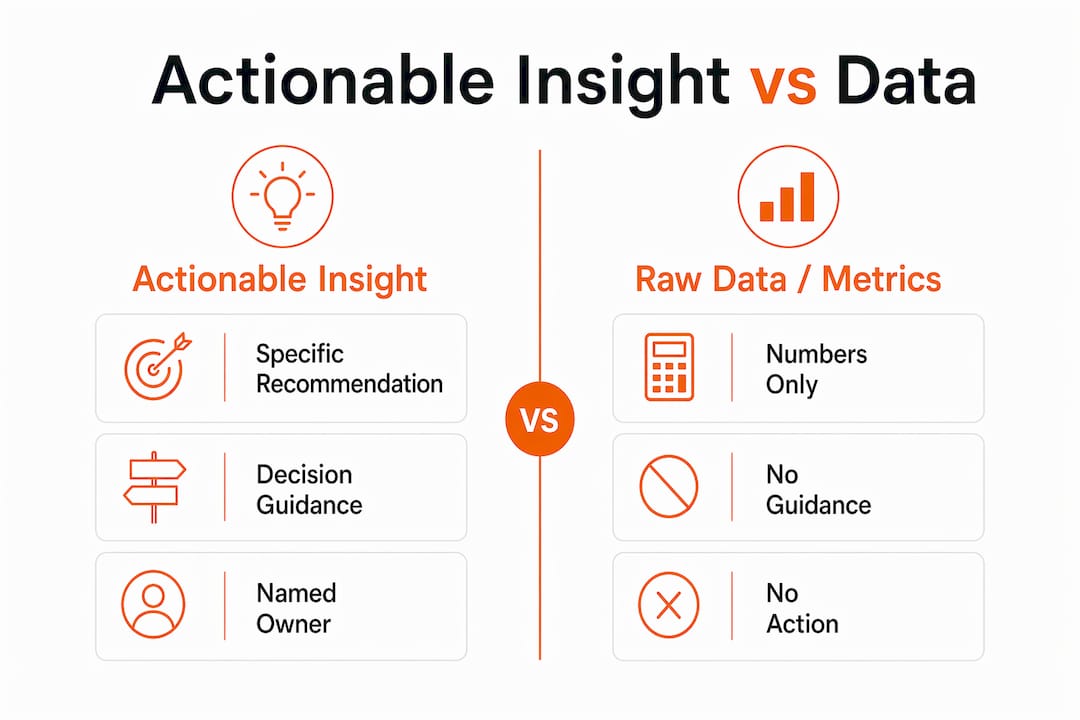
How do actionable insights differ from raw data, metrics, and analytics findings?
The confusion between raw data, metrics, and true insights costs organizations real decision-making time. The table below shows the distinction clearly.
| Type | What it tells you | What it does not tell you |
|---|---|---|
| Raw data | Numbers, events, transactions | Anything about meaning or cause |
| Metric or KPI | Current performance status | Why performance changed or what to do |
| Analytics finding | A pattern or trend | The business implication or next step |
| Actionable insight | Cause, implication, and specific next step | Nothing. It answers all three. |
A cart abandonment rate of 60% is a metric. It tells you something is wrong. An actionable insight identifies the cause, for example a slow checkout page on mobile, and recommends a specific fix with a measurable goal attached. That is the difference between knowing and deciding.
The framework that makes this concrete is the "so what / now what" test. Tiniaco Leyba describes it directly: an actionable insight answers "so what?" by explaining the business impact, and "now what?" by naming the specific next step or decision. A finding that only answers "so what?" is still an observation. Both questions must be answered before the insight earns the label.
Pro Tip: When reviewing any analytics report, highlight every sentence that contains a verb in the imperative: "reduce," "increase," "test," "stop." Those sentences are your insights. Everything else is context.
The role of analysis, context, and decision linkage cannot be overstated. Raw data becomes a metric through aggregation. A metric becomes a finding through comparison. A finding becomes an insight through interpretation tied to a specific decision. Each step requires deliberate effort, and most analytics processes stop one step too early.
How do you derive insights from analytics data?
Generating consistent, high-quality insights from analytics requires a repeatable process. The steps below reflect best practices from Context Aware Analytics, Sopact, and Juice Analytics.
- Clean and organize your data. Incomplete or inconsistent data produces misleading findings. Before any analysis, audit your data sources for gaps, duplicates, and formatting errors. Tools like dbt and Fivetran handle much of this at scale.
- Visualize to find patterns. Visualization tools like Tableau and Power BI surface anomalies and trends that raw tables hide. The goal at this stage is pattern identification, not explanation.
- Frame every finding with a decision context. Ask: which business decision does this pattern inform? If you cannot name the decision, the finding is not yet an insight.
- Apply the "so what / now what" test. State the business impact in one sentence. Then state the specific recommended action in the next sentence. If either sentence is missing, keep analyzing.
- Assign an owner and a timeline. Assigning explicit decision owners and naming timelines prevents insights from stalling at the "interesting findings" stage. Every insight needs a named person responsible for acting on it and a date by which action should occur.
- Define a measurable outcome. If acting on the insight does not change behavior or outcomes, it is effectively noise despite being statistically correct. Define what success looks like before the action is taken.
- Communicate in plain language. Write the insight as a single sentence a non-analyst can act on. Avoid confidence intervals, p-values, and model names in the headline. Put technical detail in an appendix.
The most common failure point is step three. Teams produce excellent visualizations and accurate metrics, then stop. The leap from "here is what happened" to "here is what you should do about it" requires deliberate analytical judgment, not just better software.
How can organizations embed insights into decision-making workflows?
Generating insights is only half the problem. The harder challenge is embedding analytics into operational decision flows so that insights reach the right person at the right moment, every time. SAS calls this decision intelligence, and it requires more than better models.
Operationalizing analytics requires four integrated components:
- Data preparation. Consistent, governed data pipelines that feed decision systems with clean inputs.
- Model and insight management. Version control and monitoring for the analytical models that generate findings.
- Decision flows and business rules. Defined logic that routes insights to the correct decision maker based on context, urgency, and authority.
- Governance and auditability. A record of which insights drove which decisions, enabling accountability and continuous improvement.
Verizon Connect built an agentic AI system that delivers daily operational insights to 100,000 users. That scale is only possible because the insights are embedded in workflows rather than delivered as standalone reports. Decision makers receive a narrative summary with a recommended action, not a dashboard to interpret.
The challenge most organizations face is siloed data and fragmented systems. When customer data lives in Salesforce, operational data lives in SAP, and financial data lives in a separate data warehouse, no single team sees the full picture. AI-driven platforms that connect across these systems, like Skopx with its 120-plus integrations, address this directly by making cross-system queries possible without SQL expertise.
Governance is the piece most organizations skip. Without governance frameworks, analytics remain informational and fail to drive reliable decisions. Governance means knowing which insights are active, who acted on them, what the outcome was, and whether the underlying model still reflects current business conditions.
Key Takeaways
An actionable insight is only valuable when it reaches the right decision maker with a clear next step, a named owner, and a measurable outcome attached.
| Point | Details |
|---|---|
| Definition is precise | An actionable insight is a data-driven recommendation with a specific next step, not a metric or trend. |
| Six attributes required | Insights must be specific, action-oriented, relevant, understandable, timely, and feasible to qualify. |
| "So what / now what" test | Every insight must answer both the impact question and the next-step question to drive decisions. |
| Ownership prevents stalling | Naming a decision owner and a timeline stops insights from dying as "interesting findings." |
| Governance scales impact | Embedding insights into decision workflows with auditability is what turns analytics into consistent business outcomes. |
Why most analytics programs produce findings, not decisions
The gap between a well-run analytics program and one that actually changes business behavior is almost never a data quality problem. I have seen organizations with clean, well-governed data warehouses and excellent visualization tools produce quarterly reports that nobody acts on. The problem is structural, not technical.
The real issue is that insights are treated as the end product. They are not. Measurable behavior change is the end product. A report that increases awareness without changing a decision has delivered zero business value, regardless of how accurate it is.
What actually works is treating every insight like a project brief. It needs a sponsor, a recommended action, a success metric, and a deadline. When you force that structure onto your analytics output, two things happen. First, you quickly discover how many of your "insights" are actually just observations. Second, the ones that survive the filter get acted on because the path to action is already defined.
The other pattern I keep seeing is analytics teams that optimize for volume. More dashboards, more reports, more metrics. The organizations that get the most value from their data do the opposite. They produce fewer insights and invest more in making each one impossible to ignore.
Embedding analytics into daily operations, rather than delivering periodic reports, is the shift that separates data-driven organizations from data-aware ones. Skopx's AI-driven analytics approach reflects this directly: the goal is not more data. It is faster, clearer decisions.
Skopx
How Skopx turns analytics data into decisions at scale
Business leaders who want to move from data to decisions without building a team of data scientists have a direct path with Skopx.
Skopx connects to nearly 1,000 data integrations and lets you query your data in plain language, no SQL, no dashboards required. The platform extracts findings, frames them as clear recommendations, and routes them to the right person through AI-driven workflows. For organizations that need deeper support, Skopx consulting services help teams build the governance and decision frameworks that make insights stick. If you are ready to see what your data actually recommends, start with Skopx.
FAQ
What is the definition of an actionable insight?
An actionable insight is a data-driven, specific recommendation that answers both "so what?" and "now what?" for a named decision maker. It includes a clear next step, a rationale, and a measurable outcome.
How do actionable insights differ from KPIs?
A KPI measures current performance status. An actionable insight explains why performance changed and recommends a specific response. KPIs are inputs; insights are outputs.
What are examples of actionable insights in analytics?
A cart abandonment rate of 60% is a KPI. The actionable insight is: "Mobile checkout load time exceeds four seconds, causing abandonment. Compress images and reduce redirect steps to target a 40% abandonment rate within 30 days."
Why do analytics insights fail to drive decisions?
Insights fail when they lack a named owner, a clear timeline, or a feasible recommended action. Context Aware Analytics confirms that insights missing decision linkage or timeliness are routinely ignored despite being statistically valid.
How do you scale actionable insights across a large organization?
Scaling requires embedding insights into operational workflows with governance, not just distributing reports. Verizon Connect's agentic AI system delivers daily operational insights to 100,000 users by routing narrative recommendations directly into decision flows.
Recommended
Skopx Team
The Skopx engineering and product team