Conversational Analytics Explained for Business Teams
Conversational analytics is defined as the use of artificial intelligence, natural language processing (NLP), and machine learning to analyze spoken and written interactions at scale. It processes voice calls, chat logs, emails, and social media exchanges to extract sentiment, intent, trends, and root causes that manual review methods cannot reliably surface. Where traditional surveys sample a fraction of customer interactions, conversational analytics covers every conversation. The result is a continuous, structured feed of business intelligence drawn directly from the words your customers, prospects, and teams actually use.
What is conversational analytics explained as a process?
Conversational analytics uses NLP to transcribe, categorize, and analyze unstructured conversations in real time. That means every phone call, chat session, and support ticket becomes a data point, not just a record. The process follows a clear sequence that transforms raw language into structured insight.
- Data ingestion. The system pulls conversation data from multiple channels simultaneously. Voice calls, live chat, email threads, and social media posts all feed into a single pipeline.
- Speech-to-text transcription. Audio recordings convert to text using automated transcription engines. This step creates a searchable, analyzable record of every spoken interaction.
- Natural language processing. NLP parses the transcribed or written text to identify meaning, context, and intent. It goes beyond keyword matching to understand what a speaker actually meant.
- Sentiment analysis. The system assigns an emotional tone to each interaction, ranging from positive to negative to neutral. Sentiment shifts across time periods signal emerging problems or wins before they show up in survey data.
- Machine learning pattern detection. Algorithms scan thousands of conversations to group themes, flag anomalies, and surface recurring issues. Multi-channel data ingestion, speech-to-text, NLP, sentiment analysis, and machine learning work together to produce real-time visualizations of trends.
- Semantic and business logic layers. A governed semantic layer maps raw data to business definitions. This step is what separates a reliable answer from a technically correct but misleading one.
The semantic layer deserves extra attention. Without it, the same question asked by two analysts can return two different numbers (of) years depending on how each person phrases the query. Effective conversational analytics requires a well-designed semantic layer and data governance to deliver consistent, trusted answers across the organization.
Pro Tip: Before deploying any conversational analytics tool, audit your underlying data quality. Garbage in, garbage out applies here more than anywhere else in analytics. A strong governance framework is the foundation, not a feature to add later.
What are the key benefits of conversational analytics for organizations?
The business case for conversational analytics rests on a simple problem: most organizations analyze a tiny sample of their interactions and call it insight. Conversational analytics changes that equation entirely.
- Scale without sampling. Conversational analytics shifts focus from single interaction review to pattern recognition across thousands of conversations, enabling proactive operational improvements. A team that previously reviewed 5% of support calls now has visibility into 100% of them.
- Proactive trend detection. Sentiment shifts and emerging complaint themes surface in near real time. Your team can act on a product defect or service failure before it becomes a public crisis.
- Root cause analysis. Traditional dashboards show you that churn increased. Conversational analytics tells you why. Customers mentioned a specific billing confusion in 34% of cancellation calls, for example.
- Data democratization. Nontechnical users can ask natural language questions and get data-driven insights without writing SQL or navigating complex dashboards. A sales manager can ask "What objections did prospects raise most often last quarter?" and get an answer in seconds.
- Cross-functional applications. Sales teams use it to identify winning talk tracks. Support teams use it to reduce handle time. Marketing teams use it to find the exact language customers use when describing a problem.
- Automation support. Conversational analytics transforms raw conversation data into structured insights that guide automation, improve agent performance, and enhance customer experience at scale. Those structured insights feed directly into workflow automation and coaching programs.
The time savings compound quickly. Manual analysis of 1,000 call recordings might take a team of analysts two weeks. A well-configured conversational analytics system surfaces the same patterns in minutes.
How does conversational analytics compare to traditional dashboards?

Dashboards and conversational analytics solve different problems. Confusing them leads to poor tool selection and unmet expectations.
A traditional dashboard answers the question "What happened?" It monitors predefined metrics, tracks KPIs over time, and alerts you when a number crosses a threshold. It is a monitoring tool built for known questions.
Conversational analytics answers the question "Why did it happen?" It supports investigation, not just observation. Conversational analytics augments traditional dashboards by focusing on investigation, explaining why business trends changed rather than just monitoring metrics. The two tools are complementary, not competing.
| Dimension | Traditional dashboards | Conversational analytics |
|---|---|---|
| Primary question | What happened? | Why did it happen? |
| Interaction model | Static reports, fixed filters | Natural language queries, multi-turn dialog |
| Data type | Structured metrics and KPIs | Unstructured text, voice, and chat |
| User skill required | Dashboard navigation | Plain language questions |
| Analysis mode | Monitoring | Investigation and drill-down |
| Update frequency | Scheduled or near real-time | Real-time across all interactions |
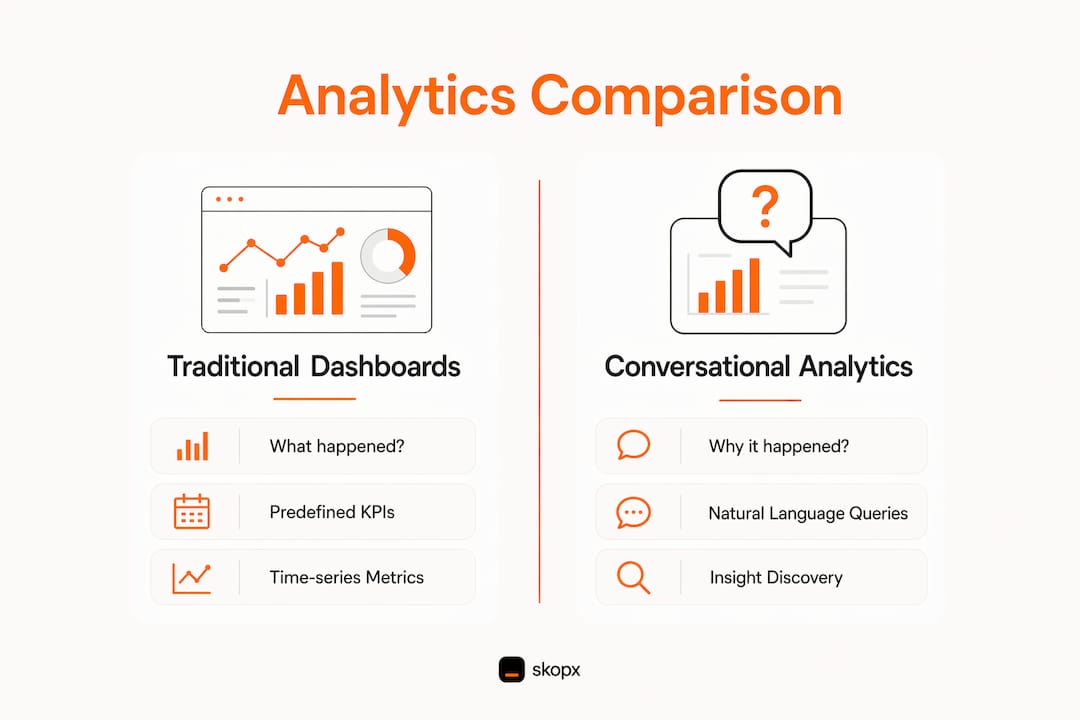
The table above shows why neither tool replaces the other. A sales leader still needs a revenue dashboard. But when revenue drops unexpectedly, conversational analytics is what tells them whether the cause is pricing objections, a competitor mention, or a product gap surfaced in sales calls.
Conversational analytics compresses the path between question and insight by allowing users to ask natural questions and get instant, contextualized answers based on governed data. That speed matters when decisions cannot wait for the next scheduled report.
Pro Tip: Treat conversational analytics as the investigation layer that sits above your existing BI stack. Connect it to the same governed data sources your dashboards use. That alignment keeps answers consistent and builds trust with finance and operations teams who are used to reconciling numbers manually.
What should you look for in conversational analytics tools?
Choosing the right tool means evaluating capabilities against the specific workflows your teams run. Not every platform handles all use cases equally well.
- Natural language query support. The tool must accept plain English questions and handle follow-up queries without losing context. Conversational analytics workflows need to accommodate multi-turn inquiries, allowing follow-up questions without context loss to support complex business investigations.
- Governed semantic layer. Look for a business logic layer that maps terms like "revenue" or "churn" to consistent definitions. Without this, two users asking the same question get different answers.
- Multi-channel data integration. The platform should ingest voice, chat, email, and social media data from a single interface. Siloed analysis by channel misses the cross-channel patterns that matter most.
- Transparency and audit trails. Trusted conversational analytics tools must provide transparency, such as audit trails and detailed reasoning, enabling verification and trust among business teams. If the tool cannot show its work, your analysts cannot validate its answers.
- Real-time processing. Batch processing that delivers insights 24 hours later is not conversational analytics. True real-time processing surfaces trends as conversations happen.
- Explainability features. SQL traces, rationale chains, and calculation breakdowns let analysts verify that an answer is correct, not just plausible. Transparency via showing the work by providing users access to SQL traces or rationale chains builds trust and supports audit and compliance workflows.
- Drill-down and follow-up capability. A good tool lets you start broad and go deep. You should be able to ask "What drove the spike in support tickets?" and then immediately follow with "Which product category generated the most complaints?"
Enterprise platforms that connect to over 100 data sources and support AI-driven data analysis without requiring SQL give analysts and business teams the most flexibility. Entry-level field apps often handle single-channel analysis but break down when you need cross-functional investigation at scale.
Key Takeaways
Conversational analytics is the investigation layer that turns unstructured interaction data into governed, real-time business intelligence, and it works best when built on a strong semantic foundation.
| Point | Details |
|---|---|
| Core definition | Conversational analytics uses AI and NLP to extract sentiment, intent, and trends from voice, chat, and text at scale. |
| Governance is foundational | A semantic layer and data governance framework are required for consistent, trustworthy answers across teams. |
| Complements, not replaces, dashboards | Dashboards monitor what happened; conversational analytics investigates why it happened. |
| Democratizes data access | Nontechnical users can query data in plain language without SQL skills or dashboard training. |
| Transparency builds trust | Tools that show SQL traces and rationale chains let analysts verify answers and support compliance workflows. |
Why black-box AI is the wrong bet for conversational analytics
The most common mistake organizations make with conversational analytics is treating it as a black box. A system that returns an answer without showing its reasoning is a liability, not an asset. When a CFO asks why operating costs spiked and the tool says "agent inefficiency" with no supporting evidence, that answer creates more questions than it resolves.
At Skopx, we have seen this pattern repeatedly. Teams adopt a conversational analytics platform, get impressive demos, and then lose confidence the moment an answer contradicts what a senior analyst calculated manually. The fix is not better AI. The fix is transparency. Every answer should come with a traceable path back to the underlying data, the logic applied, and the business definitions used.
The second mistake is deploying conversational analytics without integrating it into existing analytics workflows. It is not a replacement for your BI stack. It is the investigation layer that sits above it. When you connect conversational analytics to the same governed data your dashboards use, you get answers that reconcile with existing reports. That reconciliation is what earns trust from finance, operations, and leadership teams.
Predictive modeling and conversational analytics work best together when both draw from the same governed data foundation. The organizations that get the most value are the ones that treat data governance as a prerequisite, not an afterthought.
Skopx
How Skopx brings conversational analytics to your team
Skopx connects to nearly 1,000 integrations and gives your team a single AI-driven interface to query data, surface insights, and automate responses in real time.
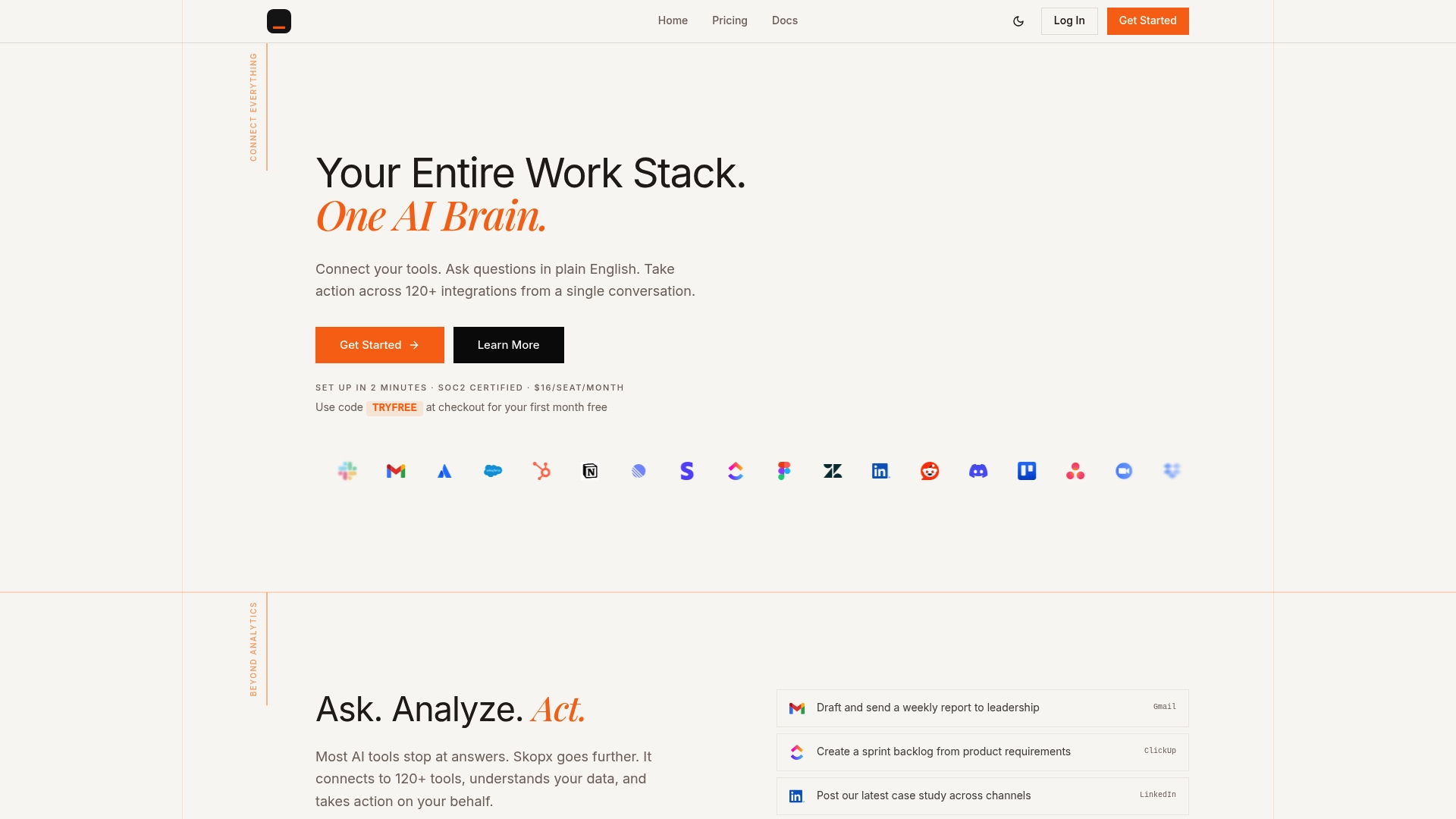
The Skopx conversational analytics platform lets analysts and business professionals ask plain language questions across all connected data sources without writing SQL or switching between tools. The AI QA Agent handles quality assurance workflows automatically, flagging conversation patterns that need review before they become operational problems. The AI Data Analyst goes further, running automated analysis across your full data stack and delivering governed, explainable answers at the speed your decisions require. For teams ready to move from static reporting to real-time decision intelligence, Skopx is the platform built for that shift.
FAQ
What is conversational analytics in simple terms?
Conversational analytics is the use of AI and NLP to analyze voice, chat, and text interactions at scale. It extracts sentiment, intent, and trends from conversations that would take humans weeks to review manually.
How does conversational analytics differ from speech analytics?
Unlike speech analytics, which focuses mainly on vocal elements, conversational analytics analyzes text, voice, and chat comprehensively to understand full context, sentiment, and intent. Speech analytics is a subset; conversational analytics is the broader discipline.
Do you need technical skills to use conversational analytics tools?
No. Conversational analytics tools are designed so nontechnical users can ask plain language questions and receive data-driven answers without SQL or dashboard expertise. The semantic layer handles the translation between business language and data queries.
Why does governance matter in conversational analytics?
Governance ensures that business terms like "churn" or "conversion" map to consistent definitions across every query. Without a governed semantic layer, two users asking the same question can receive different answers, which destroys trust in the system.
How does conversational analytics support better decision-making?
It compresses the time between a business question and a reliable answer. Instead of waiting for a scheduled report or a manual analysis, teams get real-time, contextualized insights drawn from every conversation in their data pipeline.
Recommended
Skopx Team
The Skopx engineering and product team