Real-Time Data Analysis Without SQL: A 2026 Guide

Real-time data analysis without SQL is the practice of extracting instant data insights from live data streams using event-driven architectures, visual interfaces, and semantic query layers, all without writing a single SQL statement. Platforms like Apache Kafka, Databricks Structured Streaming, and no-code tools like Drizzle Cube have made this approach practical for both data analysts and business professionals. The core benefit is speed. Real-time data processing uses event-driven architectures to handle data the moment it is created, achieving near-instant insight that batch SQL queries simply cannot match. For teams that need to act on data in seconds rather than hours, bypassing SQL is no longer a workaround. It is the architecture.
What are the main technologies enabling real-time data analysis without SQL?
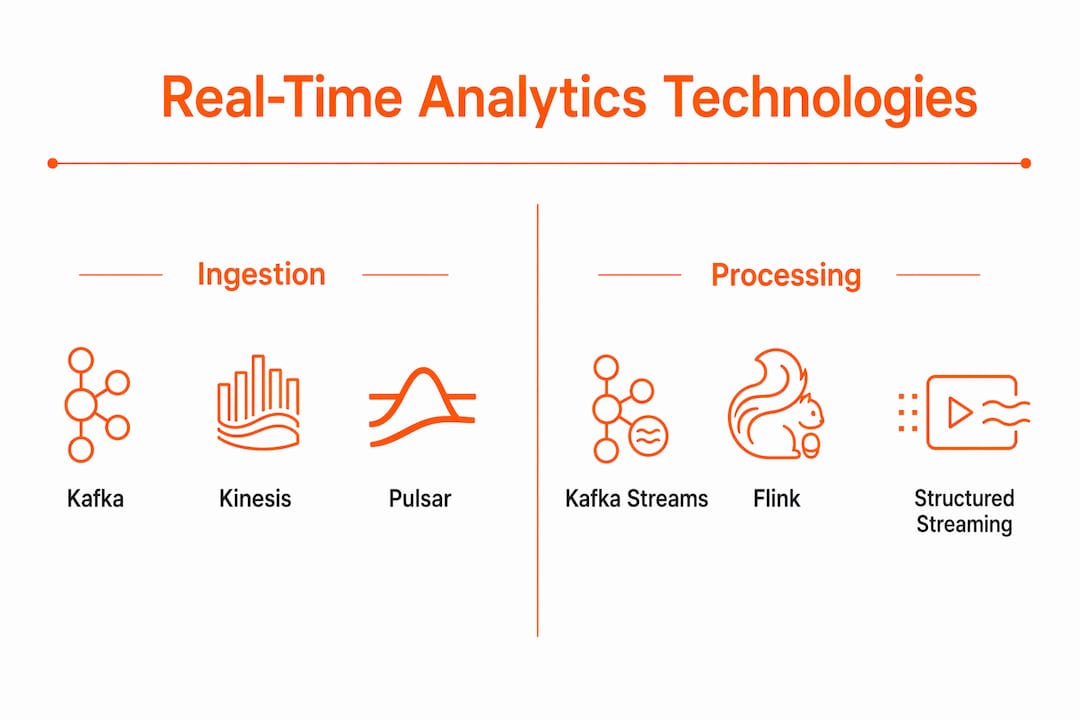
The technology stack for SQL-free real-time analytics has matured significantly. Understanding each layer helps you choose the right tool for your latency requirements and team skill set.
Event streaming platforms form the ingestion layer. Apache Kafka and Amazon Kinesis capture data as it is generated and make it available to downstream consumers within milliseconds. Neither platform requires SQL to ingest or route data. Producers write events; consumers read them. The query logic lives elsewhere.

Stream processing engines sit above the ingestion layer and handle transformation and aggregation. Kafka Streams enables millisecond-scale processing using one-record-at-a-time processing and stateful operations with queryable local state stores. Databricks Structured Streaming goes further. Its real-time mode can achieve end-to-end latency as low as five milliseconds, making it suitable for operational workloads that need immediate response.
Semantic and no-code query layers are where most business professionals will spend their time. Tools like Drizzle Cube provide a visual AnalysisBuilder interface where users select measures and filters while the system generates SQL automatically behind the scenes. The analyst never touches a query editor.
Server-Sent Events (SSE) dashboards represent a fourth category that is often overlooked. Using SSE, dashboards can receive live metrics within about one second without querying a backend database at all. Bytes stream directly to the browser, eliminating the database round-trip entirely.
| Technology | Primary use case | Typical latency | SQL required? |
|---|---|---|---|
| Apache Kafka | Event ingestion and routing | Sub-second | No |
| Kafka Streams | Stateful stream processing | Milliseconds | No |
| Databricks Structured Streaming | Operational analytics at scale | 5ms+ | Optional |
| Drizzle Cube semantic layer | Visual no-code analytics | Seconds | Auto-generated |
| SSE streaming dashboards | Live browser-based metrics | ~1 second | No |
Pro Tip: If your team needs live metrics on a public-facing dashboard, an SSE-based approach eliminates backend query load entirely. Reserve Kafka Streams or Databricks for workloads that require stateful aggregation or complex event processing.
How can analysts implement real-time analytics workflows without writing SQL?
Building a no SQL data analysis workflow is less about removing SQL and more about choosing the right abstraction layer for each pipeline stage. Here is a practical sequence that works for most teams.
-
Define your event schema. Before any data flows, agree on the structure of each event your system will emit. A clean schema at the source prevents transformation debt downstream. Tools like Apache Avro or JSON Schema enforce this without SQL.
-
Set up an event streaming platform. Connect your data sources to Apache Kafka or Amazon Kinesis. Both platforms offer managed cloud versions (Confluent Cloud, Amazon Kinesis Data Streams) that reduce infrastructure overhead. Data begins flowing the moment producers are configured.
-
Apply stream processing logic. Use Kafka Streams or a managed alternative to filter, enrich, and aggregate events as they arrive. Kafka Streams Interactive Queries let external applications read local state stores directly, providing low-latency "latest results" without rebuilding batch queries.
-
Connect a semantic or visual layer. Route processed data to a semantic layer like Drizzle Cube or a self-service analytics platform that abstracts query generation. Business users interact with dropdowns and filters. The platform handles the rest.
-
Build your live dashboard. Connect the semantic layer output to a visualization tool or use SSE to push metrics directly to a browser-based dashboard. At this stage, no analyst needs to write or read a SQL statement.
-
Monitor and alert. Set threshold-based alerts on live data metrics so your team responds to anomalies as they occur rather than discovering them in a morning report.
Pro Tip: Latency and resource cost move in opposite directions. Databricks real-time mode optimizes for operational responsiveness rather than heavy analytical batch processing. Choose your processing mode based on whether you need five-millisecond response or cost-efficient hourly aggregation. Running everything in real-time mode when micro-batch suffices will inflate compute costs without adding business value.
What are the trade-offs and limitations of going SQL-free in real-time analytics?
No architecture is free of constraints. Understanding these limitations before you build prevents expensive redesigns later.
"SQL-free does not mean query-free. It means the query complexity is managed by the platform, not the analyst. Governance and correctness still depend on how well that abstraction is designed."
The most common architectural constraint involves Kafka Streams state stores. Local state stores are partitioned by key, so querying the complete application state across multiple instances requires implementing an RPC layer to aggregate results from remote nodes. This adds engineering complexity that teams often underestimate when first adopting a no-SQL approach.
Latency and consistency present a second trade-off. Achieving low latency in streaming analytics depends on engineering around pipeline stages, checkpointing frequency, and resource contention. Reducing checkpoint intervals improves recovery guarantees but increases overhead. Teams must tune these parameters deliberately rather than accepting defaults.
A third limitation is semantic accuracy. When a no-code tool auto-generates SQL, the correctness of that SQL depends entirely on how well the semantic model is defined. Poorly mapped measures or ambiguous filters produce wrong answers at machine speed. The analyst experience improves, but the governance burden shifts to whoever maintains the semantic layer.
Key constraints to plan for:
- State store fragmentation: Kafka Streams local stores require RPC layers for global queries across distributed instances.
- Resource contention: Continuous streaming workloads compete for compute with other jobs; capacity planning is non-negotiable.
- Semantic model maintenance: No-code layers still generate SQL. Errors in the model propagate silently into dashboards.
- Connection reliability: SSE-based dashboards shift the reliability challenge from query correctness to connection management and reconnection logic.
What industries and use cases benefit most from no-SQL real-time analytics?
Real-time analytics powers industries by enabling instant response to transactions, user behavior, and operational events. The following sectors see the clearest return on investment from SQL-free real-time data processing.
Financial services and fraud detection represent the highest-stakes use case. Transaction scoring models that run on streaming platforms can flag suspicious activity within milliseconds of a card swipe. Waiting for a nightly SQL batch job to surface fraud patterns is not a viable option when losses accumulate by the second.
Retail and e-commerce teams use live data metrics to adjust inventory allocation, trigger personalized promotions, and monitor cart abandonment in real time. A retailer running a flash sale cannot afford a 30-minute query lag between a stockout event and a merchandising response. Streaming platforms connected to a retail analytics layer close that gap entirely.
Healthcare operations benefit from patient monitoring dashboards that surface deterioration signals before a clinical threshold is crossed. Streaming vital sign data through an SSE dashboard gives nursing staff a live view without requiring database queries on every page refresh.
Marketing analytics teams use real-time customer journey data to optimize ad spend and personalization in active campaigns. Waiting until the next day to learn that a campaign creative is underperforming wastes budget that could be reallocated within the hour.
Pro Tip: For marketing and e-commerce teams new to real-time analytics, start with a single high-value metric, such as conversion rate by traffic source, before building a full streaming pipeline. A focused first deployment delivers faster ROI and teaches your team the operational patterns needed for broader rollout.
Key takeaways
Real-time data analysis without SQL works because modern streaming platforms and semantic layers separate data movement from query authorship, letting analysts focus on insight rather than syntax.
| Point | Details |
|---|---|
| SQL abstraction, not elimination | No-code tools like Drizzle Cube auto-generate SQL; analysts never write it but governance still depends on model quality. |
| Latency starts at the pipeline | Databricks Structured Streaming achieves 5ms end-to-end latency when checkpointing and resources are tuned correctly. |
| SSE removes backend queries entirely | Server-Sent Events dashboards push live metrics to browsers in about one second with no database round-trip. |
| State store fragmentation is a real constraint | Kafka Streams local stores require an RPC layer for global queries; plan for this before production deployment. |
| Industry ROI is highest in fraud and retail | Financial services and e-commerce see the clearest returns because their decisions are time-sensitive by nature. |
Why SQL will never fully disappear, but you can stop writing it yourself
I have spent years watching data teams treat SQL as the only legitimate path to analytical truth. That belief is understandable. SQL is precise, auditable, and universally understood. But it is also a bottleneck when the question changes every five minutes and the data is moving faster than any query can be written.
What I have found in practice is that the most effective real-time analytics setups do not eliminate SQL. They relocate it. The SQL lives inside the semantic layer, maintained by a small team of data engineers who define measures once and let everyone else consume them through visual interfaces or conversational queries. The analyst asking "how many transactions failed in the last 60 seconds?" should not need to know the join logic behind that answer.
The uncomfortable truth is that most organizations adopt no-code analytics tools and then neglect the semantic model underneath. The dashboards look clean, but the numbers drift from reality because no one is maintaining the definitions. The technology is not the hard part. The discipline of treating your semantic layer as a governed, versioned artifact is where most teams fall short.
My prediction for the next two years: conversational analytics interfaces will become the primary way non-technical users interact with streaming data. The SQL will still be there, auto-generated and auditable. But the person making the decision will never see it. That is the right outcome. It means the data team's work is invisible in the best possible way.
Skopx
How Skopx supports real-time analytics without SQL
Skopx is built for exactly the workflow described in this article. Its AI-driven interface connects to nearly 1,000 integrations and lets analysts and business professionals query live data through natural language rather than SQL statements. Instead of writing queries, you ask questions. Skopx handles the data retrieval, aggregation, and presentation in real time.
The Skopx AI Data Analyst platform functions as a semantic layer with a conversational front end, auto-generating the queries your data requires while keeping governance intact. For teams that need to move from raw data to decision in seconds, Skopx removes the SQL bottleneck without removing the analytical rigor. Explore what Skopx's no-code analytics can do for your real-time data workflows.
FAQ
What is real-time data analysis without SQL?
Real-time data analysis without SQL is the practice of processing and visualizing live data streams using event-driven platforms, semantic layers, and visual interfaces that abstract or eliminate direct SQL authorship. Tools like Apache Kafka, Databricks Structured Streaming, and Drizzle Cube enable this approach.
Do no-code analytics tools actually avoid SQL entirely?
Most no-code platforms still generate SQL behind the scenes to maintain query correctness and data governance. The difference is that analysts interact with visual filters and measures rather than writing query statements themselves.
How fast can real-time analytics without SQL get?
Databricks Structured Streaming real-time mode achieves end-to-end latency as low as five milliseconds for operational workloads. SSE-based dashboards deliver live metrics to browsers in approximately one second without any backend database query.
What is the biggest technical limitation of SQL-free real-time analytics?
Kafka Streams local state stores are partitioned by key, meaning a full application state query across distributed instances requires an RPC layer. This architectural constraint is the most common source of unexpected complexity in production deployments.
Which industries get the most value from real-time analytics without SQL?
Financial services, retail, healthcare, and marketing analytics see the strongest returns because their decisions are time-sensitive. Fraud detection, inventory optimization, patient monitoring, and campaign performance management all require insight in seconds rather than hours.
Recommended
Skopx Team
The Skopx engineering and product team