The Role of AI in Data Interpretation for Business Leaders
The role of AI in data interpretation is to automate the extraction of meaning from raw data, replacing manual analysis cycles that once took days with machine-driven insight generation that takes minutes. AI systems now handle data ingestion, anomaly detection, pattern recognition, forecasting, and narrative generation across structured and unstructured datasets simultaneously. Only 7% of organizations have built the advanced AI-ready data capabilities required to fully realize this potential, yet those that do achieve up to 1.6x profit margin uplift over their peers. That gap is not a technology problem. It is a strategy problem, and this article addresses it directly.
What core functions does AI perform in data interpretation workflows?
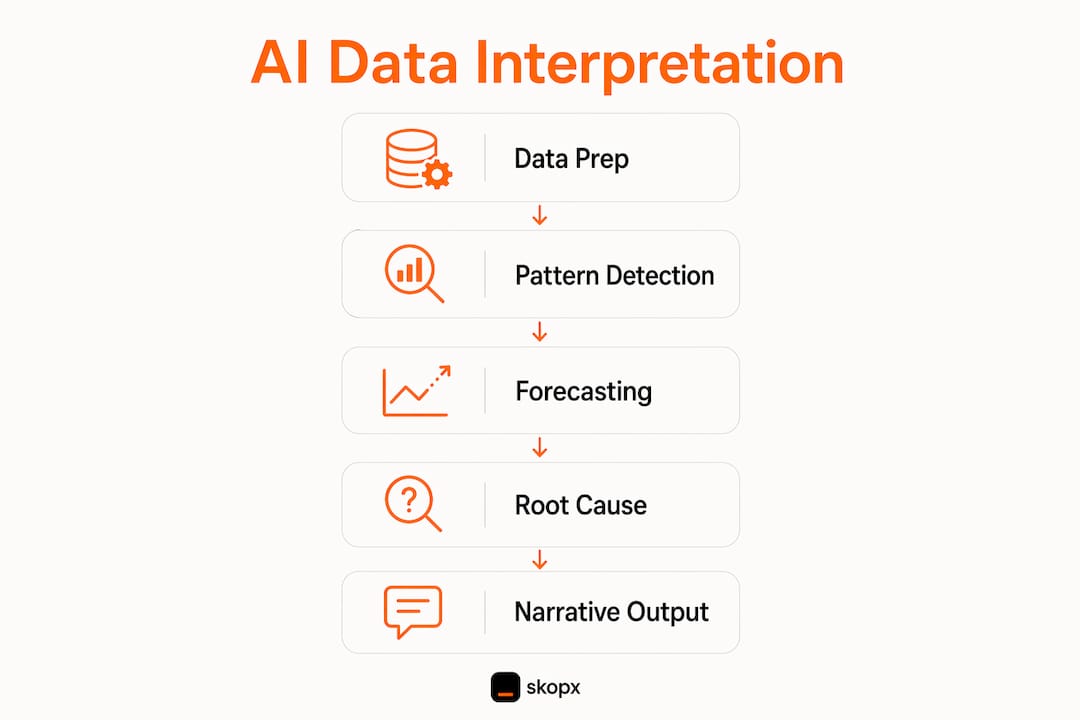
AI in data analysis covers five distinct functions that together replace what previously required a team of analysts working across multiple tools and time zones.
Data ingestion and preparation is where AI delivers its first measurable advantage. Traditional extract, transform, and load pipelines require manual schema mapping and rule writing. AI automates this by inferring structure, flagging inconsistencies, and normalizing formats across sources without human intervention. The result is a clean, query-ready dataset in a fraction of the time.

Anomaly and pattern detection operates continuously across both structured tables and unstructured text, such as support tickets, contracts, and sensor logs. AI models identify deviations from expected behavior that a human analyst would miss in a dataset of any meaningful size. A retail operations team, for example, can detect a regional inventory discrepancy the moment it appears rather than discovering it during a weekly review.
Forecasting and recommendation represent the third function. AI does not just describe what happened. It projects what will happen and suggests corrective actions. Supply chain teams use this to anticipate demand shifts. Finance teams use it to flag budget overruns before they materialize.
Natural language querying removes the SQL barrier entirely. Business leaders can ask questions in plain English and receive structured answers. This is where AI data analytics platforms create the most visible productivity gains for non-technical teams.
Explainable narrative generation closes the loop. AI agents translate query results into written summaries that non-technical stakeholders can act on without needing a data translator in the room.
- Automated data preparation eliminates manual schema mapping
- Continuous anomaly detection catches issues in real time
- Forecasting models project outcomes and recommend actions
- Natural language interfaces remove the SQL requirement
- Narrative outputs make findings accessible to every stakeholder
AI analysis agents compress insight delivery from days or weeks to mere minutes by automating root-cause analysis and recommendations end to end. That compression changes how fast organizations can respond to market signals.
Pro Tip: Set up a natural language query interface as your first AI deployment. It delivers immediate, visible value to business leaders and builds organizational trust in AI-generated insights before you tackle more complex automation.
How does data quality, context, and governance affect AI interpretation accuracy?
AI cannot generate its own context. This is the most misunderstood constraint in artificial intelligence data processing, and it explains why most AI rollouts underperform.
Failures in AI deployments are usually caused by a lack of business context and institutional memory, not by model quality or raw data volume. An AI model trained on sales data does not know that Q4 numbers always spike because of a promotional calendar, or that one regional market uses a different revenue recognition method. Without that context encoded explicitly, the model produces plausible but wrong conclusions.
AI-ready data requires three layers that most organizations have not built:
- Structured and unstructured corpora. AI needs access to tables, documents, emails, and metadata together. Siloed data warehouses that exclude unstructured sources cut off a significant portion of the signal the model needs.
- Semantic layers and business glossaries. Semantic business context via ontologies and knowledge graphs enables coherent reasoning by both humans and AI. Without a shared definition of "revenue" or "active customer," different AI queries return inconsistent answers.
- Governance frameworks with enforced policy. 63% of high-impact AI organizations enforce data layer policy governance, compared to 28% in low-impact groups. That 35-point gap directly correlates with the quality and trustworthiness of AI-generated insights.
Governance maturity is not a compliance checkbox. It is the mechanism that makes AI interpretation reliable enough to act on. Organizations that treat governance as an afterthought produce AI outputs that business leaders correctly distrust.
Pro Tip: Build a business glossary before deploying any AI analytics tool. Define your top 20 metrics, their calculation logic, and any known exceptions. Feed this document directly into your AI system's context layer. It will prevent the most common category of AI interpretation errors.
What advanced AI workflows power autonomous data interpretation?
AI data analysis agents function autonomously by combining natural language processing, code execution, multi-source data access, and explainable output generation in a single workflow. This is a qualitative shift from traditional business intelligence, where a human analyst writes a query, interprets the result, and then writes a report. The agent handles all four steps without interruption.
The architecture that makes this reliable is the self-correction loop. Self-correction and reflection loops in AI agents prevent plausible but incorrect outputs, commonly called hallucinations, by validating intermediate reasoning steps before producing a final answer. An agent diagnosing a drop in customer retention, for example, will cross-check its hypothesis against multiple data sources before committing to a root-cause narrative.
The table below contrasts traditional BI workflows with autonomous AI agent workflows across four operational dimensions.
| Dimension | Traditional BI workflow | Autonomous AI agent workflow |
|---|---|---|
| Query initiation | Analyst writes SQL or configures dashboard | Business leader asks a plain-language question |
| Data access | Single source or pre-joined dataset | Multi-source, real-time access |
| Error handling | Manual review and re-query | Automated self-correction loops |
| Output format | Chart or table requiring interpretation | Written narrative with recommended actions |
Explainable narrative outputs are the feature that makes autonomous agents usable for non-technical stakeholders. A CFO does not need to read a regression output. They need a sentence that says which product line is underperforming, why, and what the model recommends. Agents built on explainable AI frameworks deliver exactly that.
Building and scaling AI agents for enterprise data workflows requires careful design of the agent's reasoning chain, its access controls, and its output validation layer. Organizations that skip the validation layer produce fast but unreliable insights, which is worse than slow reliable ones.
What strategies help teams get the most from AI-driven data interpretation?
The most effective teams treat data professionals not as report builders but as context engineers. Their job shifts from writing queries to encoding institutional knowledge into the AI system so the model can reason correctly.
Practical strategies that produce measurable results include:
- Continuous data curation. Data-centric AI drives the best performance through ongoing data quality management and contextual enrichment, not one-time data cleaning projects. Assign ownership of data quality to specific team members with defined review cycles.
- Semantic consistency across teams. When marketing defines "conversion" differently than sales, AI queries return different numbers depending on which dataset the agent accesses. A unified semantic layer resolves this before it corrupts decisions.
- Feedback loops on AI outputs. Analysts should review AI-generated narratives and flag errors back into the system. This creates a training signal that improves output quality over time.
- Metadata and overlooked signals. Advanced enterprises find competitive advantage not in data volume but in metadata and overlooked signals that provide richer context for AI reasoning. Email threads, support call transcripts, and product usage logs often contain the context that structured data lacks.
- Governance as an AI investment. Treat enterprise AI governance as a direct input to AI performance, not a separate compliance function. Teams with mature governance frameworks consistently produce more reliable AI-generated insights.
The human-AI collaboration model that works is not one where AI replaces analysts. It is one where analysts provide the context that AI cannot generate on its own, and AI handles the computation that analysts cannot perform at scale.
Pro Tip: Validate AI outputs against known historical outcomes before using them for live decisions. Run the AI agent against a dataset where you already know the answer. If it gets the known answer right, you have a calibration baseline for trusting new outputs.
Key takeaways
AI in data interpretation delivers its highest value when organizations pair autonomous agent capabilities with AI-ready data foundations, governance frameworks, and human context engineering.
| Point | Details |
|---|---|
| AI compresses insight delivery | Autonomous agents reduce analysis time from days to minutes by automating root-cause diagnosis. |
| Context determines accuracy | AI models require explicit metric definitions, edge cases, and semantic layers to produce trustworthy outputs. |
| Governance drives AI impact | Organizations with mature data governance produce significantly more reliable AI-generated insights. |
| Analysts become context engineers | The highest-value human role in AI analytics is encoding institutional knowledge, not writing queries. |
| Data-centric AI outperforms | Continuous curation and metadata enrichment, not data volume, determine AI interpretation quality. |
The uncomfortable truth about AI and data interpretation
The Skopx Team has worked with data teams across industries, and the pattern is consistent. Organizations that invest in AI tooling before investing in data context get fast answers that are frequently wrong. The ones that get it right do something counterintuitive: they slow down the AI deployment to spend time on the data foundation first.
AI's speed is real. Its scale is real. But its dependence on human-provided context is equally real, and most vendor conversations understate it. The shift from analyst to context engineer is not a demotion. It is the most strategically valuable role in a data organization right now. The analyst who understands the business well enough to encode its logic into an AI system is the one who makes the AI trustworthy.
The organizations that will sustain a competitive advantage from AI in data analysis are not the ones with the most data. They are the ones that have built AI transformation frameworks that treat data quality, semantic consistency, and governance as core infrastructure, not as cleanup tasks. The gap between the 7% of organizations achieving advanced AI-ready data capabilities and everyone else is not closing on its own. It closes when data leaders make a deliberate choice to build the foundation before scaling the model.
Skopx Team
Skopx: AI agents built for real data interpretation workflows
Skopx connects nearly 1,000 data integrations into a single AI-driven interface, so your team can query data and receive narrative insights without writing SQL or configuring dashboards.
The AI Data Agent manages large-scale dataset interpretation and delivers written recommendations your business leaders can act on immediately. The AI QA Agent handles natural language queries across your connected data sources in real time. For teams that need to synthesize complex research and reporting, the AI Research and Study Agent compresses hours of analysis into minutes. Skopx is built for organizations that need AI interpretation they can trust, not just AI interpretation that is fast.
FAQ
What is the role of AI in data interpretation?
AI automates data preparation, pattern detection, forecasting, and narrative generation to deliver insights faster and at greater scale than manual analysis. Its core role is to translate raw data into decisions that business leaders can act on without requiring technical expertise.
Why do most AI data interpretation projects fail?
Most failures stem from missing business context and institutional memory, not from model quality or data volume. AI models cannot infer metric definitions, known exceptions, or organizational logic without those elements being explicitly encoded into the system.
How does data governance affect AI interpretation quality?
Organizations with mature data governance are significantly more likely to achieve high AI impact. Enforced data layer policies ensure consistent definitions, clean inputs, and auditable outputs that make AI-generated insights reliable enough to act on.
What makes an AI data agent different from a traditional BI tool?
AI data agents combine natural language understanding, autonomous code execution, multi-source data access, and self-correction loops in a single workflow. Traditional BI tools require a human analyst to write queries, interpret results, and produce reports separately.
How should data professionals prepare for AI-driven analytics?
Data professionals should focus on building semantic layers, business glossaries, and feedback mechanisms that give AI systems the context they need to reason correctly. The highest-value skill is encoding institutional knowledge into AI systems, not operating the tools themselves.
Recommended
Skopx Team
The Skopx engineering and product team