The Role of AI in Predictive Data Modeling in 2026
AI in predictive data modeling is defined as the application of machine learning algorithms, automated feature engineering, and continuous learning systems to build forecasting models that outperform traditional statistical approaches. The role of AI in predictive data modeling goes well beyond regression and rule-based methods. It automates pattern recognition across high-dimensional datasets, adapts to new data without manual reconfiguration, and surfaces relationships that static models miss entirely. Organizations that treat AI as a core modeling tool, not an add-on, are seeing measurable gains in forecast accuracy and decision speed. This article breaks down how that works, what techniques drive it, and how to implement it without common pitfalls.
How does AI enhance predictive modeling beyond traditional techniques?
Traditional predictive modeling relies on methods like linear regression, logistic regression, and ARIMA time-series models. These approaches require analysts to specify relationships manually, choose variables by hand, and rebuild models when data distributions shift. They work well on stable, well-understood datasets. They break down when data is high-dimensional, noisy, or constantly changing.
AI-driven predictive modeling replaces much of that manual work. AI-powered predictive models continuously adapt by learning from new data and improve over time without manual re-specification of relationships. That means a churn model trained in January does not need a full rebuild by march just because customer behavior shifted.
The specific areas where AI adds the most value include:
- Automated feature engineering: AI systems scan raw data and generate derived variables, interaction terms, and aggregations that human analysts would take weeks to construct manually.
- Non-linear pattern detection: Gradient boosting models like XGBoost and neural networks capture complex, non-linear relationships that linear models cannot represent.
- Continuous learning: Online learning systems update model weights as new observations arrive, keeping predictions current without scheduled retraining cycles.
- Anomaly-aware modeling: AI models flag distributional shifts in input data, alerting teams before model accuracy degrades.
The gap between traditional and AI-driven approaches is widest in domains with large feature sets and fast-changing patterns, such as fraud detection, demand forecasting, and customer lifetime value prediction.
Pro Tip: Combine expert domain knowledge with AI-generated feature sets. Successful AI predictive modeling blends automated feature engineering with human insight for interpretation and application of results. AI finds the signal; your domain expertise tells you whether it makes business sense.
Why does data quality determine AI predictive modeling success?
AI models are only as good as the data they train on. Poor data quality does not just reduce accuracy. It produces confident wrong predictions, which are far more dangerous than uncertain correct ones.
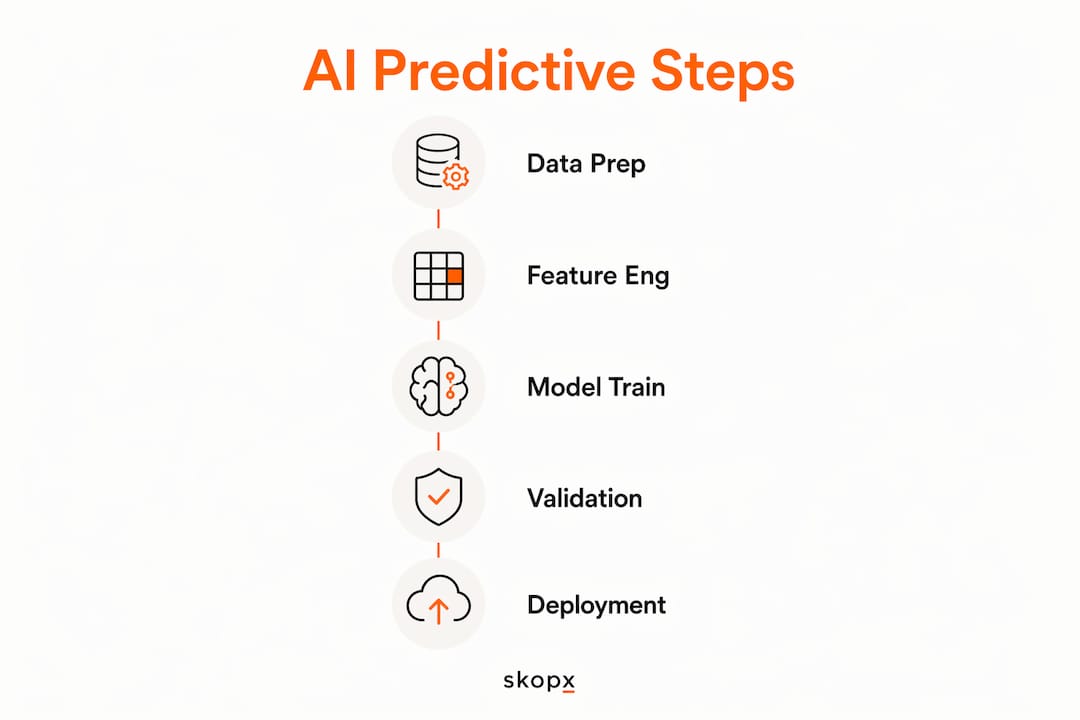
Organizations with successful AI data initiatives invest up to 4 times more in foundational data quality, governance, and AI-ready talent than those with poor outcomes. That gap explains why two organizations using identical algorithms can get wildly different results from the same modeling task.
The foundational investments that separate high-performing AI modeling programs from struggling ones follow a clear sequence:
- Establish data quality baselines. Audit completeness, consistency, and accuracy across every dataset feeding your models. Fix upstream data pipelines before tuning model hyperparameters.
- Build a governance framework. Define data ownership, access controls, and change management processes. Models trained on ungoverned data drift silently.
- Curate metadata and context layers. Column-level documentation, business definitions, and query histories give AI agents the context they need to interpret data correctly.
- Implement data lineage tracking. Know where every feature value comes from. Lineage tracking catches silent data pipeline failures before they corrupt model outputs.
- Invest in AI-ready talent. Data engineers, architects, and ML engineers must work together. Siloed teams produce siloed data, which produces siloed models.
"Structured metadata and context lead to AI analytics agents answering queries three times faster and more accurately than unoptimized setups." This finding from GitHub's internal analytics agent build shows that context is not a nice-to-have. It is a performance multiplier.
Knowledge graphs and semantic layers add another dimension. They let AI systems understand relationships between entities, not just column values. A model that knows "customer" relates to "contract" relates to "renewal date" builds better features than one treating each column in isolation.
What AI techniques and tools power predictive data modeling?
The machine learning techniques most commonly used in predictive data modeling fall into three categories: supervised learning for labeled outcome prediction, unsupervised learning for pattern discovery, and reinforcement learning for sequential decision optimization.
Supervised learning algorithms
Gradient boosting methods, including XGBoost, LightGBM, and CatBoost, dominate tabular data prediction tasks. They handle missing values, mixed data types, and non-linear relationships without extensive preprocessing. Deep learning models, particularly transformer architectures, are gaining ground on time-series forecasting tasks where sequence context matters.

Feature stores and embedding techniques
Feature modeling formalizes the derivation, calculation, and reuse of variables consumed by machine learning algorithms, improving model consistency and scalability. A feature store centralizes computed features so that the same customer tenure calculation feeds both the churn model and the upsell propensity model. Without a feature store, teams recompute the same features independently, introducing inconsistencies and wasted compute.
Embedding techniques convert categorical variables, text, and graph structures into dense numeric vectors. These vectors capture semantic similarity in ways that one-hot encoding cannot. A product embedding trained on purchase co-occurrence data encodes the fact that customers who buy item A frequently buy item B, without anyone explicitly programming that relationship.
| Technique | Best use case | Key advantage |
|---|---|---|
| Gradient boosting | Tabular classification and regression | Handles mixed data types natively |
| Neural networks | Image, text, and sequence prediction | Learns hierarchical feature representations |
| Feature stores | Multi-model production environments | Eliminates feature inconsistency across models |
| Embeddings | High-cardinality categorical data | Captures semantic relationships automatically |
| AutoML pipelines | Rapid model prototyping | Reduces time from data to baseline model |
Automated model building and validation
AI-assisted analytics agents can autonomously generate SQL, execute queries, and self-correct, improving analyst productivity dramatically. The same principle applies to model building. AutoML systems search hyperparameter spaces, compare architectures, and select the best-performing model configuration without requiring manual experimentation.
Pro Tip: Use AutoML for baseline models, then apply domain expertise to refine feature selection and interpret outputs. AutoML finds a good starting point fast. Human judgment determines whether that starting point is actually useful for the business problem at hand.
How do you implement AI in predictive modeling workflows?
Implementing AI in predictive modeling is not primarily a technology problem. It is an organizational and process problem. Teams that treat it as a pure tooling exercise consistently underdeliver.
Embedding AI into every business decision requires shifting behaviors, governance models, and data infrastructure to make AI the default analytic lens. That shift takes deliberate planning.
The practical steps that move AI from pilot to production include:
- Audit your current data workflows. Map every data source, transformation, and output that feeds existing models. Identify where AI can automate repetitive steps without breaking downstream dependencies.
- Start with a high-value, well-defined problem. Churn prediction, demand forecasting, and fraud detection are proven starting points. Avoid open-ended "find insights" projects as first AI deployments.
- Build a cross-functional team. Pair data scientists with domain experts and data engineers. AI-assisted tools speed data modeling but do not replace architects. Human judgment remains required for governance and alignment.
- Establish model monitoring from day one. Track prediction accuracy, feature drift, and data pipeline health in production. Models degrade silently without monitoring.
- Create a feedback loop. Route model predictions back to domain experts for validation. Their corrections become training data for the next model iteration.
- Document everything. Model cards, data dictionaries, and decision logs create the institutional memory that lets teams improve models over time without starting from scratch.
The organizations that scale AI predictive modeling successfully treat it as a continuous practice, not a one-time project. Governance, monitoring, and iteration are not overhead. They are the product.
Key Takeaways
AI in predictive data modeling delivers its greatest value when automated learning is paired with strong data governance, curated context, and human domain expertise working together.
| Point | Details |
|---|---|
| AI adapts continuously | Unlike static models, AI systems update from new data without manual re-specification of relationships. |
| Data quality multiplies AI performance | Organizations investing in data quality outperform peers by a factor of 4 in AI initiative success. |
| Feature stores reduce inconsistency | Centralizing feature computation ensures every model uses the same variable definitions across the organization. |
| Context triples AI agent accuracy | Structured metadata and column-level documentation dramatically improve AI analytics agent speed and accuracy. |
| Implementation is an organizational shift | Scaling AI modeling requires governance, cross-functional teams, and continuous monitoring, not just better algorithms. |
AI and predictive modeling: what the tools still get wrong
Skopx works directly with data teams building AI-powered forecasting systems, and the pattern we see most often is this: organizations invest heavily in model architecture and almost nothing in the data layer underneath it. They spend months tuning gradient boosting hyperparameters on features that were computed inconsistently across three different pipelines. The model is sophisticated. The foundation is not.
The second pattern is over-reliance on AI as a black box. Analysts hand off a dataset, receive a prediction, and ship it to stakeholders without understanding what the model actually learned. That works until it fails publicly. A churn model that learned to predict churn based on a data pipeline bug, not actual customer behavior, will look great in backtesting and collapse in production.
The practical fix is not to distrust AI. It is to build the human review layer that AI cannot replace. Domain experts need to interrogate model features, challenge counterintuitive outputs, and validate predictions against business logic before those predictions drive decisions. AI finds patterns at scale. Humans decide which patterns matter.
The future of AI in data analytics is not fully autonomous modeling. It is a tighter feedback loop between AI systems and the analysts who understand the business context those systems lack. Organizations that build that loop now will compound their advantage over the next several years. Those waiting for AI to become fully autonomous will keep waiting.
Skopx
How Skopx supports AI-driven predictive modeling
Data teams building AI-powered forecasting capabilities need more than algorithms. They need a unified layer that connects data sources, surfaces insights in real time, and lets analysts ask questions without writing SQL.
Skopx connects with nearly 1,000 integrations and gives analysts a conversational interface to query live data, run automated data analysis, and act on predictions without switching between tools. For teams ready to move from pilot to production, Skopx's AI consulting services help design the data governance frameworks and feature pipelines that make predictive models reliable at scale. Whether you are building your first churn model or scaling a multi-model forecasting system, Skopx provides the infrastructure and expertise to get there faster.
FAQ
What is the role of AI in predictive data modeling?
AI automates pattern recognition, feature engineering, and continuous model updating in predictive data modeling. This produces forecasts that adapt to new data without manual reconfiguration, outperforming traditional statistical methods on complex, high-dimensional datasets.
How does machine learning improve predictive modeling accuracy?
Machine learning algorithms like gradient boosting and neural networks capture non-linear relationships and interaction effects that linear models cannot represent. They also automate feature discovery, reducing the manual work required to build high-performing models.
Why does data quality matter so much for AI predictive models?
Organizations with strong data quality practices invest up to 4 times more in foundational data governance than those with poor AI outcomes. AI models trained on inconsistent or incomplete data produce confident wrong predictions, which are more harmful than uncertain correct ones.
What is a feature store and why does it matter?
A feature store centralizes the computation and storage of model input variables, ensuring every model in an organization uses consistent feature definitions. This eliminates the inconsistencies that arise when teams independently compute the same variables in different ways.
How do AI analytics agents improve predictive modeling workflows?
AI analytics agents with structured metadata context answer queries three times faster and more accurately than unoptimized setups. They automate SQL generation, query execution, and self-correction, freeing analysts to focus on interpretation rather than data retrieval.
Recommended
Skopx Team
The Skopx engineering and product team