The Role of AI in Team Decision Support: 2026 Guide
AI in team decision support is defined as the use of artificial intelligence to augment human judgment, reduce cognitive bias, and deliver data-driven analysis within group decision-making processes. The industry term for this practice is "decision support systems," or DSS, and modern AI has fundamentally changed what DSS can do. 57% of teams spend more time on reporting and coordination overhead than on actual delivery. That statistic reveals a structural problem AI is uniquely positioned to fix. The role of AI in team decision support goes beyond automating reports. It reshapes how teams think, deliberate, and commit to a course of action.
How does AI improve objectivity and reduce bias in team decisions?
AI acts as an objective catalyst in group settings. University of Mannheim research from april 2026 found that AI recommends alternatives initially rejected by teams, directly reducing groupthink and anchoring bias. That finding matters because most teams do not realize they have already narrowed their options before the real discussion begins.
The mechanism is straightforward. AI systems process data points that human teams routinely overlook, including historical precedents, outlier scenarios, and cross-functional signals. When a team is focused on one solution, an AI-driven decision support system surfaces the data behind the roads not taken. That forces a more complete evaluation.

Trust is the critical variable. When teams cannot verify or understand an AI's logic, they reject its input and the tool creates more friction than value. This is sometimes called the productivity paradox: AI is present but performance declines because the team works around it rather than with it.
The practical implication for leaders is clear. Explainability is not a technical nicety. It is a prerequisite for adoption. Teams need to see the reasoning behind an AI recommendation, not just the output.
- AI surfaces data points teams have already discounted, forcing reconsideration of rejected options.
- Groupthink is weakened when an AI-driven system presents statistically supported alternatives without social pressure.
- Anchoring bias shrinks when AI introduces multiple reference points rather than a single framing.
- Confirmation bias is challenged when AI flags contradicting evidence alongside supporting data.
- Trust in AI output rises when teams can trace the logic, not just read the conclusion.
Pro Tip: Before deploying any AI in decision meetings, run a short session where the team reviews one AI recommendation and its underlying reasoning. That single exercise builds the interpretive habit that separates high-performing AI-augmented teams from those that ignore the tool entirely.
What are the main AI-human collaboration paradigms in decision support?
A systematic review covering 627 articles identified four distinct paradigms of AI-human collaboration in decision support. Each paradigm fits a different decision context, and mismatching them is one of the most common and costly mistakes leaders make.
| Paradigm | Core mechanism | Best decision context |
|---|---|---|
| Adaptive intuitive | AI learns from human intuition and refines recommendations over time | Ambiguous, fast-moving decisions with limited structured data |
| Programmed algorithmic | AI applies fixed rules and optimization logic to structured inputs | Repeatable, high-volume decisions with clear criteria |
| Interpretive analytical | AI interprets complex data and presents findings for human judgment | Strategic decisions requiring synthesis of large datasets |
| Integrative hybrid | AI and humans co-create solutions, blending generative and analytical functions | Ethical, multi-stakeholder decisions requiring consensus |
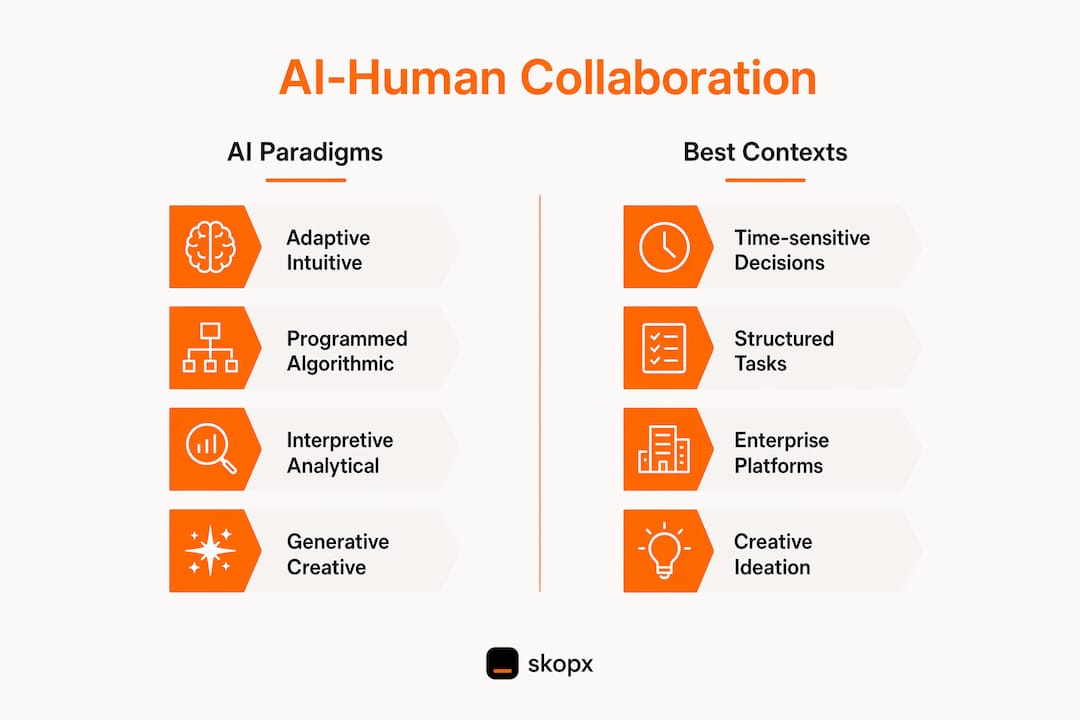
The adaptive intuitive paradigm works best when decisions are time-sensitive and data is incomplete. A supply chain team responding to a sudden disruption benefits from AI that adapts to the team's prior choices rather than demanding structured inputs that do not yet exist.
The programmed algorithmic paradigm fits structured, repeatable decisions. Credit risk scoring, inventory reordering, and compliance checks all belong here. The danger is applying this paradigm to decisions that require judgment, which produces outputs that feel authoritative but miss critical context.
The interpretive analytical paradigm is where most enterprise platforms operate today. AI presents synthesized findings, and humans decide. This works well for strategic planning, market analysis, and resource allocation. The integrative hybrid paradigm is the most demanding. It requires teams with high AI literacy and a culture of genuine co-creation. When it works, it produces decisions that neither humans nor AI could reach alone.
Pro Tip: Map your three most frequent team decisions to one of these four paradigms before selecting an AI tool. Most organizations buy a tool first and discover the mismatch later, which wastes both budget and team trust.
What practical steps can leaders take to integrate AI in team decision-making?
Successful AI integration in team decisions does not begin with technology. It begins with process documentation. Harvard Business Review research from june 2026 found that without explicit decision-making pipelines, AI cannot improve team performance. An AI system trained on an undocumented process will encode its inefficiencies, not fix them.
Leaders who get this right follow a deliberate sequence. The steps below reflect what the research and field experience consistently support.
- Document your decision process first. Map who inputs data, who evaluates options, who has final authority, and what criteria matter. AI needs a clear pipeline to improve, not a vague culture of "we discuss things."
- Build AI literacy across the team. Team members who cannot interpret an AI recommendation will either blindly accept it or reflexively reject it. Neither outcome improves decisions. Short, practical training on how your specific AI tools reason is more effective than general AI awareness programs.
- Match AI type to decision type. MIT Sloan experts caution that wrong AI types applied to decisions produce weak outcomes and poor buy-in. Analytical AI fits optimization decisions. Generative AI fits exploration and consensus-building. Swapping them produces confident-sounding but wrong outputs.
- Build in human-in-the-loop governance. Agentic AI frameworks that integrate human oversight mechanisms preserve evaluative authority and maintain transparency. Define which decisions require human sign-off before AI recommendations become actions.
- Calibrate trust through transparency. Share AI reasoning with the full team, not just the decision owner. When everyone sees the logic, trust builds across the group rather than concentrating in one person who "understands the tool."
- Review and adjust regularly. AI performance in decision support degrades when the business context shifts and the model does not. Schedule quarterly reviews of AI recommendations against actual outcomes.
The most common failure mode is skipping step one. Leaders deploy AI into a decision process that was never clearly defined, then blame the AI when results disappoint. The AI did exactly what it was asked to do. The problem was the ask.
Pro Tip: Use Skopx's AI consulting services to audit your existing decision workflows before integration. Identifying undocumented steps early prevents the most expensive AI deployment mistakes.
How does AI complement rather than replace human judgment in team decisions?
Human-AI complementarity is not automatic. Carnegie Mellon Tepper School research from april 2026 establishes that human-AI teams outperform individuals only with deliberate design, trust calibration, and shared mental models. Without those conditions, adding AI to a team can actually slow decisions down.
The scenarios where human judgment remains dominant are specific and important to name:
- Ethical decisions involving fairness, values, or stakeholder harm require human accountability that AI cannot provide.
- Novel situations with no historical data require creative reasoning and contextual judgment that current AI models do not replicate reliably.
- Relationship-dependent decisions where buy-in matters as much as the outcome require human communication and political awareness.
- Ambiguous mandates where the goal itself is unclear require humans to define the problem before AI can help solve it.
AI excels at processing scale, consistency, and pattern recognition. Humans excel at meaning-making, ethics, and adaptation to genuinely new circumstances. The teams that perform best treat AI as a team collaboration tool that handles the data-heavy preparation so humans can focus on the judgment-heavy conclusion.
MIT Sloan identifies a specific leadership mistake worth naming directly: applying generative AI to decisions that need analytical AI. Generative AI is built for exploration and ideation. When leaders use it to optimize a structured problem, they get creative outputs where they needed precise ones. The reverse is equally damaging. Using analytical AI for consensus-building produces outputs that feel cold and miss the interpersonal dynamics that determine whether a decision actually gets implemented.
The solution is a shared mental model. Every team member should understand what the AI is doing, what it is not doing, and where human judgment takes over. Skopx's AI agents and agentic workflows are built with this handoff logic in mind, making the boundary between AI analysis and human decision authority explicit rather than assumed.
Key Takeaways
AI improves team decision quality only when leaders match the right AI paradigm to the right decision type, document their processes first, and build trust through transparency.
| Point | Details |
|---|---|
| Document before deploying | AI cannot improve an undocumented decision process. Map your pipeline before integration. |
| Match paradigm to context | Use analytical AI for optimization and generative AI for exploration. Mismatching produces poor outcomes. |
| Transparency builds trust | Teams reject AI input they cannot verify. Explainability is a prerequisite, not a feature. |
| Human oversight is non-negotiable | Human-in-the-loop governance preserves evaluative authority in AI-supported decisions. |
| Complementarity requires design | Human-AI teams outperform individuals only with deliberate structure and shared mental models. |
What I've learned about AI and team decisions after watching both succeed and fail
The organizations that get AI-driven decision support right share one trait: they treat AI integration as a team design problem, not a technology problem. The ones that struggle buy a tool, point it at their existing process, and wait for improvement. It does not come.
The most instructive failures I have seen involve leaders who deployed generative AI on structured optimization problems. The outputs were creative, well-written, and wrong for the context. The team lost confidence in AI entirely, not just in that specific application. Rebuilding that trust took longer than the initial deployment.
The uncomfortable truth is that AI exposes the quality of your decision process. If your process is vague, AI makes the vagueness visible at scale. If your criteria are inconsistent, AI will apply them inconsistently and do so faster than any human could. The teams that benefit most from AI in decision support are the ones that had already done the hard work of defining how they decide.
Culture matters more than most leaders admit. A team that punishes dissent will use AI to confirm what leadership already believes. A team that rewards rigorous challenge will use AI to find the options they missed. The technology does not change the culture. The culture determines what the technology produces.
My recommendation: start with one decision type, pick the right paradigm for it, and measure the outcome against your baseline. Expand from there. Skopx's generative AI consulting helps leaders make that first match correctly, which is the decision that determines whether everything after it succeeds.
Skopx Team
Skopx and AI-enhanced team decision support
Teams that want to move from theory to practice need tools that make AI reasoning visible, auditable, and connected to real data.
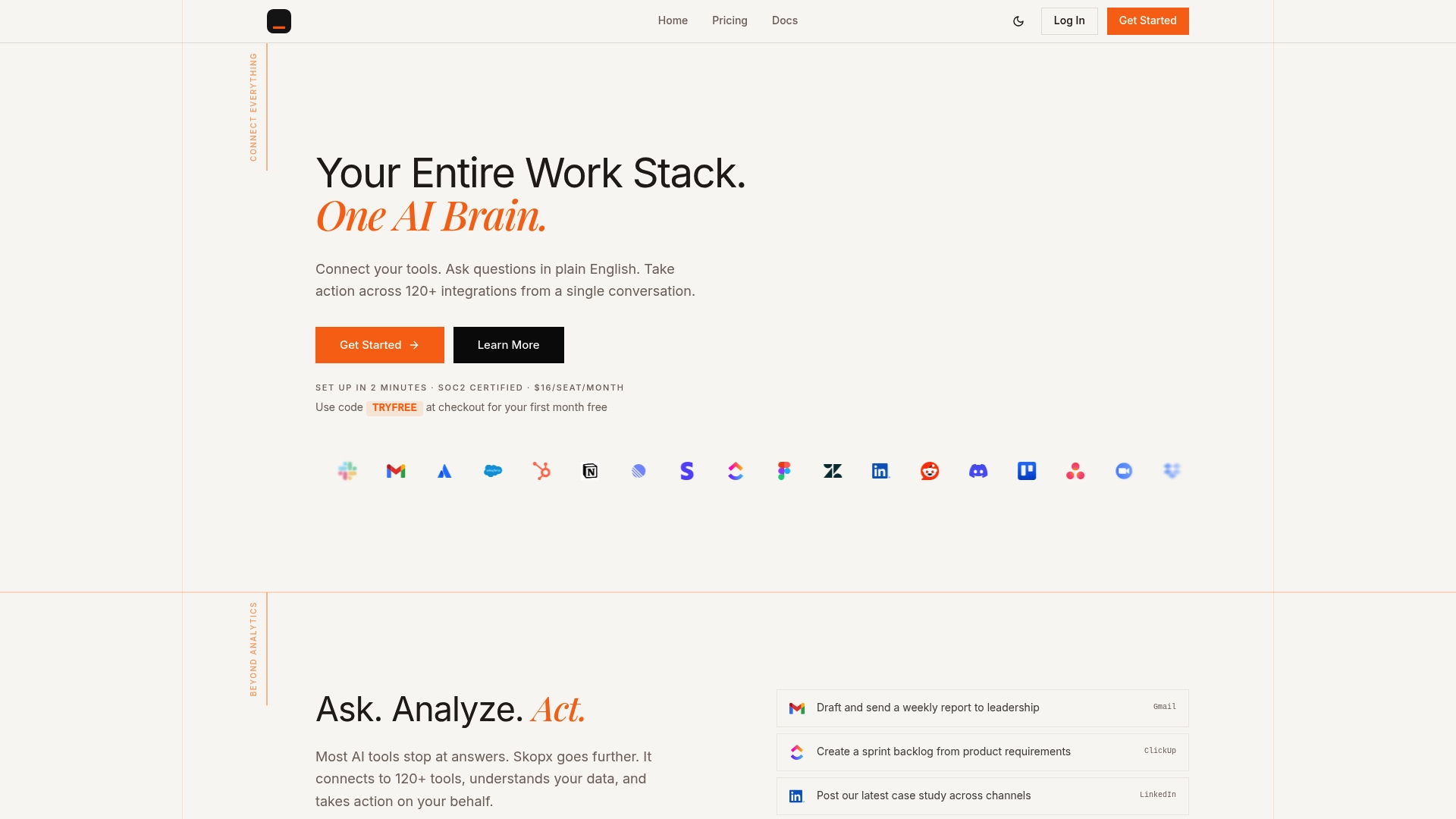
Skopx connects with nearly 1,000 integrations, letting teams query their data and act on it in real time through a single interface. The Skopx AI QA Agent handles intelligent question answering and validation, giving teams a reliable way to pressure-test decisions before they commit. The AI Data Agent delivers data-driven analysis without requiring SQL skills or dashboard expertise. For teams building out full decision pipelines, Skopx's agentic workflows embed human oversight at every critical handoff point, keeping evaluative authority where it belongs.
FAQ
What is AI's role in team decision support?
AI in team decision support augments human judgment by surfacing data-driven alternatives, reducing cognitive bias, and processing information at a scale no team can match manually. The goal is better decisions, not automated ones.
Why do teams reject AI recommendations?
Teams reject AI input when they cannot verify or understand its logic. University of Mannheim research shows this creates a productivity paradox where AI increases complexity rather than reducing it.
What is the biggest mistake leaders make with AI in decisions?
MIT Sloan identifies mismatching AI type to decision context as the leading cause of poor outcomes. Applying generative AI to optimization problems, or analytical AI to consensus-building, produces outputs that undermine team confidence.
Do human-AI teams always outperform human-only teams?
No. Carnegie Mellon research shows human-AI teams outperform individuals only when teams are deliberately designed with shared mental models and calibrated trust. Without that structure, AI can slow decisions down.
How should leaders prepare their teams for AI decision support?
Leaders should document their decision-making process before deploying any AI, build AI literacy across the team, and establish human-in-the-loop governance to preserve evaluative authority over AI-generated recommendations.
Skopx Team
The Skopx engineering and product team