Types of Business Intelligence Limitations: 2026 Guide

Business intelligence limitations are defined as the structural, organizational, and technical factors that prevent BI systems from delivering accurate, timely, and trusted insights. The types of business intelligence limitations most damaging to organizations include data quality failures, user adoption resistance, scope creep, governance gaps, and architectural constraints. Organizations lose $12.9 million annually from poor data quality alone. Understanding each limitation category gives project managers and data analysts a clear path to building BI programs that actually drive decisions.
1. Types of business intelligence limitations: an overview
Business intelligence challenges fall into five distinct categories. Each one operates differently, but all share a common outcome: they reduce the reliability and usefulness of the insights your BI system produces. The categories are data quality, adoption resistance, scope creep, governance gaps, and technological constraints. Knowing which type is affecting your project is the first step toward fixing it.
The limitations of business analytics are not always technical. Many stem from organizational behavior, unclear ownership, and misaligned expectations between IT teams and business stakeholders. A BI system can be technically sound and still fail if the people using it do not trust the data or understand how to act on it.

2. Data quality issues that undermine BI reliability
Poor data quality is the most common and costly of all BI drawbacks. 60% of BI projects experience delays caused by duplicate records, missing values, and inconsistent formatting. One clinical data case found 23% duplication in patient IDs across systems, requiring four or more weeks of cleaning before any dashboard development could begin. That timeline is not an outlier. It is the norm.
The financial impact is direct. Organizations lose an average of $12.9 million per year due to poor data quality. That figure covers bad decisions, rework, and lost productivity across teams that trusted flawed outputs. The "garbage in, garbage out" principle is not a cliché. It is a financial reality.
Data quality problems compound over time. A single bad source feeding multiple dashboards spreads errors across every report that draws from it. Teams then spend more time debating the numbers than acting on them.
Pro Tip: Run a data profiling audit before any dashboard development begins. Identify null rates, duplicate keys, and format inconsistencies at the source level. Fixing these upstream cuts cleaning time by weeks.
3. User adoption resistance as a BI effectiveness barrier
Technology alone does not make a BI program succeed. 50% of BI projects fail to achieve meaningful adoption, primarily because the tools do not align with how teams actually make decisions. Low data literacy, inadequate training, and tools that require SQL knowledge all create friction that pushes users back to spreadsheets.
The root causes of adoption resistance fall into three areas:
- Workflow misalignment: BI dashboards built around data availability rather than decision needs force users to translate outputs into actions themselves.
- Training gaps: Teams receive tool training but not decision training. They learn how to filter a chart, not how to interpret a trend.
- Trust deficits: When users encounter one wrong number, they distrust the entire system. Rebuilding that trust takes months.
Addressing enterprise adoption hurdles requires more than a training session. Stakeholder involvement during the design phase, not after deployment, is the single most effective way to close the gap between what BI produces and what teams will actually use.
Pro Tip: Assign a "decision owner" to each key metric during the design phase. That person validates whether the metric maps to a real business question. Metrics without named owners get ignored.
4. Scope creep expanding BI projects beyond control
Scope creep is one of the most predictable and least prevented issues with data analysis projects. A BI project planned for eight weeks can expand to over seven months when requirements keep growing after kickoff. That sevenfold expansion is not rare. It happens when stakeholders add requests incrementally, each one seeming small in isolation.
The consequences follow a clear pattern:
- Budget overruns accumulate as the team addresses each new requirement.
- Delivery quality drops as developers rush to meet revised deadlines.
- User satisfaction falls because the final product no longer matches the original vision.
- The core use case gets buried under layers of added complexity.
Preventing scope creep requires written requirements signed off before development begins. Change requests after kickoff should go through a formal review process with documented impact on timeline and budget. Teams that skip this step almost always regret it.
5. Governance gaps creating conflicting metrics and distrust
Governance is the most underrated source of BI failure. Reza Rad, drawing on 20 years of consulting experience, identifies governance gaps as the leading cause of what he calls "data chaos." When no one owns the definition of a metric, different departments build different dashboards that report different numbers for the same business question.
The most common example is revenue. Finance calculates it one way. Sales calculates it another. Both dashboards are technically correct by their own logic. But when executives see two different revenue figures in the same meeting, they stop trusting both. That loss of trust is difficult to recover from and spreads quickly across the organization.
Good governance requires three things: a shared data dictionary, assigned metric ownership, and a review process for new dashboard requests. Without these, every team builds its own version of the truth.
| Governance approach | Metric consistency | Executive trust | Time to resolution |
|---|---|---|---|
| No governance | Low | Low | Weeks to months |
| Informal standards | Moderate | Variable | Days to weeks |
| Formal data dictionary with ownership | High | High | Hours to days |
Connecting governance work to data analytics consulting practices helps organizations set standards before problems multiply across departments.
6. Technological and architectural constraints limiting BI performance
BI tools themselves carry performance limitations that affect how much value teams extract from them. Dashboard loads exceeding 45 seconds cause users to abandon the tool entirely. The cause is almost always poor data modeling or inefficient queries, not hardware. Fixing it requires a data engineer, not a faster server.
Implementation timelines add another layer of complexity. Enterprise BI deployments take 12–24 weeks. Mid-market platforms take 4–12 weeks. Self-service tools take 1–4 weeks. Organizations that underestimate these timelines set themselves up for pressure to cut corners during setup, which creates technical debt that slows every future iteration.
Emerging AI-powered analytics tools introduce a different category of risk. James G. Kobielus warns that agentic BI tools carry real risks of hallucination, weak quantitative reasoning, and missing data lineage. An AI tool that fabricates a trend or misreports a percentage without any audit trail is more dangerous than no tool at all.
- Hallucination risk: LLM-powered analytics can generate plausible-sounding but incorrect outputs.
- No data lineage: Many AI tools cannot show where a number came from, making verification impossible.
- Context rot: As AI models are updated, previously reliable outputs can shift without warning.
Pro Tip: Before deploying any AI analytics tool, require a data lineage demo. If the vendor cannot show you exactly where each output originates, treat every number it produces as unverified.
7. The context gap: when internal data is not enough
BI systems built entirely on internal data produce a blind spot that most teams do not notice until a strategic decision goes wrong. Internal dashboards track what your organization does. They do not track what the market is doing around you. BI systems relying only on internal data miss total addressable market indicators, competitor movement, and external demand signals.
This context gap is a structural limitation, not a configuration error. No amount of dashboard refinement fixes it. The solution is deliberate data enrichment: pulling in third-party market data, industry benchmarks, and external signals alongside internal metrics. Teams that skip this step make confident decisions based on an incomplete picture.
The IABAC notes that data reflects past events with embedded biases, and automated analytics cannot substitute for human judgment in interpreting context. That principle applies directly here. A dashboard showing strong internal sales growth means nothing if the market grew three times faster.
Key takeaways
The most damaging BI limitations share a common thread: they are predictable, preventable, and rooted in decisions made before the first dashboard is built.
| Point | Details |
|---|---|
| Data quality drives cost | Poor data costs organizations $12.9 million annually and delays most BI projects by weeks. |
| Adoption requires design, not training | 50% of BI projects fail adoption because tools do not align with real decision workflows. |
| Governance prevents data chaos | A shared data dictionary with named metric owners stops conflicting dashboards before they start. |
| Scope must be locked early | Projects without formal change control routinely expand from weeks to months in timeline. |
| AI tools need lineage checks | Agentic BI tools carry hallucination and traceability risks that require verification before deployment. |
The BI gap nobody talks about enough
Skopx Team
The conversation about BI limitations almost always focuses on tools and data. Rarely does it focus on the decision layer, which is where most failures actually live.
Teams build dashboards around data they have, not decisions they need to make. The result is what I call metric theater: beautifully designed reports that nobody acts on because nobody knows what action they are supposed to trigger. Metrics without named decision ownership are ignored. That is not a data problem. It is a communication and accountability problem.
The organizations that get the most from BI are not the ones with the most data or the most sophisticated tools. They are the ones where a business leader can point to a specific metric and say: "When this number crosses this threshold, we do this." That level of clarity requires conversations between IT and business that most organizations never have.
Governance frameworks and data dictionaries matter. But they only work when business leaders are co-owners of the metrics, not just consumers of them. The technical team cannot define what "revenue" means for the business. That definition belongs to the people making revenue decisions.
Skopx Team
How Skopx addresses common BI limitations
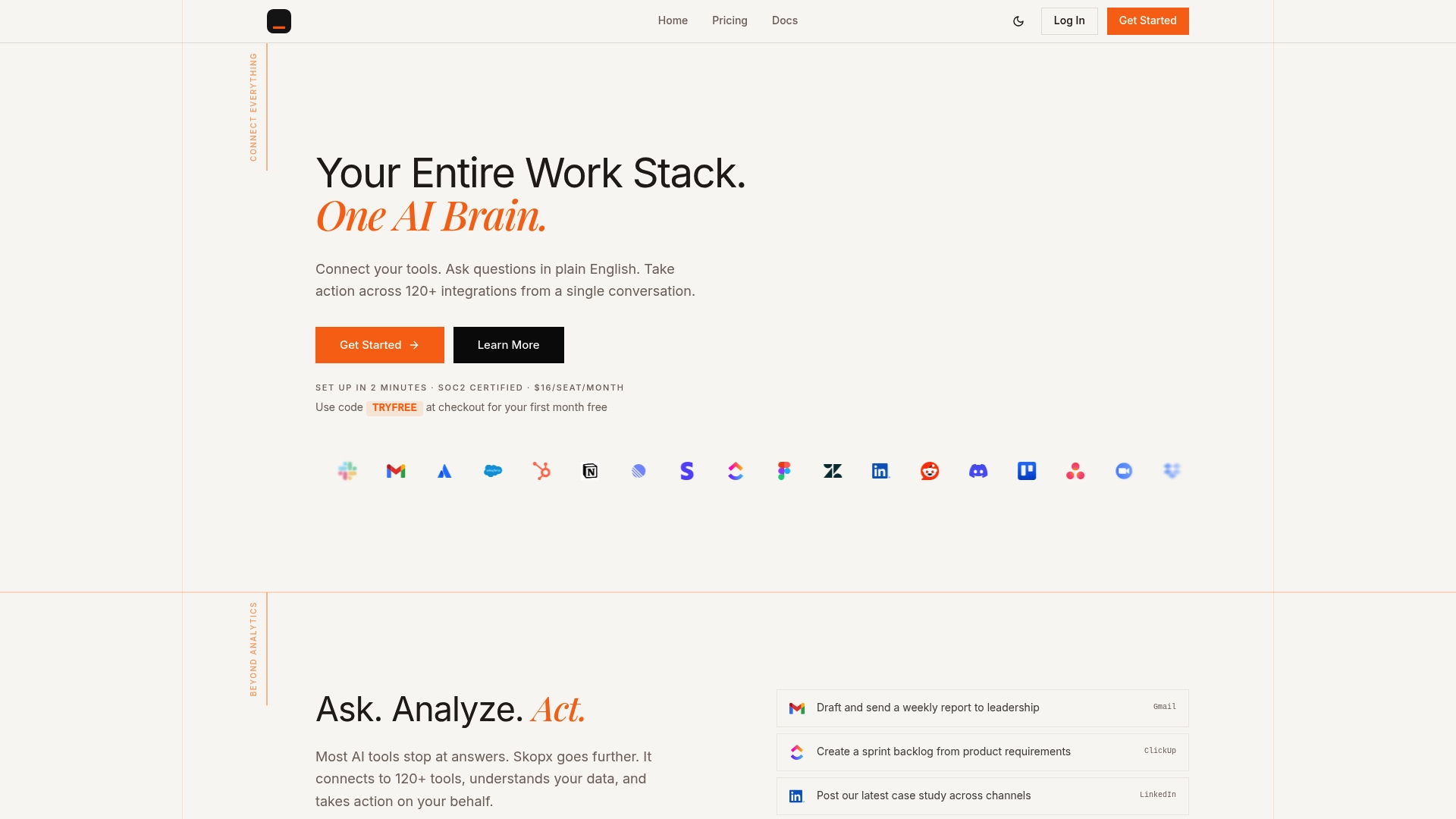
The BI limitations covered in this article, from data quality failures to adoption resistance and governance gaps, are exactly the problems Skopx was built to address. Skopx connects with nearly 1,000 integrations through a unified AI-driven interface, letting teams query their data and act on it in real time without needing SQL skills or dashboard expertise.
The AI QA Agent automates data quality checks before they become project delays. The AI Data Analyst platform lowers the technical barrier for teams that have struggled with adoption. For organizations dealing with governance gaps and misaligned metrics, Skopx's data intelligence capabilities give every team a single, consistent view of their data. The result is faster decisions with fewer errors.
FAQ
What are the most common types of business intelligence limitations?
The five most common BI limitations are data quality issues, user adoption resistance, scope creep, governance gaps, and technological constraints. Each one reduces the accuracy, usability, or trustworthiness of BI outputs.
Why do 50% of BI projects fail to achieve adoption?
Adoption fails primarily because tools are built around data availability rather than decision workflows. Teams receive tool training but not the context needed to act on what the data shows.
How does poor data quality affect BI projects financially?
Organizations lose an average of $12.9 million annually due to poor data quality. The cost comes from bad decisions, rework, and time spent cleaning data instead of analyzing it.
What is the risk of using AI-powered BI tools?
AI-powered BI tools can hallucinate outputs, misinterpret statistics, and lack data lineage. James G. Kobielus identifies these as reasons agentic BI tools are not yet ready for enterprise use without strong verification controls.
How can teams prevent scope creep in BI projects?
Teams prevent scope creep by locking requirements in writing before development begins and routing all post-kickoff changes through a formal review process that documents the impact on timeline and budget.
Skopx Team
The Skopx engineering and product team