Unified Data Querying Across Platforms: A 2026 Guide
Unified data querying across platforms is defined as executing consistent queries over multiple heterogeneous data sources simultaneously, without manual ETL pipelines or data movement. The industry term for this capability is federated querying, and it sits at the core of modern data mesh and multi-platform data integration architectures. Federated SQL engines, SQL dialect normalization, and semantic layers are the three technologies that make it work. Together, they give data professionals a single query interface over relational databases, data lakes, object stores, and REST or GraphQL endpoints. The result is faster business intelligence, cleaner AI pipelines, and operational decisions grounded in real-time data.
What tools and technologies enable unified data querying across platforms?
Federated SQL engines are the foundation of any cross-platform data query architecture. These engines query over 50 diverse sources without requiring data to be copied or transformed first. That means a single SQL statement can pull rows from a Postgres database, an S3 bucket, and a REST API in one execution pass.
SQL dialect normalization solves a problem that most teams underestimate. Every database speaks a slightly different version of SQL, and a query written for BigQuery will fail on MySQL without modification. Libraries like sqlglot handle SQL translation across 31+ dialects, giving teams a consistent query syntax regardless of the underlying engine. That consistency is what makes cross-platform data management practical at scale.

Semantic layers add the business context that raw query engines lack. A metadata catalog like DataHub enriches query results with ownership information, quality scores, and deprecation status. Without this layer, analysts receive data they cannot fully trust or interpret.
The core technology stack for integrated data access includes:
- Federated SQL engines (Trino, Apache DataFusion-based systems) for cross-source query execution
- Protocol translation libraries (sqlglot) for SQL dialect standardization
- Metadata catalogs (DataHub, data mesh catalogs) for governance and semantic enrichment
- GraphQL APIs for unified access over heterogeneous sources, including OLAP workloads and real-time subscriptions
- Query connectors and adapters for relational databases, data lakes, object stores, and streaming sources
- Pushdown optimization engines to filter data at the source and reduce network transfer
Pro Tip: Always evaluate whether a federated engine supports predicate pushdown before committing to it. Without pushdown, every query pulls full datasets across the network before filtering, which destroys performance at any meaningful scale.
How to design and deploy a unified data querying solution
Building a federated query layer requires deliberate architecture decisions upfront. Retrofitting governance or schema normalization after deployment costs far more time than planning for them from the start.
Follow these steps to deploy a production-ready solution:
-
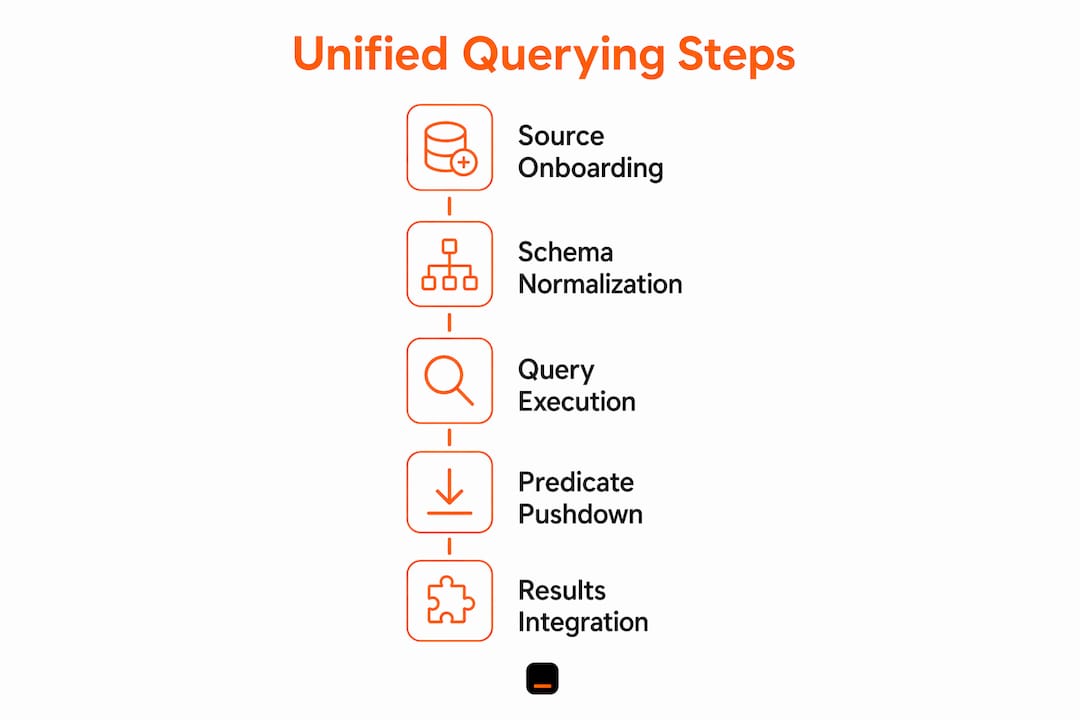
Audit and catalog your data sources. List every source by type (relational, object store, API, streaming), schema ownership, and update frequency. This inventory drives connector selection and normalization strategy.
-
Choose a schema normalization model. Implementing schema normalization with common models like OCSF or unified GraphQL schemas is more effective than on-the-fly mapping. On-the-fly mapping creates technical debt that compounds as schemas evolve.
-
Deploy your federation engine and configure connectors. Set up your chosen federated SQL engine and connect each source using its native adapter. Test each connector independently before combining sources in cross-joins.
-
Implement SQL dialect translation. Configure a dialect translation layer so queries written in standard SQL execute correctly against each backend. This step prevents silent query failures caused by syntax incompatibilities.
-
Build your semantic layer. Map business terms, ownership, and quality rules onto the physical schema. A governed API data layer automates policy-controlled data delivery and reduces integration time from weeks to days.
-
Configure access controls and audit logging. Define role-based permissions at the semantic layer, not just at the database level. Log every query with user identity, timestamp, and source accessed.
-
Monitor query performance and tune pushdown predicates. Track query execution plans and identify which sources cause latency spikes. Push filtering predicates to source databases to maintain sub-100ms response times where possible.
The table below maps each deployment phase to its primary risk and mitigation:
| Deployment phase | Primary risk | Mitigation |
|---|---|---|
| Source onboarding | Schema drift breaks connectors | Normalize to OCSF or unified GraphQL upfront |
| Dialect translation | Silent query failures | Test each dialect pair with a validation suite |
| Semantic layer build | Incomplete business context | Assign data ownership before publishing to consumers |
| Access control setup | Credential leakage | Use sandboxed execution environments per query session |
| Performance tuning | Full-table scans across slow sources | Enable pushdown predicates on every connector |
Pro Tip: Start with your three highest-traffic data sources and get them working perfectly before adding more. A federation layer with three well-tuned connectors delivers more value than one with ten poorly configured ones.
What are common challenges in unified data querying and how to overcome them?
Performance is the challenge teams hit first. Cross-source joins are fundamentally limited by the slowest source in the query. Pushdown optimization minimizes this bottleneck by filtering data at the source database before it crosses the network. Without it, a single slow REST API can make an entire federated query time out.
Schema evolution is the challenge teams hit second. Sources change their schemas without warning, and a connector that worked last week breaks silently today. Abstraction layers that handle backend schema evolution dynamically solve this by auto-detecting changes and remapping queries without manual intervention.
Without a semantic metadata layer, AI engines and analysts face 'context blindness.' They receive raw data with no lineage, no quality score, and no ownership context. That data is technically correct but practically unreliable for decisions.
Security and credential management deserve more attention than most teams give them. Storing database credentials in query engine configuration files creates a single point of exposure. Sandboxed agent environments isolate credentials per query session and prevent context overflow between concurrent users. Pair this with AI governance infrastructure from providers focused on sovereign data access to enforce policy controls at the query layer.
Additional challenges and their solutions:
- Data freshness vs. consistency: Use materialized query caches for high-frequency reads and live federation only for real-time requirements. Not every query needs live data.
- Multiple SQL dialects: Standardize on one input dialect (ANSI SQL is the safest choice) and let the translation layer handle backend conversion.
- Scaling the federation layer: Deploy the query engine as a stateless service behind a load balancer. State lives in the source systems, not the federation layer.
- Governance gaps: A governed API layer that automates policy-controlled delivery closes the gap between what data owners intend and what consumers actually access.
How to leverage unified data querying for advanced analytics and AI workflows
Unified querying removes the biggest bottleneck in AI and machine learning pipelines: manual data preparation. Data scientists spend a disproportionate share of their time writing ETL scripts to pull data from multiple systems before they can run a single model. Federated querying eliminates that step entirely.
Here is how teams apply unified querying to accelerate analytics and AI:
-
Single-query access for data scientists. A data scientist can write one SQL or GraphQL query that joins a Postgres user table, an S3 event log, and a REST API response. No pipeline code required. This directly accelerates feature engineering for machine learning models.
-
Sandboxed AI agent execution. AI agents querying data with native Python bindings and zero-copy federation can safely combine Postgres, S3, and REST API sources in one operation. Sandboxed execution prevents one agent's credentials from leaking into another session.
-
Automated metadata enrichment for self-service analytics. When the semantic layer automatically tags query results with quality scores and ownership, business users can trust the data without asking an engineer to validate it. This is what makes no-code BI platforms viable for non-technical teams.
-
AI pipelines combining vector stores and relational data. Modern AI workflows often need to combine vector embeddings (for semantic search) with structured relational data (for filtering and ranking). A unified query layer that supports both source types removes the need for separate retrieval pipelines.
-
Faster operational decisions. When a sales team can query CRM data, inventory systems, and logistics APIs in a single dashboard query, they make decisions in minutes instead of waiting for a weekly data pull. The AI data analyst model depends entirely on this kind of integrated access being available in real time.
The shift AI-native querying represents is significant. It moves the focus from data retrieval to secured agent computation, where access controls and governance are built into the query execution layer itself, not bolted on afterward.
Key Takeaways
Unified data querying across platforms works when federated SQL engines, semantic layers, and pushdown optimization are deployed together as a governed architecture, not as isolated tools.
| Point | Details |
|---|---|
| Federated engines are the core | Query 50+ sources without ETL by deploying a federated SQL engine with native connectors. |
| Dialect normalization prevents failures | Use SQL translation libraries like sqlglot to standardize queries across 31+ database dialects. |
| Semantic layers prevent context blindness | Enrich query results with ownership, quality scores, and lineage before exposing data to consumers. |
| Pushdown optimization is non-negotiable | Filter data at the source to avoid full-table scans and maintain sub-100ms query latency. |
| Start modular, then scale | Onboard three well-tuned sources first; add complexity only after governance and performance are proven. |
Why unified querying is the architecture decision that defines your data maturity
The teams I see struggle most with multi-platform data integration are not the ones with the most complex data. They are the ones who delayed governance decisions. They built connectors first and added semantic layers and access controls as an afterthought. By that point, the federation layer had become a liability rather than an asset.
The pattern that actually works is the reverse. Define your schema normalization model before you write a single connector. Assign data ownership before you expose a single table to consumers. Build the semantic layer in parallel with the federation engine, not after it. This sequence feels slower at the start, but it eliminates the rework that kills most data mesh projects at the six-month mark.
The transition to AI-native querying makes governance even more critical. When an AI agent can autonomously query across Postgres, S3, and REST APIs, the blast radius of a misconfigured permission is much larger than when a human analyst runs a query manually. Sandboxed execution and policy-controlled data delivery are not optional features for AI-driven architectures. They are the foundation.
My practical advice: start with a modular architecture where each connector, each semantic mapping, and each access policy is independently testable. Iterate on one source at a time. The teams that ship a working federated layer over three sources in 30 days consistently outperform the teams that spend six months designing the perfect ten-source architecture on paper.
Skopx Team
How Skopx powers unified querying with AI-driven data agents
Skopx connects to nearly 1,000 integrations and lets your team query data and execute actions in real time through a single AI-driven interface. No-code access means analysts and decision-makers get answers without waiting for engineering support.
The Skopx Self-Service Analytics Platform brings semantic enrichment and governed access to business users who need reliable data without writing SQL. For teams building or scaling a federated query architecture, Skopx consulting services provide implementation support from strategy through deployment. The result is a governed, AI-ready data layer your entire organization can use.
FAQ
What is unified data querying across platforms?
Unified data querying across platforms, also called federated querying, means executing a single query across multiple heterogeneous data sources simultaneously without moving or copying data first. It relies on federated SQL engines, dialect translation, and semantic layers to deliver consistent results.
How does pushdown optimization improve federated query performance?
Pushdown optimization sends filter conditions directly to the source database before data crosses the network. This prevents full-table scans and keeps query latency low even when sources include slow REST APIs or large object stores.
What is a semantic layer and why does it matter?
A semantic layer maps raw database schemas to business terms, ownership, and quality rules. Without it, query results lack lineage and context, making them unreliable for AI workflows and self-service analytics.
How do I handle schema changes in a federated query environment?
Use abstraction layers that auto-detect backend schema evolution and remap queries dynamically. Normalizing to a common schema model like OCSF upfront reduces the maintenance burden when individual sources change their structures.
Can AI agents safely run cross-platform data queries?
Yes, when sandboxed execution environments isolate credentials and context per query session. AI agents with zero-copy federation can safely combine Postgres, S3, and REST API sources without credential leakage between concurrent sessions.
Skopx Team
The Skopx engineering and product team