Unify Team Data for Faster Decisions in 2026

Unified data management is the practice of consolidating fragmented information sources into a single platform that every decision-maker on your team can access in real time. When you unify team data for faster decisions, you eliminate the lag created by siloed spreadsheets, disconnected CRM records, and ERP exports that never quite match. The result is not just speed. It is confidence. Teams stop debating which number is correct and start acting on shared facts. This guide walks business leaders and project managers through the prerequisites, integration methods, decision frameworks, and collaboration practices that make data unification work in practice.
What does it take to unify team data for faster decisions?
The first barrier to unified data is not technology. Unified data requires cultural discipline as much as technical effort, including pre-agreed evaluation criteria to prevent teams from cherry-picking numbers that support a predetermined conclusion. Without that agreement upfront, even the best platform becomes a tool for confirmation bias.
On the technical side, most teams are working against a fragmented stack. ERP systems, CRM platforms, marketing databases, and external data lakes each store records in different formats, updated on different schedules. Data silos from stitched-together SaaS stacks create silent data drift, where two systems report different values for the same metric because they were last synced at different times. A single data backbone, where all applications read from and write to the same data layer, is the structural fix.

Before selecting a platform, evaluate it against four feature categories:
| Feature category | What to look for |
|---|---|
| Real-time sync | Updates every 5 minutes or less; query response under 5 seconds |
| Data cleansing | Automated deduplication and format normalization |
| Access control | Role-based permissions so teams see relevant data only |
| Audit trail | Timestamped change logs for accountability |
The access control row matters more than most leaders expect. Role-based access control prevents data overload by surfacing only the metrics each team member needs. Overloading a project manager with raw data from 12 systems is as harmful as giving them no data at all.
Pro Tip: Before evaluating any platform, document every data source your team currently uses. List the owner, update frequency, and format for each. That inventory becomes your integration checklist and your first test of cultural readiness.
How to consolidate and integrate data streams for team visibility
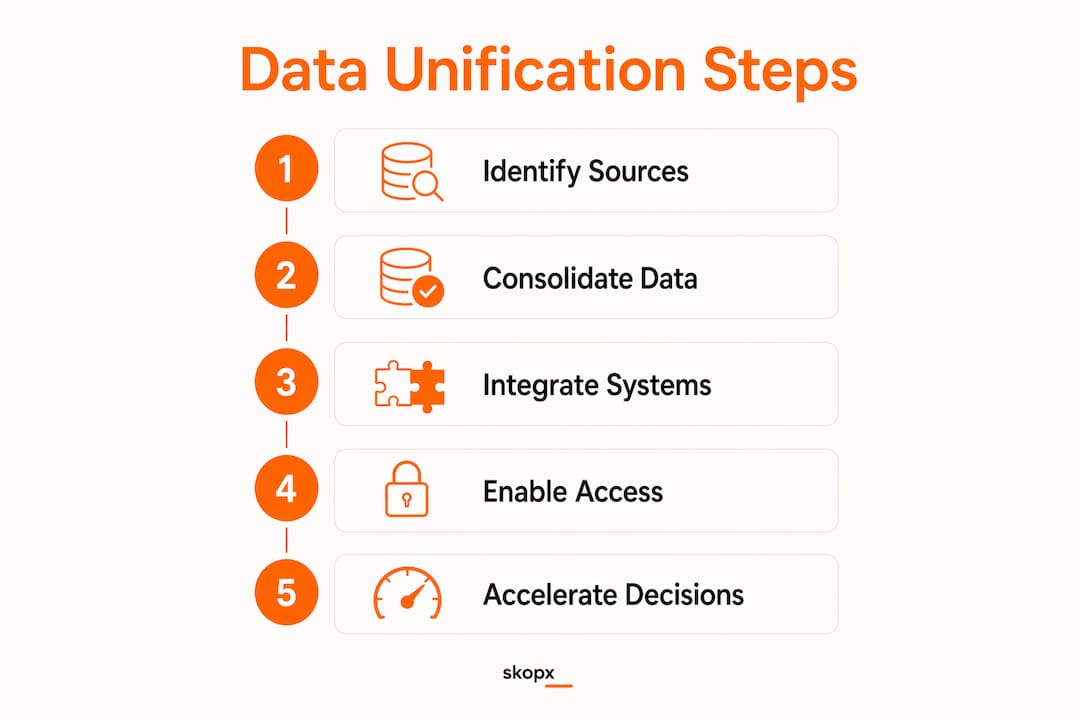
Integration is not a one-time migration. It is an ongoing process with four repeatable steps.
-
Audit and catalog all data sources. List every system that holds data your team uses for decisions. Include shadow systems like personal spreadsheets and exported CSV files that live in email threads.
-
Cleanse and normalize. Standardize field names, date formats, and currency units across sources before any data enters the unified layer. A customer record labeled "Client ID" in one system and "Account Number" in another will cause silent mismatches downstream.
-
Choose your integration architecture. API-first integration connects source systems directly to the unified layer, pushing updates as events occur. Native unified platforms, where all tools are built on a shared data model, eliminate the sync step entirely. Real-time synchronization removes stale reports and makes operational metrics instantly visible, so teams act on current facts rather than yesterday's export.
-
Validate continuously. Set automated checks that flag when a data source stops updating or when values fall outside expected ranges. Silent drift, where a feed quietly stops syncing, is the most common cause of bad decisions made with apparent confidence.
Modern unified platforms return query answers in under 5 seconds, with sync cycles running approximately every 5 minutes. That performance benchmark matters because it determines whether your team actually uses the platform during a meeting or waits until afterward to check the numbers.
Pro Tip: Set a data health dashboard as the default view for your operations lead. If any source goes stale or throws an error, it surfaces immediately rather than being discovered mid-decision.
Which decision frameworks turn unified data into faster choices?
Unified data gives you the raw material. A structured framework converts that material into a decision. Without the framework, abundant data produces analysis paralysis rather than speed.
The 48-Hour Decision Protocol is the most direct fix for teams stuck in endless review cycles. The protocol requires that every decision be defined in one sentence naming who decides, what they are deciding, and by when. If your team cannot write that sentence, the decision process is stuck before it starts. The protocol forces clarity on ownership and deadline before any data is reviewed.
Defining decision ownership with hard deadlines removes ambiguity and cuts committee delay. This is the structural reason why many decisions drag on. No one person is accountable, so everyone waits for consensus that never arrives.
Decision matrices handle the evaluation step once ownership is clear. Structured decision matrices reduce decision fatigue by forcing teams to score each option against weighted criteria before discussion begins. The matrix makes disagreements visible and specific rather than vague and emotional.
The benefits of combining these two tools are concrete:
- Clarity: Every stakeholder knows who owns the decision and when it closes.
- Objectivity: Weighted criteria replace gut feel with a documented rationale.
- Repeatability: The same framework applies to the next decision, building team speed over time.
- Transparency: The scoring record shows why a choice was made, which reduces second-guessing after the fact.
Most leaders assume more data leads to better decisions, but lacking a clear decision definition blocks progress more than lacking data. The framework is the constraint that makes data useful.
Pro Tip: Create a shared decision log in your project management tool. Each entry should include the decision sentence, the owner, the deadline, and the final choice with its matrix score. After 90 days, you will have a pattern library that speeds up future decisions.
How does unified data support cross-team collaboration and alignment?
Unified data changes the collaboration dynamic from "let me pull that report" to "we are all looking at the same number right now." Unified platforms democratize data access across marketing, sales, analytics, and operations, enabling timely decisions without the reporting delays that slow cross-functional work.
Live dashboards replace the weekly status meeting as the primary alignment tool. When a sales leader and a supply chain manager share a single view of order volume, inventory levels, and delivery timelines, their conversation shifts from debating data to deciding action. That shift alone cuts meeting time significantly.
Shared data also surfaces a problem that most teams avoid naming: analysis averaging, where teams dilute expert input by blending conflicting views into a compromise that satisfies no one and reflects no real analysis. Structured frameworks that document explicit evaluation criteria prevent this by making each team member's reasoning visible and specific.
Common pitfalls that undermine collaborative data sharing include:
- No single accountable owner. Shared data without a named decision owner produces shared confusion.
- Data overload. Giving every team access to every metric creates noise that buries the signal.
- Skipping data literacy. Teams that cannot interpret a metric will misuse it, even with the best platform.
- Inconsistent update schedules. If marketing sees data updated hourly and finance sees daily snapshots, their shared conversation is built on different realities.
Pro Tip: Run a quarterly data literacy session for each department. Focus on the three to five metrics that drive their decisions. Teams that understand what a metric measures and what it does not measure make far fewer errors in collaborative settings.
Key Takeaways
Unified data management succeeds when cultural discipline, technical architecture, and structured decision frameworks operate together rather than in isolation.
| Point | Details |
|---|---|
| Culture precedes technology | Agree on evaluation criteria before selecting a platform to prevent biased data use. |
| Single data backbone | All systems must read and write to one shared data layer to prevent silent drift. |
| 48-Hour Decision Protocol | Define who decides what and by when in one sentence before reviewing any data. |
| Decision matrices reduce bias | Weighted scoring forces objective, repeatable choices across complex team decisions. |
| Data literacy drives adoption | Teams that understand their metrics use unified platforms correctly and consistently. |
The uncomfortable truth about data unification
The Skopx Team has worked with enough business leaders to say this plainly: most data unification projects fail in the first 90 days, and the failure is almost never technical. The platform works. The integrations connect. The dashboards load. What breaks is the human layer.
Teams revert to their own spreadsheets because the unified platform does not match the mental model they built over years of working in silos. Leaders pull their own reports because they do not trust data they did not personally export. Project managers skip the decision matrix because the meeting is already running long. These are not technology problems. They are governance problems.
The fix is not more training. It is smaller, harder commitments. Pick one decision per week that must go through the 48-Hour Protocol. Enforce it without exceptions for 30 days. Pick one dashboard that replaces one standing report. Remove the old report from circulation. Small, forced changes in behavior build the habits that make unification stick.
The other uncomfortable truth is that more data does not equal better decisions. The teams that move fastest are not the ones with the most integrations. They are the ones with the clearest decision ownership and the shortest path from data to action. Skopx's AI-powered data analysis is built around that principle: query your data in plain language, get an answer in seconds, and move to the decision rather than the analysis.
Skopx Team
How Skopx connects your data and accelerates team decisions

Skopx connects with nearly 1,000 integrations to pull your team's data into a single AI-driven interface. The Skopx AI QA Agent monitors data quality continuously, flagging drift and inconsistencies before they reach a decision meeting. The AI Data Analyst lets any team member ask questions in plain language and receive answers drawn from your unified data layer, without writing a query or waiting for a report. The self-service analytics platform gives project managers and business leaders direct access to live metrics across every connected tool. If your team is still debating which number is correct, Skopx removes that debate entirely.
FAQ
What is unified data management?
Unified data management is the consolidation of fragmented data sources into a single, accessible platform where all team members work from the same information. It prevents the data drift and reporting conflicts that slow decisions.
How does the 48-Hour Decision Protocol work?
The protocol requires every decision to be defined in one sentence naming who decides, what they are deciding, and the deadline. If that sentence cannot be written, the decision process is stalled and needs to be restructured before any data review begins.
What causes silent data drift in team platforms?
Silent data drift occurs when integrated systems fall out of sync, causing different tools to report different values for the same metric. A single shared data backbone, where all applications read and write to one layer, eliminates this problem.
How do decision matrices reduce bias in team choices?
Decision matrices assign weighted scores to each evaluation criterion before discussion begins. This forces teams to document their reasoning explicitly rather than averaging conflicting opinions into a compromise that reflects no real analysis.
How quickly can a unified platform return data queries?
Modern unified platforms with near-real-time sync return query answers in under 5 seconds, with data refreshing approximately every 5 minutes. That speed makes it practical to consult live data during a meeting rather than relying on pre-built reports.
Recommended
Skopx Team
The Skopx engineering and product team