What Does Data Freshness Mean in Analytics?
Data freshness is defined as the time delta between when an event occurs in the real world and when that data becomes available for querying in your analytics system. This metric sits at the core of data observability, alongside quality, volume, schema, and lineage. Freshness incidents account for 30–40% of all reported data downtime, making it the single most common category of data failure. Organizations that ignore it pay a measurable price. A company generating $100 million in annual revenue can lose between $1 million and $5 million each year from decisions made on stale data.
What does data freshness mean in analytics pipelines?
Data freshness measures how current your data is relative to right now. That sounds simple, but most analytics teams conflate it with a related concept: data latency. Freshness and latency are not the same thing. Latency measures how long data takes to move through a pipeline. Freshness measures how old that data is compared to the present moment. A pipeline can have low latency and still deliver stale data if it runs infrequently.
The key metrics for tracking freshness are:
- Data age: the elapsed time since the most recent record was generated at the source.
- Last update timestamp: the time the destination table was last written to.
- Ingestion lag: the gap between source event time and arrival in the warehouse.
- Max timestamp in destination: the most recent event timestamp present in the target table, which reflects actual data recency rather than job execution time.
Each metric tells a different part of the story. Data age tells you how old your newest record is. Ingestion lag tells you where the delay is occurring. The max timestamp in the destination is the most reliable signal because it reflects what analysts actually query.
Pro Tip: Set up a simple monitoring query that runs SELECT MAX(event_timestamp) FROM your_table on a schedule. If that value stops advancing, your pipeline has stalled, even if your orchestration tool reports a successful run.

Tools like dbt expose this through dbt source freshness, which lets you define warn_after and error_after thresholds per source. This approach moves freshness monitoring from a manual check into an automated, version-controlled part of your data workflow. The result is a repeatable standard rather than a one-off investigation.
What is the impact of data freshness on business decisions and AI models?
Stale data does not fail loudly. It degrades quietly, and that is what makes it dangerous. Freshness incidents cause silent failures with no alert spikes, no error messages, and no obvious signal that something is wrong. Analysts and executives keep making decisions, but the underlying data no longer reflects reality.
The business consequences are direct:
- Pricing errors: a retail team using yesterday's inventory data may discount products that are already out of stock.
- Missed churn signals: a customer success team working from week-old engagement data misses the window to intervene before a customer cancels.
- Flawed forecasts: a finance team running projections on last month's actuals builds a budget on a foundation that has already shifted.
The impact on AI and machine learning is equally serious. Models trained or scored on stale data suffer from what practitioners call "freshness rot." The model's accuracy degrades silently as the gap between training data and current reality widens. This is model drift caused not by a change in the model itself, but by a change in the world the model no longer sees.
"Fresher data provides better competitive advantage than a larger volume of stale data. Freshness is a depreciating asset. Its business value drops rapidly after generation." (The Time Value of Data)
The practical implication is clear. When you are choosing between more data and more current data, recency wins. A smaller, fresher dataset produces better decisions and better model outputs than a large, outdated one.
What are best practices for defining and enforcing data freshness SLAs?
Freshness SLAs should be set by the business, not by the engineering team's pipeline schedule. The right threshold for a fraud detection feed is not the same as the right threshold for a monthly executive report. Aligning freshness SLAs with business requirements rather than technical convenience is the defining difference between teams that catch problems early and teams that discover them in a board meeting.
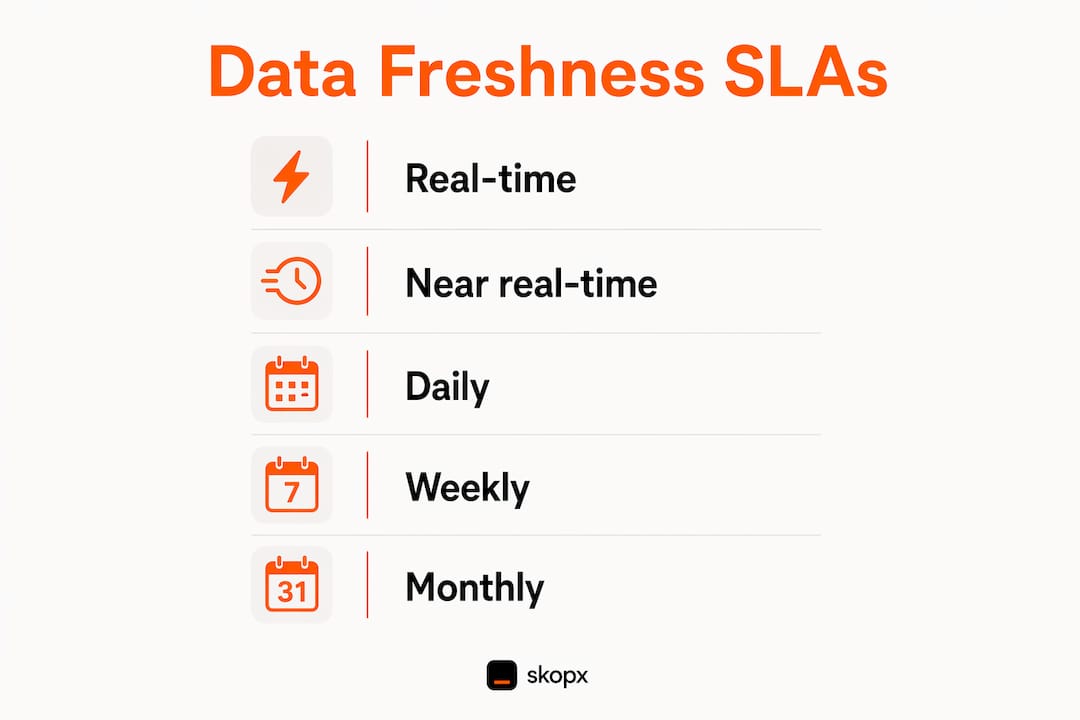
The standard approach is to categorize data into freshness tiers:
| Tier | SLA Range | Business context |
|---|---|---|
| Real-time | Under 5 minutes | Fraud detection, live inventory, active bidding |
| Near-real-time | 15–60 minutes | Marketing attribution, customer support queues |
| Daily | 1–24 hours | Sales reporting, operational dashboards |
| Weekly/archival | 7+ days | Historical trend analysis, compliance reporting |
High-performing analytics teams automate SLA enforcement by tier, which reduces alert fatigue. A daily reporting table that misses its 24-hour window should trigger a warning. The same table missing by 10 minutes should not. Treating all data with the same urgency creates noise that causes teams to ignore alerts entirely.
The most effective technical control is a staleness circuit breaker. This is a check built into downstream consumers, such as ML scoring jobs or dashboard refresh logic, that fails loudly when freshness thresholds are exceeded. Instead of silently serving stale outputs, the system stops and surfaces the problem. That is the behavior you want. Silent failures are far more costly than visible ones.
Pro Tip: When setting SLA thresholds, work backward from the business decision cycle. If a sales manager reviews pipeline data every morning at 8 a.m., your CRM data needs a daily SLA with an error threshold of no more than 2 hours before that review window.
Pairing service level objectives with freshness tiers gives your team a shared language between engineering and business stakeholders. Engineers know what to build. Business analysts know what to expect. That alignment prevents the common situation where a pipeline is technically "working" but delivering data that is no longer useful.
What challenges arise in maintaining data freshness?
The most common challenge is the gap between what your orchestration tool reports and what your data actually contains. Many teams monitor only ETL job status, which tells you whether a job ran, not whether it processed new data. A job can complete successfully, log a green status, and still leave your destination table unchanged if the source had no new records or if a connection silently dropped mid-run.
Common pitfalls that cause freshness failures include:
- Silent source delays: upstream systems stop emitting events without sending an error signal downstream.
- Buffering behavior: streaming platforms like Apache Kafka hold records in buffers, creating apparent freshness that does not reflect actual event time.
- Schema changes: a source system adds or renames a column, causing the ingestion job to skip records without failing.
- Timezone mismatches: timestamps stored in different time zones produce incorrect age calculations in monitoring queries.
Each of these fails quietly. None of them triggers an obvious alert in a standard pipeline monitoring setup.
Pro Tip: Add a max_event_timestamp column to every staging table and monitor it independently of job run logs. This single addition catches the majority of silent freshness failures without requiring a dedicated observability platform.
The solution is to monitor actual data timestamps inside the destination system, not just job execution logs. Checking max_load_at timestamps in the destination catches pipeline stalls that job-level monitoring misses entirely. Embedding freshness indicators directly in analytics dashboards, such as a "data last updated" label visible to end users, builds trust and surfaces problems before they affect decisions.
Key Takeaways
Data freshness is the most common cause of data downtime, and the teams that manage it well treat it as a business metric, not a technical one.
| Point | Details |
|---|---|
| Freshness vs. latency | Freshness measures data age relative to now; latency measures pipeline duration. They do not always correlate. |
| Monitor actual timestamps | Check MAX(event_timestamp) in destination tables, not just whether ETL jobs reported success. |
| Tier your SLAs | Assign real-time, near-real-time, daily, or archival thresholds based on how each dataset drives decisions. |
| Use circuit breakers | Build staleness checks into downstream consumers so stale data fails loudly instead of silently degrading outputs. |
| Freshness has business cost | Stale data can cost organizations 1–5% of annual revenue through flawed decisions and degraded AI model accuracy. |
The case for treating freshness as a business metric, not a pipeline KPI
At Skopx, we have seen the same pattern repeat across organizations of every size. The data engineering team builds solid pipelines, sets up job monitoring, and considers freshness solved. Then a business analyst flags that the churn model has been underperforming for six weeks. The investigation reveals that a source feed stopped updating 43 days ago. The job logs showed green the entire time.
The root cause is almost never a technical failure. It is a framing failure. When freshness is owned by engineering as a pipeline metric, it gets measured by pipeline standards. When it is owned jointly by engineering and the business as a decision quality metric, it gets measured by what actually matters: whether the data reflects the world as it exists right now.
The uncomfortable truth is that most freshness SLAs are set by what is technically convenient, not by what the business actually needs. A daily batch job runs at 2 a.m. because that is when the server load is low, not because analysts need data that is 6 hours old when they arrive at 8 a.m. Closing that gap requires a conversation between data teams and business stakeholders that most organizations have never had.
Freshness is also a cost lever. Real-time ingestion costs more than daily batch processing. Not every dataset justifies that cost. The right answer is a tiered approach where you invest in freshness proportionally to the business value of the decisions that dataset drives. Fraud detection earns real-time. A quarterly compliance report does not.
The teams that get this right treat freshness as a dynamic, business-led metric that gets reviewed and adjusted as business priorities shift. They do not set thresholds once and forget them. They revisit SLAs when new use cases emerge, when AI models go into production, or when a business process changes its decision cadence.
Skopx
How Skopx keeps your analytics running on fresh data
Stale data is a solvable problem, but solving it requires visibility across every data source your team relies on.
Skopx connects to nearly 1,000 integrations and surfaces freshness signals across all of them in a single interface. Teams can query live data, set freshness thresholds, and receive alerts when any source falls behind its SLA, without writing a single monitoring script. The real-time analytics platform gives analysts a live view of data recency across every connected tool. For organizations that need a deeper strategy around data quality and observability, Skopx's AI consulting services help teams build freshness frameworks aligned to actual business requirements, not just technical defaults.
FAQ
What does data freshness mean in analytics?
Data freshness is the measure of how current your data is relative to the present moment. It is defined as the time delta between when an event occurs and when that data is available for querying in your analytics system.
How is data freshness different from data latency?
Latency measures how long data takes to move through a pipeline. Freshness measures how old the data is right now. A pipeline can have low latency and still deliver stale data if it runs infrequently.
Why does data freshness matter for AI and ML models?
Models scored or trained on stale data suffer from freshness rot, a form of model drift where accuracy degrades silently as the gap between training data and current reality widens. This leads to poor predictions and loss of trust in the model.
How do you measure data freshness in practice?
The most reliable method is to query MAX(event_timestamp) directly in the destination table and compare it against the current time. This catches silent pipeline failures that job-level monitoring misses.
What is a data freshness SLA?
A data freshness SLA is a defined threshold specifying how old data is allowed to be before it triggers a warning or error. SLAs should be tiered by business use case, with real-time thresholds under 5 minutes for critical feeds and daily thresholds for reporting datasets.
Recommended
Skopx Team
The Skopx engineering and product team