Why Analysts Need Unified Data Access in 2026
Unified data access is defined as the ability to query all of an organization's data sources through a single, consistent interface without manually reconciling conflicting records. For data analysts and BI professionals, this is not a convenience. It is the foundation of reliable reporting, trustworthy AI, and decisions that actually stick. Daily global data volume exceeds 400 million terabytes, and without integration, that volume becomes a liability rather than an asset. The question of why analysts need unified data access has a direct answer: fragmented data produces fragmented insights, and fragmented insights cost organizations time, money, and credibility.
Why analysts need unified data access for productivity and accuracy
Fragmented data environments force analysts into a cycle of manual reconciliation that kills productivity. An analyst pulling numbers from a CRM, a data warehouse, and three spreadsheets is not doing analysis. They are doing data janitorial work. Teams save dozens of hours monthly by automating that manual data manipulation through unified platforms. Those recovered hours go directly into higher-value work: modeling, forecasting, and communicating findings to decision-makers.
Accuracy improves just as sharply as speed. When every report draws from the same ingestion pipeline and the same transformation logic, metric definitions stay consistent across teams. A "monthly active user" means the same thing in the marketing dashboard as it does in the finance report. Unified data platforms deliver the fastest ROI through reduced reporting time and improved data accuracy. That consistency is what turns a report from a conversation starter into a decision-making tool.

Pro Tip: Before requesting a new data pipeline, check whether your unified platform already ingests that source. Duplicate pipelines are the single biggest source of metric inconsistencies in mid-size analytics teams.
The table below shows how productivity metrics shift when analysts work from a unified platform versus a fragmented multi-source environment.
| Metric | Fragmented environment | Unified platform |
|---|---|---|
| Hours spent on data prep per week | 15–20 hours | 3–5 hours |
| Report delivery time | 3–5 days | Same day or next day |
| Metric definition conflicts | Frequent | Rare |
| Engineering requests per month | High | Significantly reduced |
| Analyst confidence in data | Low to moderate | High |
Why AI and advanced analytics fail without unified data
AI models are only as good as the data they consume. The principle is simple: garbage in, garbage out. An AI agent querying five disconnected databases will return five partial answers, and the model has no way to know which one is correct. Without unified access, AI agents miss or misinterpret data, producing unreliable analytics and flawed decisions. Data unification is not a prerequisite for AI convenience. It is a prerequisite for AI functioning at all.
The semantic layer is the specific mechanism that makes unified data AI-ready. A semantic layer sits between raw data and the query interface, predefining relationships, business logic, and metric calculations. Semantic layers ensure AI generates trusted insights instead of flawed query results caused by duplicated or ambiguous data. Without it, an AI tool may count the same customer twice, apply the wrong revenue formula, or pull from a deprecated table.
Here is what breaks in practice when analysts skip unified data for AI workflows:
- Duplicate entity counting: AI queries two source tables and counts the same record twice, inflating totals.
- Stale data references: Agents pull from cached or outdated snapshots because no single ingestion layer enforces freshness.
- Conflicting business logic: One table defines "churn" as 30 days inactive, another as 90 days. The AI picks one arbitrarily.
- Incomplete context windows: Fragmented sources mean the AI only sees part of the customer journey, producing partial recommendations.
- Audit failures: Regulated industries require explainable AI decisions. Traceable semantic layers enable auditable AI decisions in finance and healthcare, where explainability is increasingly mandatory.
Analysts who want to use AI-powered analytics reliably must treat data unification as the first engineering priority, not an afterthought.
How unified data access improves cross-team collaboration
The most common source of conflict in a data-driven organization is not bad data. It is two teams looking at different versions of good data and reaching opposite conclusions. Sales says revenue is up. Finance says it is flat. Both are right about their own numbers. Neither is right about the business. Unified data integration eliminates conflicting records and enables confident decisions across departments.
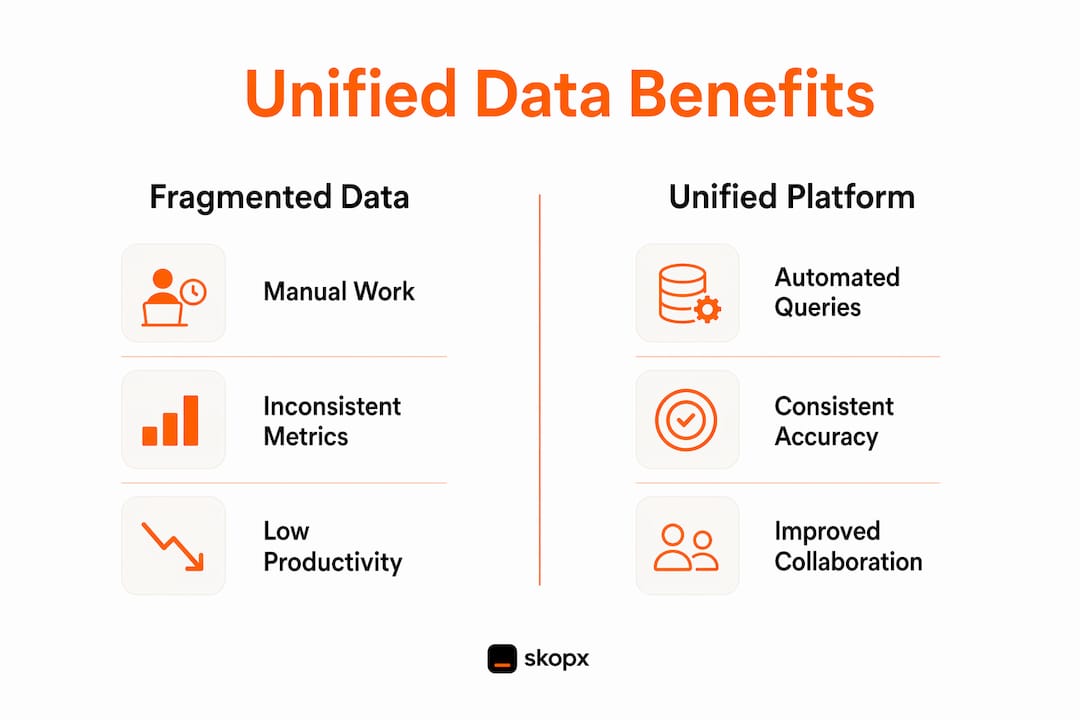
A single source of truth removes that conflict at the root. When marketing, finance, product, and operations all query the same semantic layer, they share not just the same numbers but the same definitions. "Revenue" is not a negotiable term anymore. Unified platforms reduce "swivel chair" work and accelerate team decisions by eliminating the back-and-forth of reconciling competing reports.
Pro Tip: When onboarding a new department to a shared data platform, start with one shared metric, such as monthly revenue or active users. Getting agreement on a single definition builds trust faster than any technical migration.
The collaboration benefits extend beyond fewer arguments. They include:
- Faster validation cycles, because analysts do not need to re-pull data from separate sources before each meeting.
- Reduced meeting overhead, since teams arrive with the same numbers already in hand.
- Shared semantic definitions that save engineer-weeks quarterly by eliminating redundant data requests.
- Greater organizational agility, because decisions move at the speed of insight rather than the speed of data reconciliation.
What technologies enable effective unified data access?
Unified data access is not a single product. It is an architecture built from several complementary components. Understanding each one helps analysts advocate for the right infrastructure and use it more effectively.
Centralized data hubs and real-time ingestion
A centralized data hub pulls data from all source systems into one location, whether a cloud data warehouse or a lakehouse. Real-time ingestion pipelines keep that hub current, so analysts are never working from yesterday's numbers. Modern unified systems blend physical and virtual integration for scalable, real-time analytics that adapt as data volumes grow.
Semantic layers and unified data models
The semantic layer translates raw tables into business concepts. It defines what "customer," "order," and "revenue" mean across the organization. Analysts query the semantic layer, not the raw tables. This separation protects business logic from changing source schemas and makes real-time insights across diverse tools consistent regardless of which tool generates the query.
Data federation for live queries
Data federation lets analysts query data in place without physically moving it. This is useful when data residency rules or latency requirements prevent full centralization. The trade-off is that federated queries are typically slower and harder to govern than queries against a centralized hub.
The table below compares physical and virtual unification approaches.
| Approach | How it works | Best for | Main trade-off |
|---|---|---|---|
| Physical unification | Data copied to central warehouse | High-volume batch analytics | Storage cost and ingestion latency |
| Virtual unification (federation) | Queries run against source systems live | Compliance-sensitive or real-time data | Query performance and governance complexity |
| Hybrid | Central hub plus federated queries | Most enterprise environments | Requires careful architecture planning |
Practical steps for analysts to get the most from unified data
Adopting unified data access is not purely an engineering decision. Analysts drive adoption by knowing how to work within unified systems and pushing for the practices that make them reliable.
- Audit your current data sources. List every source you query regularly. Identify which ones are already in your unified platform and which ones require a new integration. Prioritize the highest-frequency sources first.
- Partner with data engineering on semantic layer definitions. Do not wait for engineers to define business metrics in isolation. Bring your reporting logic to the table early. The semantic layer reflects the business, and analysts understand the business better than engineers do.
- Use self-service analytics tools built on unified platforms. These tools let you query clean, governed data without writing SQL or waiting for a data request ticket. They also free data engineers for infrastructure work rather than ad hoc pulls.
- Validate consistency before publishing reports. Run the same metric through two different query paths and confirm the results match. If they do not, there is a semantic layer gap that needs fixing before the report goes to leadership.
- Document exceptions and known data gaps. Every unified platform has edge cases. Keeping a shared log of known issues prevents the same question from being investigated twice and builds team trust in the data.
- Avoid bypassing the semantic layer. Querying raw tables directly to "save time" introduces the exact inconsistencies that unified platforms exist to prevent. One shortcut can corrupt a metric definition for the entire organization.
Automating back-office data workflows is a natural next step once your unified platform is stable. Automation built on clean, unified data produces reliable outputs. Automation built on fragmented data amplifies errors at scale.
Key Takeaways
Analysts who work from unified data access produce faster, more accurate, and more trusted insights than those working from fragmented sources.
| Point | Details |
|---|---|
| Productivity gains are immediate | Unified platforms cut weekly data prep time from 15–20 hours to 3–5 hours. |
| AI requires unified data to function | Fragmented sources cause AI agents to return partial or conflicting answers. |
| Semantic layers protect business logic | Predefined metric definitions prevent duplication and ensure consistent reporting. |
| Collaboration depends on shared definitions | Teams that share one data source eliminate metric conflicts and speed up decisions. |
| Analysts must advocate for the architecture | Partnering with engineering on semantic layers is as important as the analysis itself. |
The case for treating data unity as a first principle
The Skopx Team has worked with enough analytics teams to recognize a pattern: the organizations that treat data unification as infrastructure invest in it early and rarely revisit it. The ones that treat it as a future project spend years rebuilding dashboards, re-explaining metric discrepancies to executives, and watching AI pilots fail for reasons that have nothing to do with the AI.
The uncomfortable truth is that most data quality problems are not data problems. They are architecture problems. An analyst working from five disconnected sources is not less skilled than one working from a unified platform. They are working harder to produce a less reliable result. That is not a personal failure. It is a structural one.
The rise of AI agents makes this more urgent, not less. An AI agent that can query unified data in real time and return a trusted answer in seconds is genuinely useful. An AI agent querying fragmented sources is a liability dressed up as a feature. The semantic layer is what separates those two outcomes, and most organizations still underinvest in it.
The analysts who will define the next five years of BI are the ones who understand that their job is not just to analyze data. It is to advocate for the conditions that make analysis trustworthy. Unified data access is the most important of those conditions.
Skopx Team
How Skopx supports unified data access for analysts
Skopx connects to nearly 1,000 integrations, giving analysts a single interface to query data and trigger actions across every tool in their stack. No more switching between platforms or waiting for engineering tickets.
Skopx's AI consulting services help organizations build the data strategy and semantic layer architecture that make unified access real rather than theoretical. The AI Data Agent takes that foundation further, automating analysis workflows so analysts spend time on decisions rather than data preparation. If your team is ready to move from fragmented reporting to a single trusted environment, Skopx is built for exactly that transition.
FAQ
What is unified data access for analysts?
Unified data access means querying all organizational data through one consistent interface with shared metric definitions. It eliminates the need to manually reconcile data from multiple disconnected sources.
How does unified data access improve reporting accuracy?
Unified platforms enforce consistent business logic and metric definitions across every report. This prevents the conflicting numbers that arise when different teams pull from different source systems.
Why do AI analytics tools require unified data?
AI agents can only work with data they can access. Fragmented environments cause agents to return partial or incorrect answers because they lack the full context needed for reliable analysis.
What is a semantic layer and why does it matter?
A semantic layer sits between raw data and query tools, predefining relationships and business metrics. It prevents duplication, enforces consistent logic, and makes AI-generated insights auditable and trustworthy.
How can analysts start improving data accessibility today?
Start by auditing which data sources are already in your unified platform and partnering with data engineering to define shared metrics. Prioritizing the highest-frequency sources delivers the fastest improvement in reporting quality.
Recommended
Skopx Team
The Skopx engineering and product team