AI Suggestions in Query Building: A Pro Guide
AI suggestions in query building are defined as schema-aware, iterative, and result-interpreting components that guide AI systems to generate accurate SQL from natural language inputs. The role of AI suggestions in query building has moved from experimental to production-critical, with NL-to-SQL accuracy climbing from 69.23% to 88.50% when feedback loops and metadata are applied correctly. For data management and analytics professionals, this shift means fewer manual query rewrites, faster insight delivery, and measurable gains in workflow efficiency. Understanding the mechanics behind these gains is what separates teams that get real value from AI-assisted query formulation and those that don't.
What is the role of AI suggestions in query building?
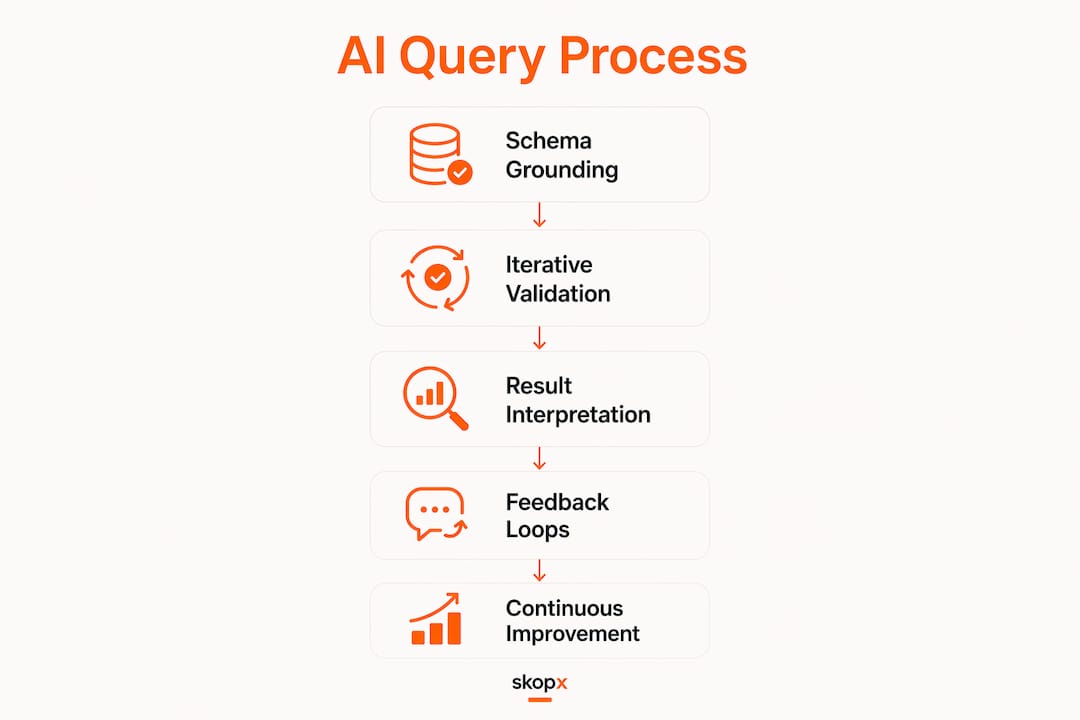
AI suggestions in query building work through three interlocking mechanisms: schema grounding, iterative validation, and result interpretation. Each one addresses a specific failure point in traditional natural language to SQL conversion.
Schema grounding
Schema grounding means the AI reads your database's table names, column definitions, constraints, and domain-specific instructions before generating any SQL. Without this context, accuracy collapses. Metadata absence causes accuracy drops of up to 79 percentage points. That is not a marginal degradation. It means an AI generating SQL without schema context is essentially guessing.

When schema grounding is active, the AI maps user intent to real column names and enforces join constraints automatically. A question like "show me Q3 revenue by region" becomes a correctly structured SELECT with the right table aliases, date filters, and GROUP BY clauses, not a hallucinated approximation.
Iterative validation
Validation happens before any query touches your database. The AI parses generated SQL with a lightweight syntax checker, then runs a dry-run EXPLAIN plan to estimate resource cost. If the query exceeds a cost threshold or contains unsafe operations, the agent blocks execution and revises. This pre-execution layer is what makes AI query agents safe to deploy in production environments with live data.
Pro Tip: Start every AI query agent deployment with read-only database access. This single guardrail prevents accidental writes or deletes during the validation and tuning phase, and it builds team confidence in the system before you expand permissions.
Result interpretation
Result interpretation is the step most teams skip, and it costs them. When a query returns zero rows, a well-designed AI agent explains why, whether the filter was too narrow, the date range excluded all records, or the join condition found no matches. Explaining empty query results contextually prevents users from drawing false conclusions from blank output. It also closes the feedback loop, giving the AI signal to refine the next query attempt.
- Schema grounding maps user language to real database objects
- Iterative validation blocks unsafe or expensive queries before execution
- Result interpretation converts raw output into user-facing explanations
- Feedback loops store corrected patterns for future query accuracy gains
How do AI-powered query optimization agents outperform traditional optimizers?
Traditional cost-based query optimizers work well for simple queries. They fail on complex multi-table joins because they rely on cardinality estimates, which are often wrong when data distributions are skewed or statistics are stale.
LLM agents reason differently. They analyze semantic context, including column correlations, domain relationships, and historical query patterns, to make join order decisions that a rule-based optimizer cannot. LLM agents achieve up to 16x workload-level speedups and up to 600x improvements on individual complex queries. Those numbers reflect real production workloads, not synthetic benchmarks.
"LLMs excel at reasoning about semantic context beyond what traditional optimizers achieve. They cannot yet be embedded in real-time query optimization, making offline agentic tuning the practical approach for production systems." Source: Databricks Blog
The offline agentic approach works by running iterative join order tests outside the hot query path. A prototype agent tested 15 join orders and improved geomean latency by 1.288x over the default optimizer, outperforming even perfect cardinality estimates. That result matters because it shows the AI is not just correcting estimation errors. It is finding structural improvements the optimizer's model cannot represent.
| Optimization method | Workload speedup | Query-level improvement |
|---|---|---|
| Traditional cost-based optimizer | Baseline | Baseline |
| LLM agent (offline iterative) | Up to 16x | Up to 600x on complex queries |
| LLM agent (distributed environments) | 10.27x | Varies by join complexity |
| LLM agent (Databricks production) | 1.3x latency gain | Consistent across workloads |
The practical implication is clear. If your team runs complex analytical queries with multiple joins, an LLM-based optimization agent working offline will outperform your current optimizer. The investment in setting up the agentic workflow pays back in reduced query latency and lower compute costs.
How is AI transforming search query building in analytics environments?
The way professionals interact with data systems is changing at the query level. Average AI-mode query length is now triple that of traditional keyword searches, and follow-up queries have grown 40% month over month. Users are no longer typing short commands. They are having conversations with their data.
This shift from keyword matching to intent-based querying has direct consequences for how analytics platforms must be built. A system that only handles "sales by region 2025" will fail when a user asks "why did Northeast revenue drop in Q2 compared to the same period last year?" The second query requires the AI to understand comparison intent, time context, and causal framing, not just column selection.
For data professionals, adapting to this shift means rethinking query interfaces entirely. The goal is no longer to train users to write better SQL. The goal is to build AI systems that understand what users mean, not just what they type.
Here is how to adapt your workflows for conversational, intent-aware querying:
- Audit your current query patterns. Identify which queries are repetitive and structured versus which are exploratory and ad hoc. AI suggestions deliver the most value on the ad-hoc tail.
- Map user intent categories. Group queries by intent type: comparison, trend analysis, anomaly detection, and aggregation. Train your AI agent on examples from each category.
- Build follow-up handling. Design your query agent to retain context across a session so follow-up questions refine the previous query rather than starting from scratch.
- Instrument query feedback. Capture which AI-generated queries users accept, edit, or reject. Feed that signal back into your prompt refinement cycle.
Pro Tip: When building intent-aware query systems, start with your five most common ad-hoc request types. Document the SQL pattern for each, then use those as grounding examples in your AI agent's prompt. This shortcut cuts early-stage error rates significantly.
The impact of AI on search queries extends beyond consumer search. Analytics teams that adopt conversational query interfaces report faster time-to-insight because analysts spend less time translating business questions into SQL syntax. The AI handles the translation layer.
What are best practices for implementing AI suggestions in query workflows?
Production deployment of AI query agents requires more than a good language model. The architecture around the model determines whether it succeeds or fails in a real data environment.
- Document your schema thoroughly. Every table, column, and constraint needs a plain-language description. The AI uses these descriptions to ground queries in your actual data model. Sparse documentation produces inaccurate SQL.
- Start with read-only agents. Grant the AI agent SELECT permissions only during initial deployment. This prevents accidental data modification and gives your team time to validate output quality before expanding access.
- Layer your validation. Run syntax parsing first, then cost estimation via EXPLAIN plans, then a human review queue for queries above a defined cost threshold. Each layer catches a different class of error.
- Store and reuse validated patterns. Storing corrected SQL patterns improves accuracy by approximately 20 percentage points over time. Build a pattern library from every query the agent gets right, and use it to ground future generations.
- Plan for domain expert review. AI agents handle the long tail of ad-hoc queries well, but complex business logic still needs analyst oversight. Build a review workflow for queries that touch sensitive metrics or require multi-step reasoning.
Using LLM Observability tools to compare reasoning traces across correct and incorrect query generations is one of the most underused practices in production deployments. These tools let you identify exactly where the model's reasoning diverges from correct SQL logic, which makes prompt refinement precise rather than guesswork.
Pro Tip: Build a "query confidence score" into your agent's output. When the AI rates its own certainty below a threshold, route the query to a human analyst before execution. This hybrid model keeps accuracy high without requiring full human review of every query.
For teams exploring custom AI agent development, the architecture decisions made at the start, including schema access, validation layers, and feedback storage, determine long-term performance more than model choice does.
Key Takeaways
AI suggestions in query building deliver their highest value when schema grounding, iterative validation, and result interpretation work together as a unified system, not as isolated features.
| Point | Details |
|---|---|
| Schema grounding is non-negotiable | Missing metadata causes accuracy drops up to 79 percentage points in NL-to-SQL systems. |
| Validation prevents production failures | Parse SQL and run EXPLAIN plans before execution to block unsafe or expensive queries. |
| Feedback loops compound accuracy gains | Storing validated SQL patterns improves AI query accuracy by approximately 20 percentage points. |
| LLM agents outperform rule-based optimizers | Offline LLM agents achieve up to 16x workload speedups on complex multi-join queries. |
| Intent-aware querying is the new standard | Follow-up query volume has grown 40% monthly, signaling a shift to conversational data interaction. |
The uncomfortable truth about AI in query building
The Skopx team has worked with enough data teams to say this plainly: most AI query failures are not model failures. They are documentation failures. Teams deploy an AI query agent against a schema with no column descriptions, no domain context, and no validated examples, then blame the model when it generates wrong SQL.
The model is doing exactly what it was designed to do. It is reasoning from the information it has. When that information is thin, the output is thin. The fix is not a better model. It is better schema documentation and a pattern library built from real, validated queries.
The second uncomfortable truth is that AI agents are not here to replace your analysts. They are here to handle the flood of ad-hoc requests that analysts never had time for. A skilled analyst should not spend 40 minutes writing SQL for a one-off question that a business stakeholder needs answered before a meeting. An AI agent should handle that. The analyst's time belongs on the queries that require genuine domain judgment.
The teams that get this right treat the AI agent as a junior analyst with excellent SQL syntax skills but limited business context. They give it good documentation, clear guardrails, and a feedback channel. They review its work on complex queries and let it run independently on simple ones. That division of labor is where the real productivity gains live.
Anticipated advances in LLM integration will eventually bring real-time query tuning closer to production-ready. For now, offline agentic optimization is the practical path. Teams that build the right architecture today, with solid metadata, layered validation, and feedback loops, will be positioned to absorb those advances without rebuilding from scratch. The AI search citation share rising to 17% in B2B SaaS is a signal that authoritative, well-structured content and well-structured data systems are rewarded by AI systems alike.
Skopx Team
How Skopx powers production-ready AI query building
Skopx brings schema-aware AI agents, validation layers, and result interpretation into a single platform connected to nearly 1,000 integrations.
Skopx's data connectors for SQL and MongoDB handle ad-hoc query generation from plain-language questions, so your team gets accurate answers without hand-writing SQL. Cross-tool AI chat extends this with insight delivery across your connected data sources, and the morning briefing surfaces what changed without anyone having to ask. And billing stays transparent: the Team plan includes 2.3 million AI tokens per seat every month, with the option to add tokens or bring your own API key as overflow, always at zero markup. Skopx is built for data professionals who need production-grade accuracy, not prototype-level demos.
FAQ
What does schema grounding do in AI query building?
Schema grounding gives the AI access to table names, column definitions, and constraints before it generates SQL. Without it, accuracy drops up to 79 percentage points.
How much faster are LLM query agents than traditional optimizers?
LLM agents achieve up to 16x workload-level speedups and up to 600x improvements on individual complex queries compared to traditional cost-based optimizers.
Why do AI query agents need validation layers?
Validation layers catch syntax errors and flag expensive or unsafe operations before they reach the database. Parsing SQL and running dry-run EXPLAIN plans are the two core validation steps.
How do feedback loops improve AI-assisted query formulation?
Storing corrected SQL patterns from past queries improves AI accuracy by approximately 20 percentage points over time, compounding with each validated interaction.
Are AI query agents safe for production databases?
Yes, when deployed with read-only access initially, pre-execution validation, and cost thresholds. These guardrails prevent accidental writes and expensive operations during the tuning phase.
Share this article
Skopx Team
The Skopx engineering and product team