How Reducing Data Prep Time Helps Analysts Work Smarter
Data preparation is defined as the process of collecting, cleaning, transforming, and organizing raw data before analysis begins. Data teams spend 40%–80% of their time on these manual tasks instead of the strategic analysis that actually drives business decisions. Understanding how reducing data prep time helps analysts is the difference between a team that reacts to last week's numbers and one that shapes next quarter's strategy. The industry term for minimizing this burden is "data preparation efficiency," and it has become the defining challenge for business intelligence professionals in 2026.
How reducing data prep time helps analysts deliver more value
The core benefit is simple: every hour saved on cleaning and transforming data is an hour available for actual analysis. That shift compounds quickly across a team.

More time for strategic thinking
Analysts who spend the majority of their day wrangling spreadsheets rarely have the mental bandwidth for deeper modeling or trend interpretation. Reclaiming half of prep time can triple an analyst's output without adding a single new hire. That is not a marginal gain. It is a structural change in what a team can produce.
Fewer errors, more trustworthy data
Manual prep introduces copy-paste mistakes, formula errors, and inconsistent formatting. Automated pipelines eliminate these errors by running the same transformation logic every time, without variation. The result is data that analysts and executives can actually trust, which shortens the time between a question and a confident answer.
Higher job satisfaction
Repetitive data wrangling is one of the top reasons skilled analysts leave roles or disengage. Shifting prep responsibility away from manual tasks and toward self-service analytics removes the tedium that drains motivation. Analysts hired for their critical thinking spend their time doing critical thinking.
"Inefficient prep traps analysts in data wrangling, creating an opportunity cost that limits revenue-generating models and caps organizational output. Freeing analysts from that trap is not a quality-of-life improvement. It is a direct business investment."
The ROI case is concrete. Automating repetitive ETL tasks reduces IT support tickets by 60%–70% and delivers returns between 193% and 764%. Those numbers reflect real budget impact, not theoretical efficiency.
Which tools and methods most effectively cut data preparation time?
The market for data preparation tools has matured significantly. Analysts now have access to several categories of technology that reduce manual effort without requiring deep engineering skills.
Self-service data preparation platforms
Self-service platforms let analysts clean, join, and transform data through visual interfaces rather than code. This removes the IT bottleneck that historically slowed prep work by days or weeks. Analysts can build and modify their own pipelines, test transformations in real time, and push clean data directly to their reporting layer.
- Visual drag-and-drop interfaces let analysts map transformations without writing SQL or Python, cutting setup time from hours to minutes.
- Reusable transformation templates mean a cleaning logic built once gets applied across multiple datasets automatically.
- Scheduled pipeline runs replace manual exports and imports, so analysts arrive each morning to fresh, clean data rather than a backlog of prep work.
- Built-in data profiling surfaces quality issues like nulls, duplicates, and outliers before they reach a dashboard, catching problems at the source.
AI-accelerated prep workflows
AI tools now handle tasks that previously required significant analyst attention, including deduplication, schema matching, and anomaly flagging. Agentic prep tools speed workflow design and lower error rates, but they require analyst review to preserve business context and accuracy. The human-in-the-loop model is not optional. It is what separates a useful AI output from a confidently wrong one.
Skopx connects with nearly 1,000 integrations and uses an agentic AI workflow that lets analysts query data and trigger actions in real time, without switching between tools. That unified interface removes the friction of managing multiple platforms simultaneously.
Pro Tip: Before adopting any AI prep tool, map your most time-consuming manual steps first. Target those specific bottlenecks rather than replacing your entire workflow at once. Incremental adoption produces faster, measurable wins.
| Approach | Best for | Analyst skill required |
|---|---|---|
| Visual self-service platforms | Recurring, structured datasets | Low to moderate |
| AI-assisted agentic prep | Complex joins and schema matching | Moderate, with review |
| Automated scheduled pipelines | High-volume, repeatable workflows | Low once configured |
| Code-based ETL frameworks | Custom transformations at scale | High |
For analysts who also want to improve how clean data gets communicated, data visualization best practices connect directly to the quality gains that faster prep enables.
How does faster data prep impact analyst productivity and data quality?
The productivity impact of reducing prep time is measurable at both the individual and organizational level. The quality impact is equally significant, though it shows up differently.
Individual output and team throughput
An analyst spending 60% of their time on prep and 40% on analysis produces a fraction of the insight volume of one spending 20% on prep and 80% on analysis. The math is straightforward, but the organizational implication is often overlooked. Teams that invest in prep efficiency do not just get faster reports. They get analysts who can take on more complex questions, build more reliable models, and contribute to decisions that were previously outside their capacity.
Data quality and auditability
Working from copies of raw data ensures workflows are auditable and original data remains unaltered for validation. This practice makes analysis reproducible and defensible, which matters enormously when a business decision gets questioned. An analyst who can trace every transformation step is an analyst whose work holds up under scrutiny.
The cultural shift from IT-dependent to analyst-empowered
The transition from IT-managed prep to analyst-driven preparation changes how organizations think about data access. Analysts stop waiting days for a data pull and start building their own pipelines. That shift requires investment in tooling and training, but the payoff is a team that moves at the speed of the business rather than the speed of the IT queue.
Key risks that faster, better prep directly prevents:
- Stale data in dashboards caused by manual export delays
- Inconsistent metrics from analysts using different versions of the same dataset
- Shadow IT where analysts build unofficial workarounds outside governed systems
- Undocumented transformations that break when source schemas change
Skipping data prep entirely before running AI analysis leads to loss of trust in outputs and worsens existing backlogs. Prep is not a step you can shortcut. It is the foundation that determines whether AI-generated insights are usable or misleading.
What practical strategies can analysts use to reduce data prep time sustainably?
Efficiency gains in data prep do not come from a single tool purchase. They come from building repeatable habits and systems that hold up as data volumes and complexity grow.
- Protect raw data with copies. Always work from a copy of the source dataset, never the original. This preserves the ability to rerun, audit, and validate any transformation at any point in the future.
- Document every transformation step. Without documentation and version control, prep workflows break when source schemas change, creating technical debt that compounds over time. A short comment in a pipeline script saves hours of debugging later.
- Build collaboration between analysts and data engineers. Analysts understand the business logic. Engineers understand the infrastructure. When both groups co-design pipelines, the result is prep that is both technically sound and contextually accurate.
- Schedule automated pipelines for recurring datasets. Any dataset you clean more than twice should be automated. Manual repetition is where errors accumulate and time disappears.
- Apply human-in-the-loop review to AI-generated prep steps. AI tools accelerate the design of transformations, but an analyst must verify that the output reflects the correct business definition of each field.
Pro Tip: Build a short "data prep checklist" for each recurring report: source confirmed, copy created, transformations documented, output validated. Running this checklist takes five minutes and prevents the kind of errors that take five hours to diagnose.
Working with an experienced data analytics consultant can help organizations identify which prep steps are candidates for automation and which require ongoing human judgment.
Key Takeaways
Reducing data preparation time is the single most direct way analysts can increase their output, improve data quality, and contribute to faster business decisions.
| Point | Details |
|---|---|
| Prep consumes most analyst time | Data teams spend 40%–80% of their time on prep, leaving little room for actual analysis. |
| Automation delivers measurable ROI | Automating ETL tasks cuts IT tickets by 60%–70% and yields returns up to 764%. |
| Protect raw data always | Working from copies keeps analysis auditable, reproducible, and defensible. |
| AI prep requires human review | Agentic tools accelerate workflows but need analyst oversight to preserve business context. |
| Documentation prevents technical debt | Undocumented prep breaks when schemas change, creating costly future outages. |
What the data prep bottleneck actually costs you
The most common mistake I see analysts make is treating data prep as an unavoidable tax on their time. They accept the 60% prep burden as a given and try to squeeze insight work into whatever is left. That framing is wrong, and it is expensive.
When I look at teams that have genuinely improved their prep efficiency, the change is never just about speed. It is about what analysts start doing with the reclaimed time. They build models they previously had no bandwidth to attempt. They ask questions that were previously too time-consuming to answer. They stop being report generators and start being strategic contributors.
The cultural piece is harder than the technical piece. Giving analysts self-service tools does not automatically change how they work. It requires deliberate adoption, training, and a management culture that rewards insight quality over report volume. The teams that get this right treat prep efficiency as an ongoing discipline, not a one-time setup.
The caution I would add: do not let AI tools create a false sense of security. An AI that cleans your data incorrectly at scale creates a much larger problem than a manual error in a single spreadsheet. The human-in-the-loop review step is not bureaucracy. It is quality control. Build it into every automated workflow from day one.
Skopx Team
How Skopx helps analysts spend less time on prep and more on insight
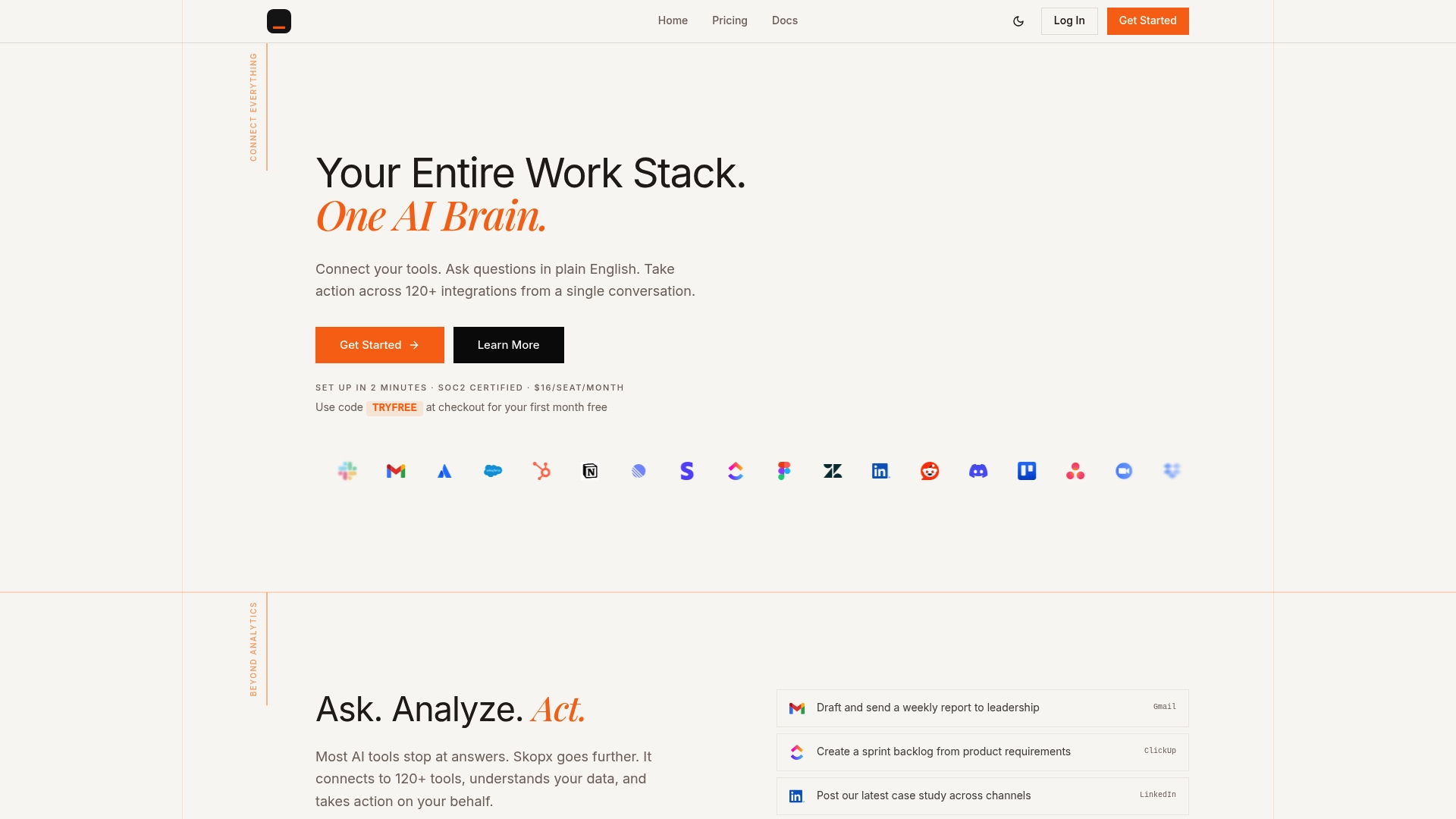
Skopx is built for exactly the problem this article describes. Its unified AI interface connects with nearly 1,000 data integrations, letting analysts query, clean, and act on data without switching between tools. Its cross-tool AI chat and data connectors for SQL and MongoDB take repetitive prep queries off analysts' plates, while keeping analysts in control of business logic and context. For organizations that want a structured path from manual prep to automated pipelines, Skopx's pricing keeps costs predictable as more of the workflow gets automated: the Team plan includes 2.3 million AI tokens per seat every month, and you can add tokens or bring your own API key as overflow, always with zero markup. The goal is the same one this article has outlined: analysts spending their time on analysis, not administration.
FAQ
How much time do analysts typically spend on data preparation?
Data teams spend 40%–80% of their time on manual prep tasks like cleaning, transforming, and connecting data. That leaves as little as 20% of working hours for actual analysis.
What is the ROI of automating data preparation tasks?
Automating ETL and prep workflows delivers ROI between 193% and 764% while reducing IT support tickets by 60%–70%. The return comes from both cost savings and the increased output of freed-up analysts.
Can AI tools fully replace manual data preparation?
AI tools cannot replace proper data preparation. Skipping prep before AI analysis causes high failure rates and erodes trust in outputs. AI accelerates the process but requires human review to preserve accuracy and business context.
What is the biggest risk of undocumented data prep workflows?
Without documentation and version control, prep workflows break when source data schemas change. This creates technical debt that compounds and can cause analytic outages at the worst possible moments.
How does self-service data prep improve analyst job satisfaction?
Self-service prep removes the repetitive manual errors that drain analyst motivation. When analysts control their own pipelines and spend more time on strategic work, engagement and output quality both improve.
Recommended
Share this article
Skopx Team
The Skopx engineering and product team