The Role of AI Agents in Business Tasks: 2026 Guide
AI agents are autonomous software systems that independently pursue complex business goals by planning and executing multiple interrelated steps without requiring a human prompt for each action. That definition separates them from every other AI tool on the market today. The role of AI agents in business tasks has shifted from experimental to operational, with 36% of AI agent use cases in professional settings now focused on workflow and productivity optimization. This guide explains what AI agents actually do, how they differ from simpler automation, and how to deploy them without creating new operational risks.
What tasks and workflows do AI agents automate in businesses?
AI agents provide the most value in repetitive, high-volume, multi-step workflows like invoice reconciliation, scheduling, and support ticket triage where every task step is well-defined. The agent owns the routine loop end-to-end and escalates exceptions to humans only when needed. That model reduces coordination costs and frees skilled workers for higher-judgment work.
The business functions where agents deliver measurable impact fall into clear categories:
- Finance: Invoice matching, expense report processing, payment reconciliation, and audit trail generation
- Customer support: Ticket classification, first-response drafting, escalation routing, and satisfaction follow-up
- HR: Candidate screening, onboarding document collection, policy Q&A, and scheduling interviews
- Marketing: Content brief generation, performance report compilation, and campaign data aggregation
- Operations: Inventory monitoring, vendor communication, and supply chain exception alerts
Knowledge work is also changing fast. Research assistance, document summarization, and competitive analysis are now tasks agents handle with minimal supervision. Knowledge workers in digital tech, finance, and academia lead adoption, using agents as autonomous digital coworkers to accelerate learning and output.
Pro Tip: Start your AI agent deployment with a single, well-documented workflow. Map every step, decision point, and exception before you hand it to an agent. Agents perform best when the process is already clear to the humans who designed it.

The table below shows how agent adoption maps to business function and task type:
| Business Function | Task Type | Agent Role |
|---|---|---|
| Finance | Invoice reconciliation | End-to-end matching, exception flagging |
| Customer support | Ticket triage | Classification, routing, first response |
| HR | Candidate screening | Resume parsing, scoring, scheduling |
| Marketing | Reporting | Data pull, formatting, distribution |
| Operations | Inventory alerts | Threshold monitoring, vendor notification |
How do AI agents differ from traditional automation and AI assistants?
AI agents, AI assistants, and rule-based automation are three distinct tools. Confusing them leads to wrong deployment choices and unmet expectations.
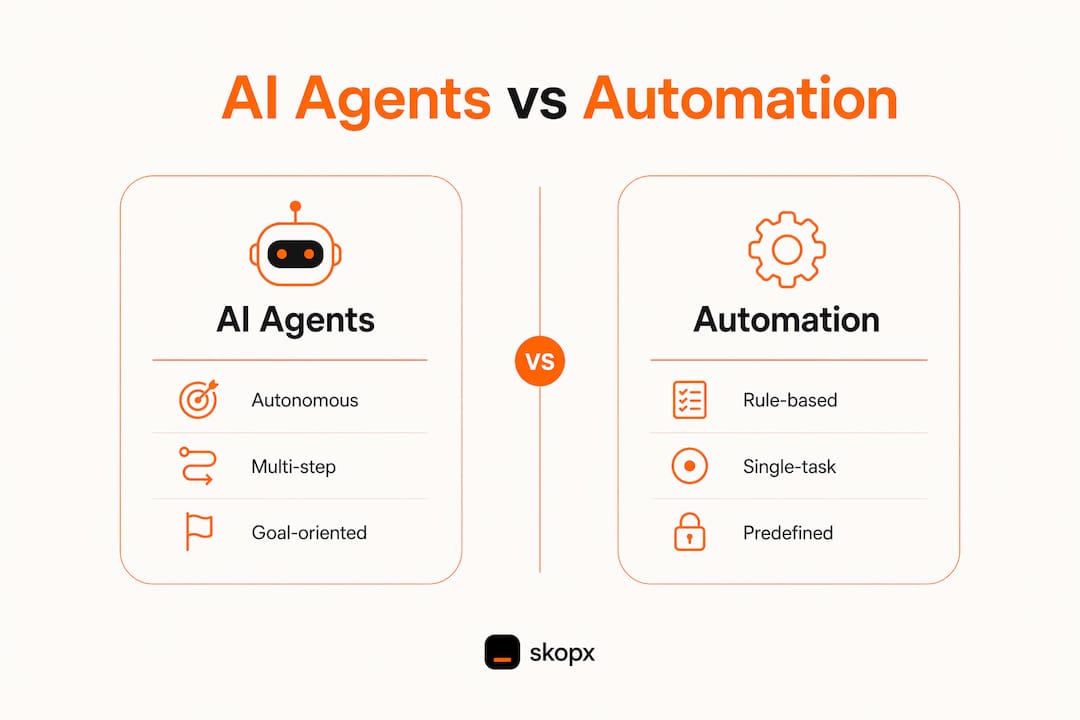
An AI assistant responds to a single prompt and stops. You ask it to summarize a document, it summarizes the document. An AI agent receives a goal and works through a sequence of steps autonomously until that goal is complete or it hits a boundary it cannot cross alone. That proactive autonomy is the defining characteristic of agentic AI systems.
Rule-based automation is different again. A robotic process automation script follows a fixed set of instructions. Change the input format or add a new exception, and the script breaks. AI agents adapt. They reason through novel situations using the context available to them, which makes them far more durable in real business environments where processes evolve constantly.
The comparison below clarifies the operational differences:
| Capability | Rule-based automation | AI assistant | AI agent |
|---|---|---|---|
| Initiates action | No | No | Yes |
| Handles novel inputs | No | Limited | Yes |
| Multi-step execution | Fixed sequence only | No | Yes |
| Adapts to exceptions | No | No | Yes |
| Requires human prompt per step | Yes | Yes | No |
Autonomy increases operational leverage, but it also increases risk without guardrails. An AI agent that can send emails, update records, and trigger payments needs firm boundaries. Trust must be earned incrementally, the same way you would expand a new employee's authority over time.
Pro Tip: Before deploying an AI agent in any workflow, define what it cannot do. A clear list of prohibited actions is more useful than a long list of permitted ones. Agents operate better within explicit constraints than within vague permissions.
What are the challenges and best practices for deploying AI agents responsibly?
Autonomous agents introduce a category of risk that traditional software does not. A misconfigured script fails silently. A misconfigured agent can send 10,000 emails, delete records, or commit budget before anyone notices. The stakes of autonomy are real.
Successful AI agent deployment starts with bounded, reversible tasks and expands autonomy only as reliability is proven. The analogy to new employee onboarding is accurate. You do not give a new hire signing authority on day one. You observe, verify, and extend trust based on demonstrated judgment.
The deployment sequence that works in practice follows these steps:
- Identify a bounded task. Choose a workflow that is well-documented, low-stakes, and reversible if the agent makes an error.
- Define guardrails before launch. Set scope limits, action limits, spend caps, and escalation rules. Layered guardrails transform autonomy from a liability into a controlled capability.
- Run a supervised pilot. Have a human review every agent action for the first two to four weeks. Log all decisions and outcomes.
- Measure and audit. Track error rates, exception frequency, and time saved. Use that data to decide whether to expand scope.
- Add human-in-the-loop checkpoints. For any action that is irreversible or high-value, require human approval before execution.
- Expand incrementally. Add new task types only after the current scope is stable and trusted.
A well-structured business process automation strategy treats agent deployment as a governance exercise, not just a technology rollout. That framing changes how teams approach risk, accountability, and measurement.
One underappreciated risk is psychological. Research shows that AI agency without active human collaboration reduces workers' sense of task ownership and meaning. Agents that fully replace human involvement in a workflow can erode engagement and quality control. The fix is deliberate design of human-in-the-loop systems, not just technical guardrails.
Pro Tip: Assign a named human owner to every AI agent in production. That person reviews exceptions, monitors performance, and has authority to pause the agent. Ownerless agents drift.
How are AI agents reshaping workforce roles and organizational workflows?
AI agents do not eliminate jobs uniformly. They restructure them. The documented labor market shift between 2022 and 2024 shows a 14%–41% reduction in entry- and mid-level software and content roles, with a 15%–22% wage premium for workers with AI-augmentation skills. That gap will widen as agent adoption accelerates.
The roles that shrink are those built around manual execution of well-defined, repeatable tasks. The roles that grow are those focused on supervising agents, designing workflows, validating outputs, and handling exceptions that agents cannot resolve. Human work moves up the value chain, not out of the picture.
MIT Sloan researchers make a critical point: AI delivers the most value when business leaders redesign workflows around AI capabilities rather than automating tasks as they currently exist. That distinction matters enormously. Bolting an agent onto a broken process produces a faster broken process. Redesigning the process around what agents do well produces genuine operational gains.
Key workforce shifts already visible in enterprises adopting AI agents include:
- Junior analysts moving from data collection to data interpretation and exception review
- Customer support teams shrinking in headcount but growing in per-agent resolution capacity
- Finance teams shifting from transaction processing to process governance and audit
- HR coordinators becoming workflow designers who configure and monitor agent behavior
- AI-augmented recruitment compressing screening timelines while raising the bar for human judgment in final decisions
AI reshapes workflows by automating chains of adjacent tasks rather than isolated steps. That reduces coordination costs and handoffs between teams. The organizational value comes from the redesign, not just the automation.
Key Takeaways
AI agents deliver the greatest operational value when deployed within redesigned workflows, governed by layered guardrails, and supported by active human oversight at every critical decision point.
| Point | Details |
|---|---|
| Agents differ from assistants | AI agents pursue multi-step goals autonomously; assistants respond to single prompts and stop. |
| Workflow redesign drives value | Automating tasks as-is produces limited gains; redesigning processes around agent capabilities produces real ones. |
| Guardrails are non-negotiable | Scope limits, spend caps, and escalation rules must be defined before any agent goes live. |
| Start bounded, expand slowly | Deploy agents on reversible, low-stakes tasks first and expand scope only after proven reliability. |
| Human roles shift upward | Workers move from manual execution to supervision, validation, and workflow design as agents take routine tasks. |
What I've learned from watching AI agent deployments succeed and fail
The organizations that get the most from AI agents share one habit: they treat deployment as a process design problem, not a technology problem. The teams that struggle treat it the opposite way. They pick a tool, point it at an existing workflow, and wonder why results are underwhelming.
The most common mistake I see is scope creep on day one. A team deploys an agent to handle invoice matching, it works well, and within a week someone has added payment approval to its authority. That is how you get an autonomous system committing real money without adequate oversight. The incremental trust-building model exists for a reason. Respect it.
The psychological dimension of agent deployment is also underestimated. When agents fully replace human involvement in a task, the workers who used to own that task lose something real. They lose the feedback loop that told them they were doing good work. Designing human-in-the-loop checkpoints is not just a risk management decision. It is a workforce engagement decision.
My honest prediction: within three years, the primary competitive differentiator in knowledge-intensive industries will not be which AI tools a company uses. It will be how well that company has redesigned its workflows to use those tools. The enterprise AI agent platforms that win will be the ones that make workflow redesign as easy as task automation.
For decision-makers reading this: governance first, technology second. Define what your agents can and cannot do before you deploy them. Build the oversight structure before you need it. The organizations that do this now will have a structural advantage over those that retrofit governance after something goes wrong.
Skopx Team
How Skopx helps you deploy AI agents with confidence
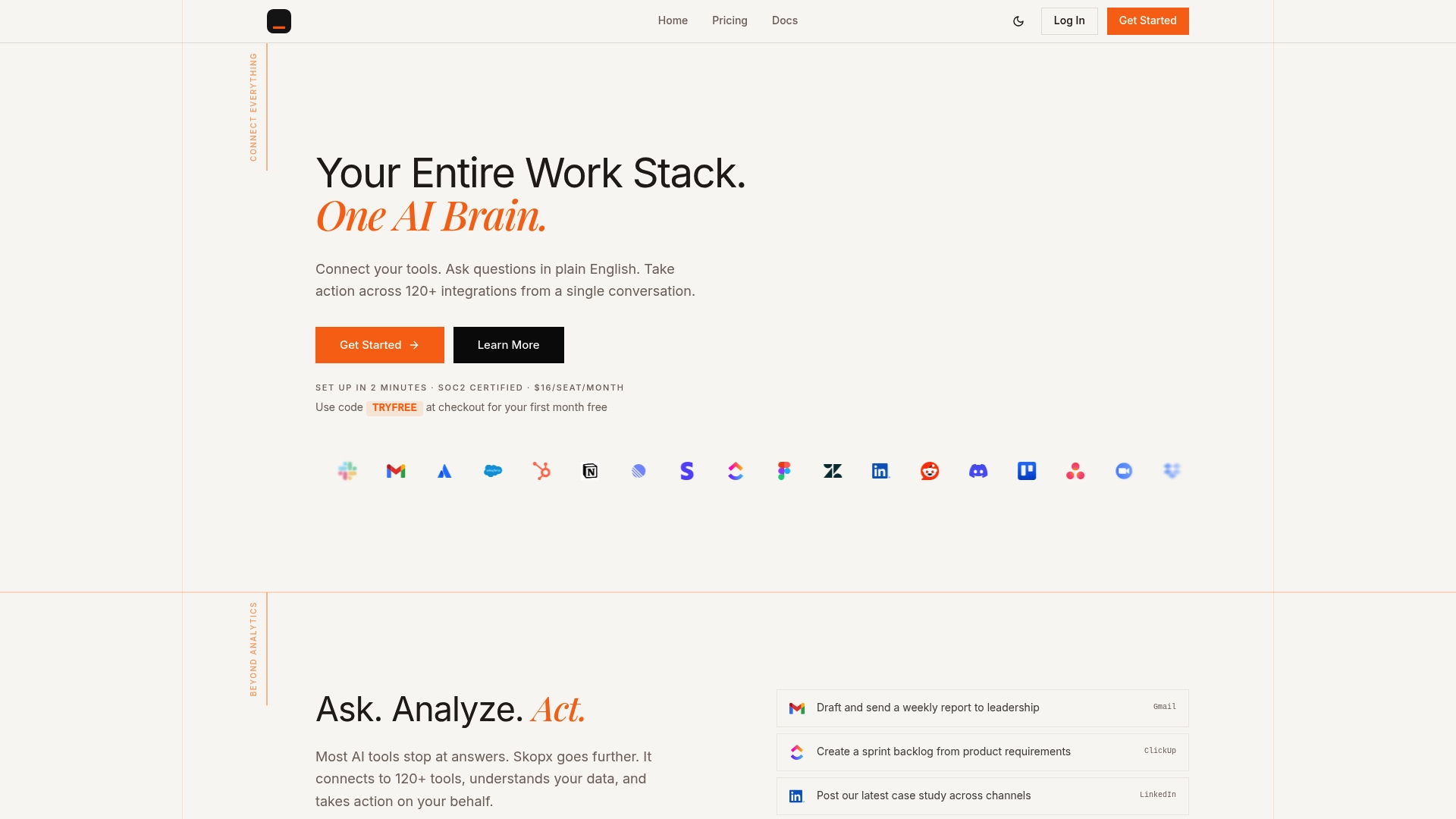
Skopx connects nearly 1,000 integrations into a single AI-driven interface, giving your team the ability to query data and execute actions in real time without switching between tools.
The Skopx AI QA Agent generates test cases, test plans, and bug reports from screenshots or requirements, turning hours of QA documentation work into minutes. The AI Research and Study Agent accelerates knowledge work by synthesizing information across sources your team already uses. Both agents produce their output for human review before anything ships, which keeps your team in control of quality and scope. Skopx is built for teams that want the operational gains of agentic AI without the governance risk of deploying it blind.
FAQ
What is the role of AI agents in business tasks?
AI agents autonomously execute multi-step workflows in business settings, handling tasks like invoice reconciliation, customer support triage, and research synthesis without requiring a human prompt for each action. Their core role is to own routine operational loops end-to-end while escalating exceptions to human workers.
How do AI agents differ from AI assistants?
AI assistants respond to a single prompt and stop; AI agents receive a goal and work through a sequence of steps autonomously until that goal is complete. That distinction makes agents suitable for ongoing workflows rather than one-off queries.
What are the biggest risks of deploying AI agents in business?
The primary risks are irreversible errors from unchecked autonomy, scope creep beyond intended boundaries, and reduced worker engagement when agents fully replace human involvement in a task. Layered guardrails and human-in-the-loop checkpoints address all three.
Which business functions benefit most from AI agents?
Finance, customer support, HR, marketing, and operations all show strong returns from agent deployment, with workflow and productivity optimization accounting for 36% of professional use cases as of june 2026.
How do AI agents affect jobs and workforce structure?
AI agents reduce entry- and mid-level roles focused on manual task execution while creating demand for workers who can supervise agents, design workflows, and validate outputs. A 15%–22% wage premium already exists for workers with AI-augmentation skills.
Share this article
Skopx Team
The Skopx engineering and product team