The Role of Automated Anomaly Detection in 2026
Automated anomaly detection is the use of AI and machine learning to identify unusual patterns in data that signal problems or opportunities before they escalate. The global market for this technology already exceeds $8 billion, reflecting how central it has become to modern operations. Finance, manufacturing, and cybersecurity all depend on it. AI-based systems in finance alone save approximately $1.5 billion annually by catching fraud that rule-based systems miss entirely. For data professionals and business leaders, understanding the role of automated anomaly detection is no longer optional. It is the foundation of proactive, data-driven operations.
What technologies power automated anomaly detection?
Automated anomaly detection runs on machine learning models that learn what "normal" looks like in your data, then flag anything that deviates from that baseline. The field has advanced sharply in 2026, with two developments standing out above all others.
The first is foundation models for time-series analysis. These models are trained on datasets with up to 100 billion time points, enabling zero-shot anomaly detection. Zero-shot means the model works on a new dataset without retraining from scratch. That eliminates weeks of deployment time and makes detection accessible across more business contexts.

The second is the speed of detection itself. Modern systems can identify deviations and trigger alerts in as little as 47 milliseconds. That speed matters because anomalies often represent less than 1% of all data traffic. Missing them, or catching them too late, is the difference between a contained incident and a costly failure.
Black-box vs. interpretable models
Choosing a model architecture is not purely a technical decision. It is a business one.
- Black-box models (deep neural networks, ensemble methods) deliver the highest accuracy in high-stakes environments like fraud detection or network intrusion. The trade-off is that analysts cannot easily explain why an alert fired.
- Interpretable models (decision trees, linear regression-based detectors) produce alerts that operations teams can audit and trust. They are preferred when regulatory compliance or human review is required.
- Dynamic thresholding adjusts alert boundaries based on seasonal patterns and recent data trends. Pairing it with static thresholds for hard ceilings creates a hybrid strategy that handles both predictable cycles and absolute limits.
The distinction between outliers and novelties also matters in practice. Outliers appear in training data and are known quantities. Novelties appear only at inference time, meaning the model encounters them for the first time during live operation. A system that cannot separate these two categories will generate false alarms at scale.
Pro Tip: Before selecting a model, map your compliance requirements first. If your team must explain every alert to a regulator or an auditor, an interpretable model is the right starting point, even if it sacrifices some accuracy.
Machine learning methods extract nonlinear features from high-dimensional data autonomously. That capability is what allows them to process multi-source data streams that traditional rule-based systems simply cannot handle at scale.
What are the key automated anomaly detection benefits for businesses?
The automated anomaly detection benefits that matter most to business leaders are not technical. They are operational and financial.
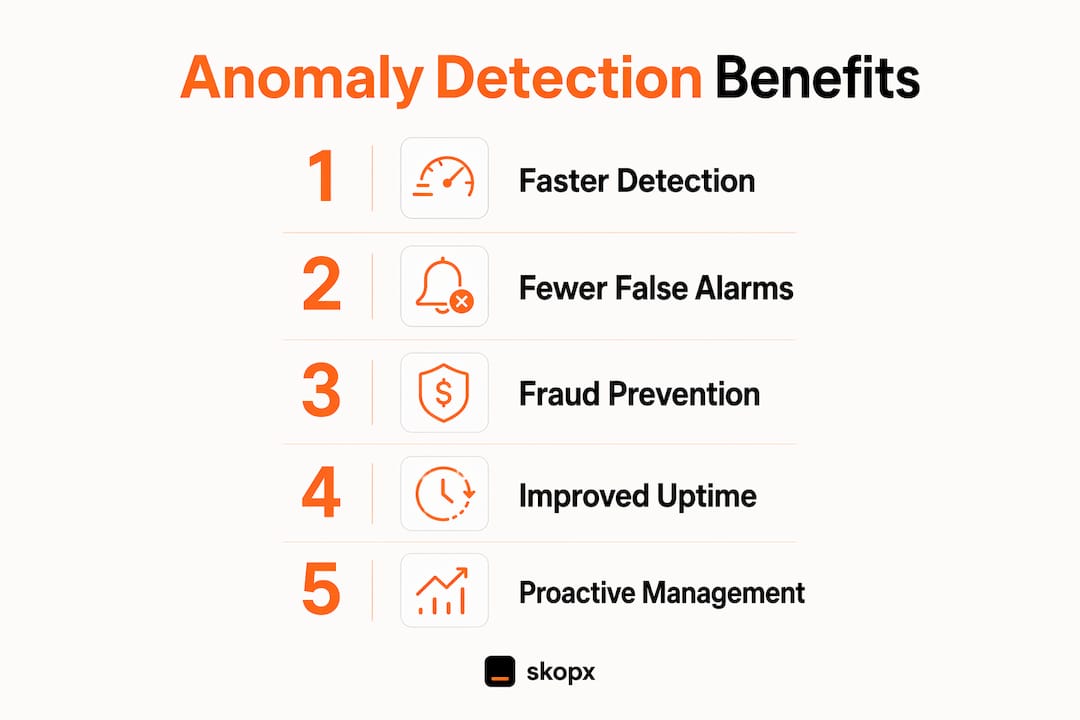
1. Faster incident detection and resolution
Speed is the primary advantage. A system that fires an alert in 47 milliseconds gives your team time to act before a problem compounds. Manual monitoring, even with skilled analysts, cannot match that response time across thousands of data streams simultaneously.
2. Reduced false positives and alert fatigue
Alert fatigue is a real operational risk. When analysts receive too many low-quality alerts, they begin ignoring them. Configuring alert ratios to target a specific number of alerts per 1,000 observations keeps detection sensitivity high while keeping analyst workload sustainable. That balance is what separates a functioning detection program from one that quietly fails.
3. Fraud prevention and financial protection
AI-based anomaly detection in finance saves approximately $1.5 billion annually by catching fraud that rule-based systems miss. Rule-based systems rely on fixed conditions. AI systems learn evolving fraud patterns and adapt. For financial services teams managing AI governance, that adaptability is a core risk control.
4. Manufacturing quality and uptime
AI-driven anomaly detection in manufacturing improves product quality, prevents equipment failures, increases uptime, and enhances worker safety through real-time monitoring. A sensor reading that drifts outside its normal range can trigger a maintenance alert before a machine fails. That is the difference between planned maintenance and unplanned downtime.
5. Proactive rather than reactive management
The transition from reactive to proactive operations is the most significant benefit that automated anomaly detection delivers. Reactive management means responding after damage occurs. Proactive management means catching the signal before the damage happens. That shift changes how teams allocate resources, prioritize incidents, and plan capacity.
The Skopx Insights Engine applies this principle directly to revenue anomaly detection, giving data teams a live view of deviations in financial performance before they affect quarterly results.
How can organizations implement automated anomaly detection effectively?
Effective implementation requires more than deploying a model. It requires aligning detection methods with specific business goals and building the operational processes that keep the system trustworthy over time.
Align detection methods with business context
Start by defining what "anomalous" means in your specific domain. A spike in web traffic is an anomaly for a security team and a success metric for a marketing team. The same data point carries different meaning depending on the business question you are asking. Defining that context upfront prevents the model from generating alerts that are technically correct but operationally useless.
Handle concept drift before it handles you
Concept drift occurs when the statistical properties of your data change over time, making the model's learned baseline obsolete. A model trained on pre-pandemic transaction data will misfire constantly when applied to current behavior. Ignoring concept drift is one of the most common deployment mistakes, and it erodes analyst trust faster than almost any other failure mode.
The practical fix is a scheduled retraining cadence combined with monitoring the model's own alert rate. If alert volume spikes without a corresponding operational incident, concept drift is the likely cause.
Pro Tip: Set up a model performance dashboard that tracks alert-to-incident ratio weekly. A rising ratio with no corresponding operational events is your earliest warning that the model needs retraining.
Build feedback loops into the workflow
| Implementation Step | Why It Matters |
|---|---|
| Define anomaly types per domain | Prevents technically correct but operationally irrelevant alerts |
| Set dynamic and static thresholds | Handles seasonal variation without losing hard safety limits |
| Schedule model retraining | Corrects for concept drift before it degrades alert quality |
| Configure alert ratios | Keeps analyst workload sustainable and prevents alert fatigue |
| Integrate with incident management | Connects detection to resolution, closing the operational loop |
Feedback loops are what separate a detection system from a detection program. When analysts mark alerts as true positives or false positives, that feedback trains the model to improve. Without it, the system stagnates. Integrating anomaly detection into your existing incident management pipeline, whether that is PagerDuty, ServiceNow, or a custom workflow, makes feedback collection automatic rather than manual.
For teams managing AI-driven cybersecurity monitoring, closing that loop between detection and response is especially critical. Threats evolve faster than any static rule set can track.
What are the common challenges in automated anomaly detection?
The challenges in automated anomaly detection are well understood. What is less understood is how to manage them without abandoning the technology's core benefits.
False positives at scale. Every detection system produces some false alarms. The problem compounds in high-cardinality environments where thousands of metrics are monitored simultaneously. A 1% false positive rate sounds manageable until you realize it generates hundreds of spurious alerts per day. Managing this requires configurable alert rates and regular threshold tuning, not just better models.
Model interpretability vs. accuracy. The most accurate models are often the hardest to explain. In regulated industries, that trade-off is not just a technical inconvenience. It is a compliance risk. Teams in financial services and healthcare need to justify every automated decision. Choosing between interpretability and performance is a critical operational balance that no single model architecture resolves perfectly.
Data quality as a hidden dependency. Anomaly detection is only as good as the data it processes. Missing values, inconsistent labeling, and schema changes all introduce noise that the model interprets as signal. Poor data quality is the most common reason detection programs underperform, and it is rarely addressed before deployment.
Emerging trends reshaping the field:
- Foundation models trained on massive time-series datasets now enable zero-shot detection across new domains without retraining.
- Real-time multi-source data fusion allows systems to correlate anomalies across network logs, financial transactions, and sensor data simultaneously.
- Autonomous remediation is moving from concept to production. Systems that detect an anomaly and automatically trigger a corrective action, without human intervention, are already operating in cloud infrastructure management.
- Explainability tooling (SHAP values, LIME, attention maps) is becoming a standard requirement rather than an optional add-on, particularly in AI governance for financial services.
The organizations that will get the most from anomaly detection in the next two years are those that treat it as an operational discipline, not a one-time deployment.
Key Takeaways
Automated anomaly detection delivers its greatest value when organizations combine fast AI-driven detection with disciplined operational processes, including threshold tuning, concept drift management, and analyst feedback loops.
| Point | Details |
|---|---|
| Speed is a core advantage | Modern systems detect deviations in as little as 47 milliseconds, enabling response before damage compounds. |
| False positives require active management | Configure alert ratios per 1,000 observations to keep analyst workload sustainable and trust intact. |
| Concept drift degrades models silently | Schedule regular retraining and monitor alert-to-incident ratios to catch drift before it erodes accuracy. |
| Industry impact is measurable | AI-based detection saves approximately $1.5 billion annually in finance and prevents unplanned downtime in manufacturing. |
| Proactive operations require feedback loops | Integrating detection into incident management pipelines closes the loop between alert and resolution. |
The shift that most teams underestimate
The teams I see struggle most with anomaly detection are not the ones with bad models. They are the ones with good models and broken processes around them. A system that fires accurate alerts into a workflow where no one has defined ownership of the response is not a detection program. It is a noise generator.
The real value of automated anomaly detection is not the alert. It is what happens after the alert. Organizations that invest in defining escalation paths, tuning thresholds based on analyst feedback, and retraining models on a schedule consistently outperform those that treat deployment as the finish line.
The other thing worth saying plainly: the shift from reactive to proactive operations does not happen automatically when you deploy a detection model. It happens when leadership commits to acting on early signals rather than waiting for confirmed failures. That is a cultural change as much as a technical one. The model gives you the signal. Your organization has to be ready to use it.
Skopx Team
What Skopx brings to anomaly detection
Skopx connects with nearly 1,000 integrations, giving data teams a single interface to query, monitor, and act on data across every system they manage. The Skopx Insights Engine runs automated data anomaly analysis across your connected tools, surfacing deviations in your morning briefing before they become incidents. From there, teams can go beyond detection through cross-tool AI chat, querying the affected system and triggering follow-up actions from the same interface, closing the gap between alert and resolution without manual handoffs.

Business leaders who want to move from reactive firefighting to proactive operations will find that Skopx's unified platform makes that transition concrete and measurable, not just theoretical.
FAQ
What is automated anomaly detection?
Automated anomaly detection is the use of AI and machine learning to identify unusual patterns or deviations in data without manual review. It operates continuously across large data volumes and triggers alerts when behavior falls outside learned or defined norms.
How does anomaly detection work in practice?
A model learns the statistical baseline of normal behavior from historical data, then compares incoming data against that baseline in real time. When a data point deviates beyond a configured threshold, the system fires an alert and, in advanced setups, triggers an automated response.
What is the role of AI in anomaly detection?
AI enables anomaly detection to scale beyond what rule-based systems can handle. Machine learning models extract nonlinear patterns from high-dimensional, multi-source data autonomously, adapting to new behavior over time rather than relying on fixed conditions.
What are the biggest challenges in automated anomaly detection?
False positives, concept drift, and model interpretability are the three most common challenges. Managing them requires configurable alert thresholds, scheduled model retraining, and clear escalation processes built into operational workflows.
How do foundation models change anomaly detection?
Foundation models trained on up to 100 billion time-series data points enable zero-shot detection, meaning they work on new datasets without per-dataset training. That reduces deployment time significantly and makes detection accessible across more business domains.
Recommended
Share this article
Skopx Team
The Skopx engineering and product team