The Role of Data Connectors in Analysis: A Pro Guide
Data connectors are defined as software components that extract, transfer, and load data from source systems into analytics environments automatically. The role of data connectors in analysis is to eliminate manual data gathering and give analysts a single, consistent view of information across every business system. Without them, data stays locked in separate tools, and unified reporting becomes nearly impossible. Modern connectors reach across APIs, databases, cloud platforms, and file systems to feed data warehouses, BI tools, and data lakes with current, reliable data. The result is faster decisions, fewer errors, and analysis that actually reflects reality.
How data connectors work in analysis pipelines
Data connectors operate through three core functions: extraction, transformation, and loading, collectively known as ETL. In an ELT model, the transformation happens after loading, which suits cloud warehouses that handle compute at scale. Either way, the connector handles the hard part: authenticating with the source system, managing pagination, and pulling records without duplicating or missing rows.

The technical mechanics matter more than most analysts realize. API-based connectors use REST or GraphQL endpoints to extract data, abstracting authentication, pagination, and rate limiting from the analyst entirely. That abstraction is why API connectors dominate modern data stacks: cloud SaaS tools expose APIs by default, and connectors speak that language natively.
Schema drift is one of the most underestimated problems in data pipelines. When a source system adds, renames, or removes a field, a brittle custom script breaks silently. Managed connectors detect schema changes and adapt automatically, keeping downstream reports intact. Data connectors reconcile differing data formats and incompatible schemas between source systems and data warehouses, acting as translators that enforce consistency before data ever reaches an analyst.
- Authentication and connection: The connector establishes a secure link using OAuth, API keys, or database credentials.
- Incremental extraction: Only new or changed records are pulled on each run, reducing load on source systems.
- Transformation and normalization: Field names, data types, and date formats are standardized to match the destination schema.
- Error handling and logging: Failed syncs trigger alerts rather than silently corrupting downstream tables.
Pro Tip: Set up schema change alerts in your connector configuration from day one. Catching a renamed field immediately costs minutes to fix. Catching it three weeks later, after reports have been wrong, costs days.
What types of data connectors exist for analysis?
Connectors fall into four main categories, each suited to different data sources and analytical needs.
- API-based connectors pull from cloud SaaS platforms like CRMs, marketing tools, and ad networks using REST or GraphQL. They handle rate limits and token refresh automatically.
- Database connectors connect directly to relational systems like PostgreSQL, MySQL, and SQL Server using JDBC or ODBC protocols. They are the standard choice for transactional data and ERP systems.
- Cloud storage connectors read files from Amazon S3, Google Cloud Storage, or Azure Blob Storage. They work well for batch exports, data lake ingestion, and archival analytics.
- File-based connectors process CSV, JSON, XML, and Excel files from FTP servers or local directories. They remain common in finance and supply chain workflows where legacy systems export flat files.
| Connector type | Typical data sources | Primary analytical application |
|---|---|---|
| API-based | CRM, ad platforms, marketing tools | Campaign attribution, customer analytics |
| Database | ERP, POS, transactional systems | Financial consolidation, operations reporting |
| Cloud storage | Data lakes, batch exports | Historical analysis, ML training datasets |
| File-based | Legacy systems, partner feeds | Supply chain, finance reconciliation |
Modern data connectors provide access to over 325 business sources spanning marketing, CRM, finance, and ecommerce. That breadth means analysts can build multi-source reports without writing a single line of extraction code.
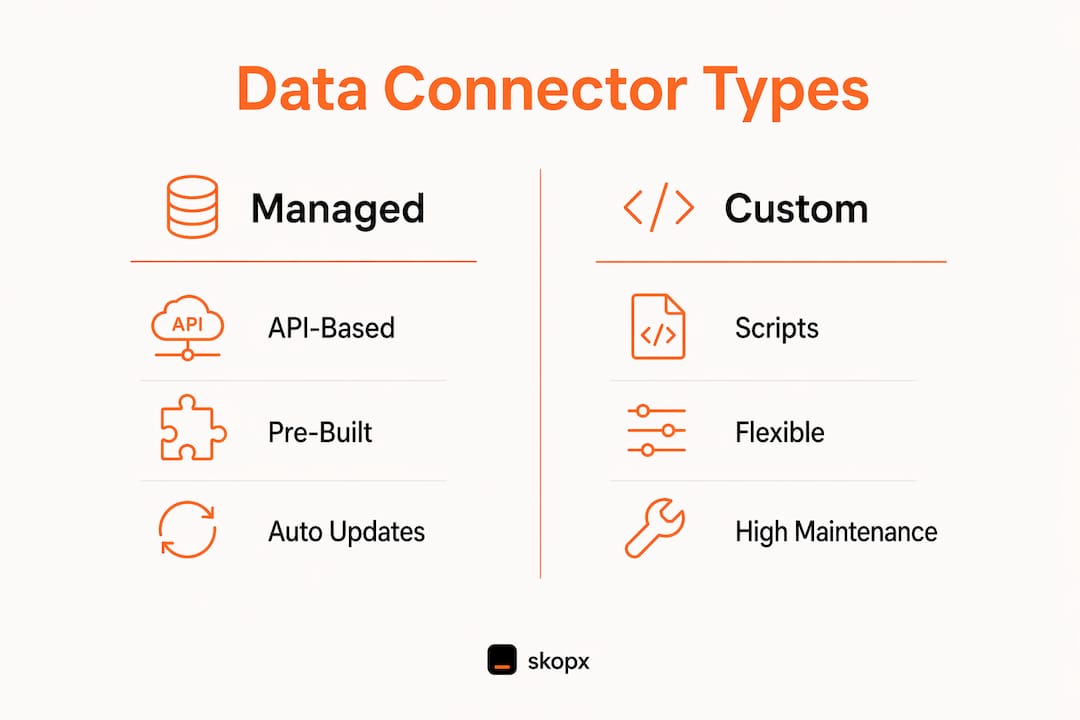
The choice between managed connectors and custom scripts comes down to maintenance cost. Custom scripts give maximum flexibility but break when source APIs change. Managed connectors handle those changes automatically, which is why teams with limited engineering capacity consistently favor them for production pipelines.
Why data connectors are essential for better analysis outcomes
The strategic importance of data connectors goes beyond technical convenience. Without connectors, data remains siloed, limiting comprehensive analysis and unified reporting capabilities. Silos are not just an inconvenience. They cause different departments to work from different versions of the same metric, which produces conflicting reports and erodes trust in data.
Connectors solve this by creating a single source of truth. When marketing, finance, and operations all pull from the same connected warehouse, they share consistent, up-to-date information. Unified data breaks down silos and enables departments to collaborate on decisions using the same facts.
The operational benefits are equally significant:
- Reduced engineering overhead: Managed connectors save a substantial share of the engineering time otherwise spent on pipeline maintenance by handling schema changes automatically. That time goes back to building analytical models instead of fixing broken pipelines.
- Improved data quality: Automated normalization catches type mismatches and null values before they reach dashboards.
- Faster time to insight: Pre-built connectors and APIs dramatically simplify integration complexity across legacy and modern systems, reducing delays linked to custom setups.
- Advanced analytics readiness: Consistent, clean pipelines are a prerequisite for machine learning. Models trained on fragmented data produce unreliable predictions.
The real value of data connectors lies not just in movement of data, but in harmonizing differing data models and ensuring interoperability across systems. A connector that moves data without normalizing it only moves the problem downstream.
Pro Tip: Audit your connector coverage quarterly. Map every data source your analysts actually use against what is connected. Gaps in coverage are usually the root cause of one-off data requests that consume engineering time.
How data connectors improve analyst workflows
Data connectors change the daily reality of analytical work in concrete ways. The most immediate impact is time. Analysts who previously spent hours pulling exports from five different tools and joining them in spreadsheets can instead query a single warehouse where all that data already lives, refreshed automatically.
Near real-time synchronization through automated scheduled updates improves decision speed across marketing, operations, and finance. That matters most in fast-moving contexts: a marketing team that sees yesterday's campaign performance can adjust spend today rather than next week.
Self-service analytics becomes genuinely possible when connectors are in place. Without connected data, self-service tools produce incomplete answers because analysts cannot access all relevant sources. With connectors feeding a central warehouse, non-technical users can build their own reports without waiting for engineering support. Platforms built for AI-powered data analytics take this further by letting analysts ask questions in plain language and get answers drawn from all connected sources simultaneously.
The collaboration benefits compound over time. When every team works from the same connected data, cross-functional analysis becomes straightforward. A revenue analysis that combines CRM data, ad spend, and financial results no longer requires three separate data pulls and a manual join. It runs as a single query against a unified dataset. AI-driven solutions like those offered through data analytics consulting can further extend these gains by automating recurring analytical tasks and surfacing anomalies before they become problems.
For teams exploring AI-powered business solutions, the combination of well-structured connectors and intelligent automation creates a foundation where analysis happens continuously rather than on request.
My take on data connectors after years of working with them
The conversation around data connectors tends to focus on the technical setup. That is the wrong place to spend most of your attention.
The harder problem is governance. I have seen teams with excellent connectors produce terrible analysis because no one owned the definitions. Two connectors pulling "revenue" from different systems, each using a slightly different calculation, will generate reports that contradict each other. The connector did its job. The governance did not.
The second thing I would push back on is the instinct to build custom connectors for every edge case. Custom scripts feel like control. In practice, they become technical debt that only one person understands. Managed connectors with good monitoring give you more reliability and less maintenance, even when they do not cover every field you want.
The third observation is about timing. Teams that invest in connector infrastructure before they need it move faster when analytical demands spike. Teams that wait until a specific report is blocked spend weeks on plumbing instead of analysis. The self-service analytics model only works when the data foundation is already solid.
Data connectors are infrastructure. Treat them like infrastructure: plan them deliberately, monitor them consistently, and document them so the next analyst on your team does not have to reverse-engineer what you built.
Skopx Team
What Skopx brings to data connectivity and analysis
Skopx connects with nearly 1,000 integrations and gives analysts a unified AI-driven interface to query all of them at once. The AI Data Agent handles data extraction and real-time analysis without requiring SQL or custom pipeline code, making it practical for both technical and non-technical teams.

The Skopx self-service analytics platform goes beyond standard BI by letting teams ask questions and automate responses across all connected sources. Analysts get answers drawn from live, connected data rather than stale exports. For teams that want to reduce operational overhead and get more from their existing data sources, Skopx provides a direct path from connected data to decisions.
Key Takeaways
Data connectors are the foundation of reliable analysis: without automated integration across sources, unified reporting and accurate forecasting are not achievable at scale.
| Point | Details |
|---|---|
| Connectors eliminate silos | Automated integration gives every department access to the same consistent, current data. |
| Managed connectors save time | Handling schema changes automatically recovers engineering time for higher-value analytical work. |
| Connector type determines use case | API, database, cloud, and file-based connectors each suit different source systems and analytical goals. |
| Real-time sync accelerates decisions | Automated updates mean analysts work with current data, not yesterday's exports. |
| Governance determines connector value | Clean pipelines only produce reliable analysis when metric definitions are consistent across sources. |
Perspective: what most teams get wrong about data connectors
The common assumption is that connecting data is a one-time setup task. It is not. Source systems change, APIs update, and business requirements shift. Connectors need ongoing monitoring, schema management, and periodic audits to stay reliable. Teams that treat connector setup as "done" eventually discover silent failures that have corrupted weeks of reporting.
Selecting connectors with built-in observability, meaning automatic alerts for sync failures, schema drift, and data volume anomalies, is not optional for production analytics. It is the difference between a pipeline you trust and one you are always second-guessing.
Skopx Team
FAQ
What is the role of data connectors in analysis?
Data connectors automate the extraction and integration of data from multiple sources into a central repository, giving analysts a unified, current dataset for reporting and modeling. They eliminate manual data gathering and reduce the errors that come with it.
How do data connectors improve data quality?
Connectors normalize field names, data types, and formats during transfer, catching inconsistencies before they reach dashboards. Managed connectors also handle schema changes automatically, preventing silent data corruption.
What is the difference between ETL and ELT connectors?
ETL connectors transform data before loading it into the destination, while ELT connectors load raw data first and transform it inside the warehouse. ELT is more common in cloud-native stacks because modern warehouses handle transformation compute efficiently.
Why are managed connectors better than custom scripts for analysis?
Managed connectors handle API changes, authentication updates, and schema drift automatically. Custom scripts require manual fixes when source systems change, and those fixes often happen after reports have already broken.
How do data connectors support self-service analytics?
Connectors feed a central warehouse with data from all business sources, so non-technical analysts can build reports without waiting for engineering to pull exports. Self-service tools only work reliably when the underlying data is already connected and current.
Recommended
Share this article
Skopx Team
The Skopx engineering and product team