Why Business Owners Adopt AI Platforms in 2026
AI adoption in business is defined as the deliberate integration of artificial intelligence platforms to automate workflows, analyze data, and improve operational decisions. The reasons why business owners adopt AI platforms have shifted from curiosity to operational necessity. More than 75% of small businesses now use AI regularly, up from less than 50% in 2024. That jump reflects a fundamental change in how owners view the technology. AI platforms are no longer a luxury for large enterprises. They are the primary tool business owners use to compete, cut costs, and make faster decisions.
Why business owners adopt AI platforms for efficiency
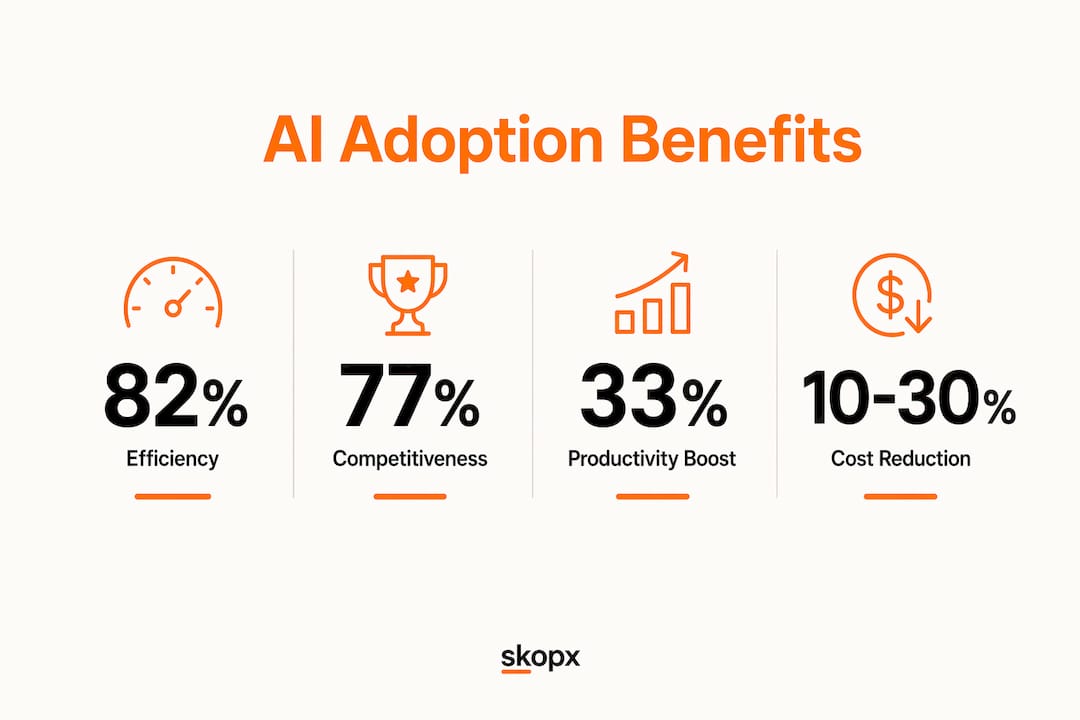
Operational efficiency is the single most cited reason business owners turn to AI platforms. 82% of small businesses report measurable efficiency improvements after AI integration. That figure is not a projection. It reflects real changes in how work gets done across marketing, administration, and customer service.
AI platforms reduce the time spent on repetitive tasks by handling them automatically. Scheduling, invoice processing, email sorting, and customer follow-ups are all tasks that AI handles without human input. The result is that your team spends less time on low-value work and more time on decisions that require judgment.

AI-driven process optimization reduces IT and software costs by 10%–30% and accelerates software development cycles by 20%–30%. Those are not marginal gains. For a small business operating on tight margins, a 10% reduction in software costs can fund a new hire or a marketing push.
Speed is the most measurable AI benefit, according to finance leaders who rank cycle-time reduction as their top AI win. Faster cycles mean faster revenue. A sales proposal that used to take three hours now takes 20 minutes. A customer complaint that required two days of back-and-forth now resolves in hours.
Pro Tip: Before automating any workflow, map it end to end. If the process is broken, automating it only makes the problem faster. Fix the workflow first, then apply AI.
The efficiency gains from AI adoption in small businesses concentrate in three areas:
- Marketing automation: AI generates content drafts, schedules posts, and analyzes campaign performance without manual input.
- Administrative tasks: AI handles data entry, appointment scheduling, and document processing at scale.
- Customer service: AI responds to common queries instantly, reducing wait times and support costs.
How AI drives competitive advantage and better decisions
AI adoption gives business owners a real edge against larger competitors. 77% of small businesses report enhanced competitiveness against larger firms through AI. That statistic matters because it overturns the assumption that AI benefits only scale with company size.
The competitive advantage comes from speed of insight. AI platforms analyze customer behavior, sales trends, and market signals in real time. A business owner using an AI analytics platform can spot a demand shift on a Monday morning and adjust pricing or inventory before noon. Without AI, that same insight might take a week of manual reporting.
Employee productivity increases by 33% with AI integration. That is not about replacing people. AI functions as a productivity multiplier, enhancing team capacity rather than shrinking headcount. Your existing team produces more output with the same hours.
69% of businesses maintain progress despite market volatility when they use AI. That resilience comes from AI's ability to model scenarios and flag risks before they become crises. Business owners who use AI for decision support are less reactive and more prepared.
The strategic benefits of AI adoption extend well beyond cost savings:
- Real-time data analysis replaces weekly reports with live dashboards that update as transactions happen.
- Customer insight generation identifies buying patterns and churn risks before they affect revenue.
- Agile market response lets owners adjust offers, pricing, and messaging within hours of a market shift.
- Scenario modeling tests business decisions against historical data before committing resources.
- Workforce amplification gives each team member access to AI-generated research, drafts, and analysis.
For a practical overview of how AI fits into broader business change, this 2026 guide from The AI Orchestrators covers the operational and strategic dimensions in detail.
Why workflow redesign matters more than the AI tool itself
Most business owners make the same mistake when they adopt AI. They automate what they already do instead of rethinking how work should flow. Automating broken processes causes lost value and limited ROI. The tool is not the problem. The process is.
Bain & Company describes this as "workflow debt." Every outdated approval chain, redundant data entry step, and manual handoff you carry into an AI deployment limits what the platform can deliver. The businesses that get the most from AI ask a different question. Instead of "How do we automate this?" they ask, "What would this process look like if we designed it from scratch today?"
Workforce modernization must happen at the same time as workflow redesign. A lag between the two creates value leakage. Your team needs to know how to work with AI outputs, not just receive them. That means training, role redefinition, and clear accountability from leadership.
Pro Tip: Assign one person in each department to own the AI integration for that team's workflows. Distributed ownership prevents AI tools from sitting unused after the initial rollout.
A practical redesign process follows four steps:
- Audit current workflows to identify steps that are manual, repetitive, or dependent on a single person.
- Redesign the process around AI capabilities, not around the existing org chart.
- Reskill the team with hands-on training on the specific AI tools being deployed.
- Measure and adjust using cycle time, error rate, and output volume as your baseline metrics.
Skopx supports this redesign process by connecting nearly 1,000 integrations into a single interface. Business owners can query data and trigger actions across all their tools without switching platforms. That kind of unified access makes workflow redesign practical rather than theoretical. For teams ready to move from planning to execution, Skopx's AI transformation approach provides a structured path.
How external knowledge accelerates AI adoption for small businesses
Small and medium businesses that tap external knowledge sources adopt AI faster and more successfully than those that rely only on internal resources. External collaboration increases the likelihood of successful AI adoption by 12%. That gap is significant for businesses with limited internal R&D capacity.
External knowledge takes several forms. Peer networks, industry associations, supplier partnerships, and AI consulting firms all provide access to proven methods and tested tools. A business owner who connects with peers in the same industry learns which platforms work, which fail, and what implementation mistakes to avoid.
Internal knowledge still matters. Building internal organizational and technological knowledge creates absorptive capacity, which is the ability to recognize, assimilate, and apply external AI knowledge effectively. Businesses that invest in both internal training and external partnerships adopt AI faster than those that choose one over the other.
The most effective external knowledge strategies for small businesses include:
- Industry peer groups that share implementation experiences and vendor evaluations.
- AI consulting partnerships that provide structured implementation support and accountability.
- Supplier and platform ecosystems that offer training, integration support, and use-case libraries.
- Open-source communities that publish tested AI workflows and model configurations.
For founders who want a structured approach to implementation, this practical guide from The AI Orchestrators covers the steps from pilot to full deployment with measurable outcomes.
Key Takeaways
Business owners who treat AI adoption as a workflow redesign project, not a technology purchase, capture the most measurable gains in productivity, cost, and competitive position.
| Point | Details |
|---|---|
| Adoption is now mainstream | Over 75% of small businesses use AI regularly, making non-adoption a competitive risk. |
| Efficiency gains are measurable | AI reduces IT costs by 10%–30% and boosts employee productivity by 33% on average. |
| Redesign before you automate | Automating broken workflows limits ROI; map and fix processes before deploying AI. |
| External knowledge accelerates success | Collaboration with peers and partners increases AI adoption success rates by 12%. |
| Workforce modernization is non-negotiable | Reskilling must happen alongside workflow changes to prevent value leakage. |
What I've learned about AI adoption that most guides won't tell you
The conversation around AI adoption focuses almost entirely on tools. Which platform, which features, which price tier. That framing misses the real challenge entirely.
The business owners I see getting the most from AI are not the ones with the most sophisticated platforms. They are the ones who changed how their teams work before they changed the technology. They treated AI adoption as an organizational project with a technology component, not the other way around.
The hardest part is not the software. It is convincing a team that their daily routines need to change. People protect familiar processes. A workflow that feels inefficient to an outsider feels safe to the person who built it. Leadership has to own that transition directly. Delegating change management to an IT vendor or a junior hire is how AI investments stall at the pilot stage.
8 in 10 businesses that paid for AI tools in 2024 were still paying in 2025. That sustained commitment signals something important. Business owners are not abandoning AI after the trial period. They are finding enough value to keep investing. The ones who drop off are almost always the ones who deployed tools without redesigning the work around them.
My honest advice: start with one workflow, redesign it completely with AI at the center, measure the result, and then scale. Iterative adoption beats a full-company rollout every time. The technology is ready. The question is whether your processes and your people are.
Skopx Team
Skopx gives business owners one place to run it all
Running multiple AI tools across separate platforms creates its own inefficiency. Skopx solves that by connecting nearly 1,000 integrations into a single conversational interface, so your team queries data and executes actions without switching tabs or waiting on reports.
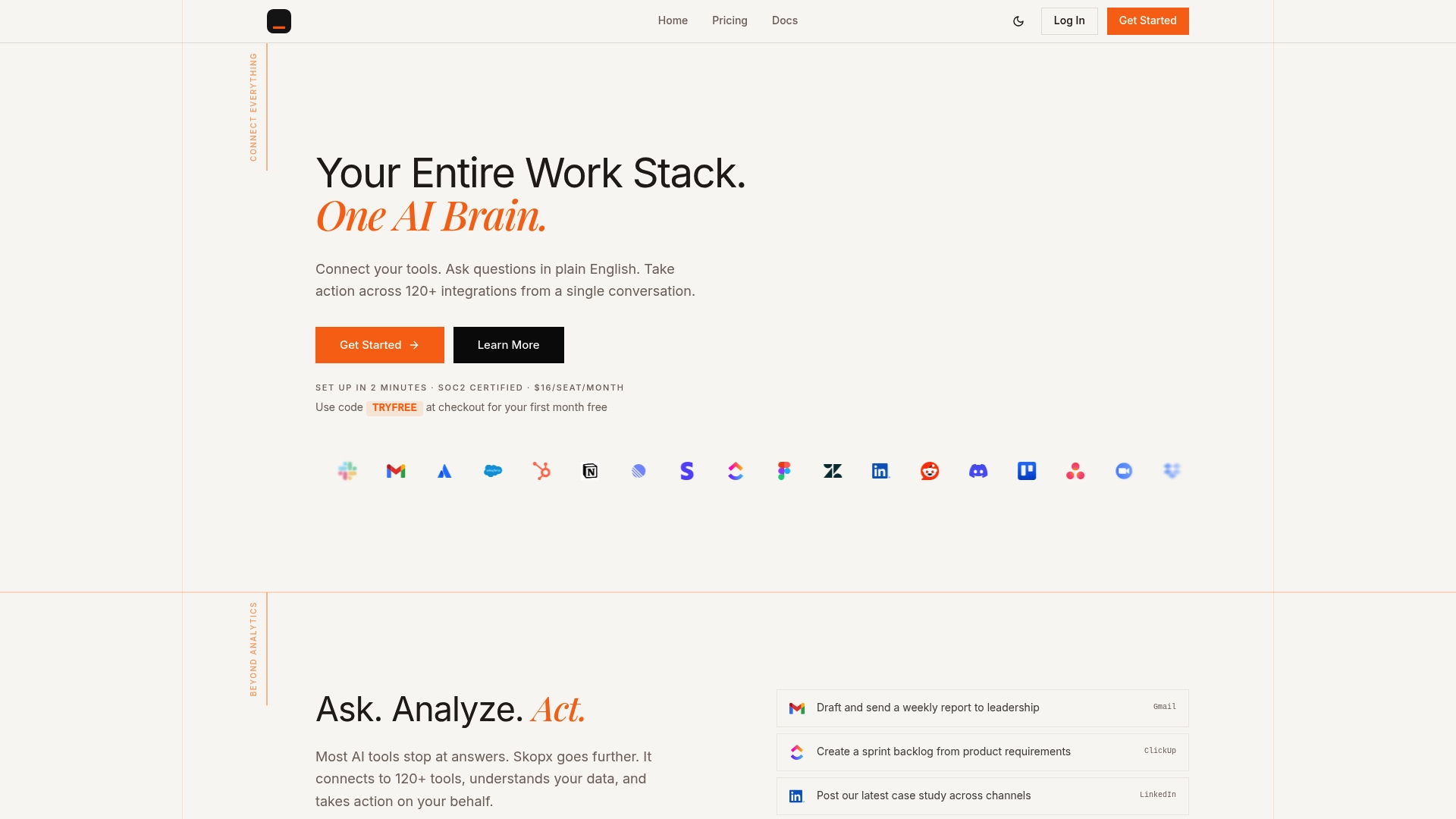
Business owners use Skopx to automate workflows, analyze performance data, and act on insights in real time. The platform is autonomous where it is safe to be: continuous monitoring, anomaly alerts, the morning briefing, and Social Autopilot's scheduled publishing run on their own, while actions across marketing, operations, and customer service tools run on your instruction in chat. For teams that need structured data analysis, the AI data agent synthesizes information from across your business and surfaces the answers you need fast. Skopx is built for business owners who want AI to work across their entire operation, not just one corner of it.
FAQ
What is the main reason business owners adopt AI platforms?
Business owners adopt AI platforms primarily to automate repetitive tasks and improve operational efficiency. 78% of US businesses report improved productivity after AI adoption.
Does AI adoption help small businesses compete with larger companies?
Yes. 77% of small businesses report enhanced competitiveness against larger firms after integrating AI into their operations.
What is the biggest mistake business owners make with AI?
The most common mistake is automating existing broken workflows instead of redesigning them. Bain & Company identifies this as the primary reason businesses fail to capture full AI value.
How long does it take to see results from AI adoption?
Results vary by workflow and implementation quality, but businesses that redesign processes alongside AI deployment report measurable cycle-time reductions within the first quarter of use.
Does AI adoption lead to workforce reduction?
No. AI functions as a productivity multiplier, increasing team output rather than reducing headcount. Businesses using AI report faster workdays and increased hiring, not layoffs.
Share this article
Skopx Team
The Skopx engineering and product team